
Vatican experts uncovering gilded glory of Hercules statue struck by lightning
Advertisement
Read this article for free:
or
Already have an account? Log in here »
We need your support!
Local journalism needs your support!
As we navigate through unprecedented times, our journalists are working harder than ever to bring you the latest local updates to keep you safe and informed.
Now, more than ever, we need your support.
Starting at $15.99 plus taxes every four weeks you can access your Brandon Sun online and full access to all content as it appears on our website.
Subscribe Nowor call circulation directly at (204) 727-0527.
Your pledge helps to ensure we provide the news that matters most to your community!
To continue reading, please subscribe:
Add Brandon Sun access to your Free Press subscription for only an additional
$1 for the first 4 weeks*
- Enjoy unlimited reading on brandonsun.com
- Read the Brandon Sun E-Edition, our digital replica newspaper
*Your next Free Press subscription payment will increase by $1.00 and you will be charged $20.95 plus GST for four weeks. After four weeks, your payment will increase to $24.95 plus GST every four weeks.
Read unlimited articles for free today:
or
Already have an account? Log in here »
Hey there, time traveller!
This article was published 13/05/2023 (1093 days ago), so information in it may no longer be current.
VATICAN CITY (AP) — Scaffolding in a niche of the Vatican Museums’ Round Hall conceal from view the work of restorers who are removing centuries of grime from the largest known bronze statue of the ancient world: the gilded Hercules Mastai Righetti.
For more than 150 years, the four-meter-tall (13-foot-tall) figure of the half-human Roman god of strength has stood in that niche, barely garnering notice among other antiquities because of the dark coating it had acquired.
But it was only after removing a layer of wax and other material from a 19th-century restoration that Vatican experts understood the statue’s true splendor as one of the most significant gilded statues of its time. Museum-goers will be able to see its grandeur for themselves once the restoration is finished, which is expected in December.
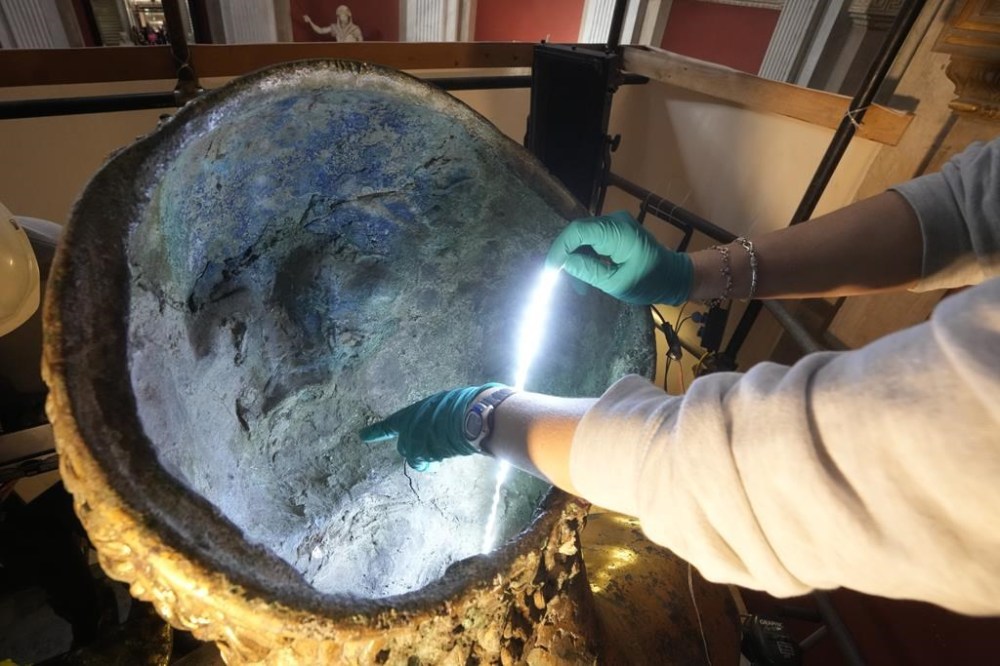
“The original gilding is exceptionally well-preserved, especially for the consistency and homogeneity,” Vatican Museum restorer Alice Baltera said.
The discovery of the colossal bronze statue in 1864 during work on a banker’s villa near Rome’s Campo dei Fiori square made global headlines.
Visitors drawn to the ancient wonder at the time included Pope Pius IX, who later added the work to the papal collection. The statue depicting Hercules after he finished his labors had the last names of the pope — Mastai — and of the banker, Pietro Righetti, added to its title.
The statue has been variously dated from the end of the first to the beginning of the third centuries. Even in its day, the towering Hercules was treated with reverence.
The inscription FCS accompanying the statue on a slab of travertine marble indicates it was struck by lightning, according to Claudia Valeri, curator of the Vatican Museums department of Greek and Roman antiquities. As a result, it was buried in a marble shrine according to Roman rites that saw lightning as an expression of divine forces.
FCS stands for “fulgur conditum summanium, a Latin phrase meaning “Here is buried a Summanian thunderbolt.” Summanus was the ancient Roman god of nocturnal thunder. The ancient Romans believed that not only was any object stricken imbued with divinity, but also the spot where it was hit and buried.
“It is said that sometimes being struck by lightning generates love but also eternity,’’ Vatican Museums archaeologist Giandomenico Spinola said. The Hercules Mastai Righetti “got his eternity … because having been struck by lightning, it was considered a sacred object, which preserved it until about 150 years ago.”
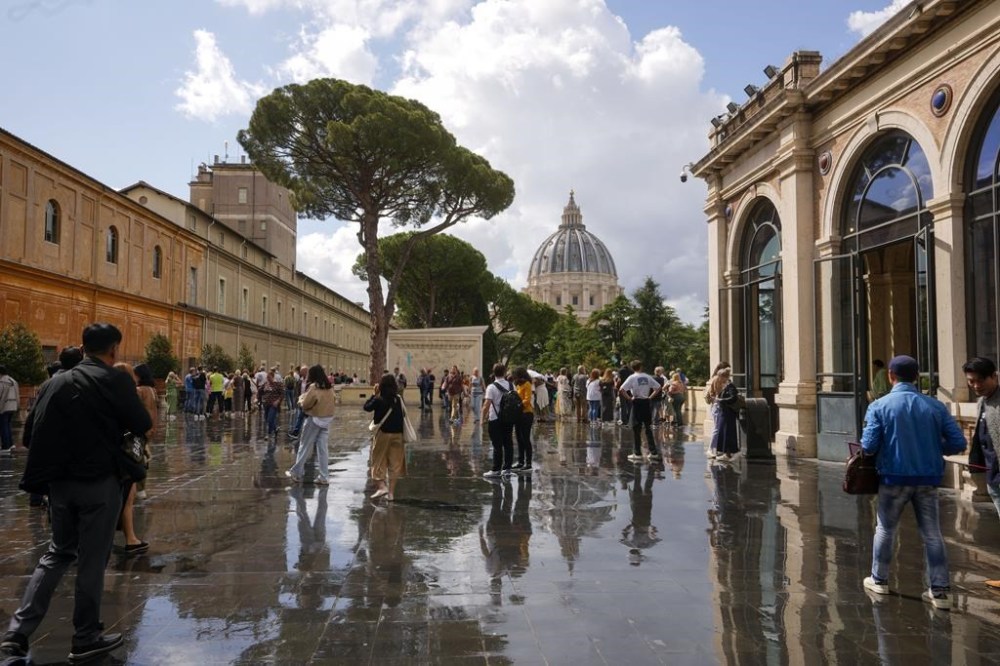
The burial protected the gilding, but also caused dirt to build up on the statue, which Baltera said is very delicate and painstaking to remove. “The only way is to work precisely with special magnifying glasses, removing all the small encrustations one by one,” she said.
The work to remove the wax and other materials that were applied during the 19th-century restoration is complete. Going forward, restorers plan to make fresh casts out of resin to replace the plaster patches that covered missing pieces, including on part of the nape of the neck and the pubis.
The most astonishing finding to emerge during the preliminary phase of the restoration was the skill with which the smelters fused mercury to gold, making the gilded surface more enduring.
“The history of this work is told by its gilding. … It is one of the most compact and solid gildings found to date,’’ said Ulderico Santamaria, a University of Tuscia professor who is head of the Vatican Museums’ scientific research laboratory.