
Jonathan Glazer rocks Cannes with a chilling Holocaust drama from a different perspective
Advertisement
Read this article for free:
or
Already have an account? Log in here »
We need your support!
Local journalism needs your support!
As we navigate through unprecedented times, our journalists are working harder than ever to bring you the latest local updates to keep you safe and informed.
Now, more than ever, we need your support.
Starting at $15.99 plus taxes every four weeks you can access your Brandon Sun online and full access to all content as it appears on our website.
Subscribe Nowor call circulation directly at (204) 727-0527.
Your pledge helps to ensure we provide the news that matters most to your community!
To continue reading, please subscribe:
Add Brandon Sun access to your Free Press subscription for only an additional
$1 for the first 4 weeks*
- Enjoy unlimited reading on brandonsun.com
- Read the Brandon Sun E-Edition, our digital replica newspaper
*Your next Free Press subscription payment will increase by $1.00 and you will be charged $20.95 plus GST for four weeks. After four weeks, your payment will increase to $24.95 plus GST every four weeks.
Read unlimited articles for free today:
or
Already have an account? Log in here »
Hey there, time traveller!
This article was published 20/05/2023 (1269 days ago), so information in it may no longer be current.
CANNES, France (AP) — Jonathan Glazer’s “The Zone of Interest,” a chilling Auschwitz-set drama shot through “a 21st century lens,” has delivered the Cannes Film Festival’s first critical sensation by approaching the Holocaust from an unlikely perspective.
“The Zone of Interest,” which premiered to rave reviews Friday night, dramatizes the life of a fictional German family whose handsome home and tasteful gardens abut the outer wall of Auschwitz. There, they live a mostly peaceful, mundane life, while incinerators rumble in the background, smoke rises from the gas chambers, and muffled screams can be heard.
The father is Rudolf Höss (Christian Friedel), a Nazi commandant who designed Auschwitz, who lives with his wife, Hedwig (Sandra Hüller) and children. “The Zone of Interest,” loosely based on a Martin Amis novel, rigorously follows the family’s daily lives while atrocity thrums next door.
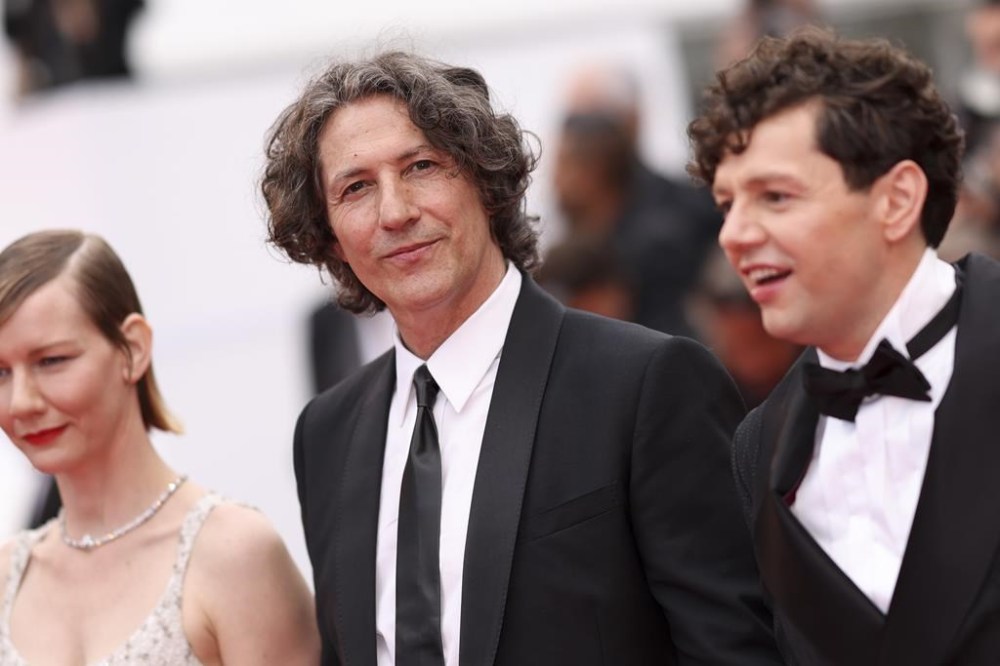
“What it’s trying to do is talk to the capacity within each of us for violence, wherever you’re from, and to try to show these people as people and not as monsters was a very important thing to do,” Glazer told reporters Tuesday. “The great crime and tragedy is that human beings did this to other human beings.”
“It’s very convenient to distance ourselves from them as much as we can because we think we don’t behave that way,” added Glazer. “But we should be less certain than that.”
Following its premiere, “The Zone of Interest” quickly rose to the top of forecasts for the Palme d’Or, the festival’s top prize to be handed out May 27. Critics lauded the film’s formal rigor in capturing the capacity of people to compartmentalize horror.
“The Zone of Interest,” Glazer’s first film since 2013’s grimly elegant science fiction “Under the Skin,” proceeds largely without story in almost documentary fashion. It’s set almost entirely in the orderly hallways and flower beds of the Höss home. Glazer said he and his filmmaking team, using up to 10 cameras at once, tried “to make ourselves as absent as possible, almost as authorless as possible.”
“It had so little to do with acting what we were doing,” said Hüller. The process, she said, was more about being present.
Glazer sought to avoid movie tropes to bring viewers into a life they might recognize as their own, composed mostly of chores, work and child-rearing. For Glazer, it was about creating something “in present tense, not as a museum piece or something in aspic.”
“It needed to be presented with a degree of urgency and alarm,” said the 58-year-old British filmmaker.
Höss is based on Karl Bischoff, the concentration camp’s builder. A trip to Auschwitz, in which Glazer visited Bischoff’s home, inspired him to make “The Zone of Interest,” which A24 will release in theaters at a not-yet-announced date. He returned to shoot it at the camp in Poland.
“It was never an option for it to be shot anywhere else,” he said. “We tried to look for a place to shoot in other parts of Poland, but I kept gravitating back to Auschwitz.”

As in “Under the Skin,” Glazer uses a wide spectrum of techniques to create a densely layered visual and auditory experience. The score is by Mica Levi. Key in the process, Glazer said, was to avoid all the usual trapping of period films. Props were authentic but new. Glazer wanted a “present day” precision to make “The Zone of Interest” cut through history to reach today.
Glazer isn’t the only British filmmaker in Cannes with a formally daring film that seeks to bridge Holocaust past with the present. Steve McQueen debuted his lengthy documentary “Occupied City,” which combines narrated accounts of Nazi atrocities in Amsterdam with present-day footage from those locations.
To Glazer, finding new ways to make the Holocaust real and immediate drove him to make “The Zone of Interest.”
“It’s important to try to find a new paradigm for it so that a new generation can understand it,” Glazer said.
___
Follow AP Film Writer Jake Coyle on Twitter at: http://twitter.com/jakecoyleAP