
Canadian writers picket in support of U.S. counterparts, say there’s uncertainty here
Advertisement
Read this article for free:
or
Already have an account? Log in here »
We need your support!
Local journalism needs your support!
As we navigate through unprecedented times, our journalists are working harder than ever to bring you the latest local updates to keep you safe and informed.
Now, more than ever, we need your support.
Starting at $15.99 plus taxes every four weeks you can access your Brandon Sun online and full access to all content as it appears on our website.
Subscribe Nowor call circulation directly at (204) 727-0527.
Your pledge helps to ensure we provide the news that matters most to your community!
To continue reading, please subscribe:
Add Brandon Sun access to your Free Press subscription for only an additional
$1 for the first 4 weeks*
*Your next subscription payment will increase by $1.00 and you will be charged $20.00 plus GST for four weeks. After four weeks, your payment will increase to $24.00 plus GST every four weeks.
Read unlimited articles for free today:
or
Already have an account? Log in here »
Hey there, time traveller!
This article was published 14/06/2023 (1025 days ago), so information in it may no longer be current.
TORONTO – More than one hundred Canadian film and TV workers gathered under cloudy skies and sporadic showers to picket in support of striking Hollywood writers Wednesday, warning that many of the labour issues upending U.S. sets plague Canadian ones, too.
Members of the Writers Guild of Canada (WGC) and International Alliance of Theatrical Stage Employees (IATSE)waved union placards and handwritten signs in front of the Toronto offices of Amazon and Apple Canada, chanting: “The writers, united, will never be divided.”
The demonstration was among dozens planned around the world as a “day of solidarity” in support of the Writers Guild of America (WGA), which is now six weeks into a work stoppage.
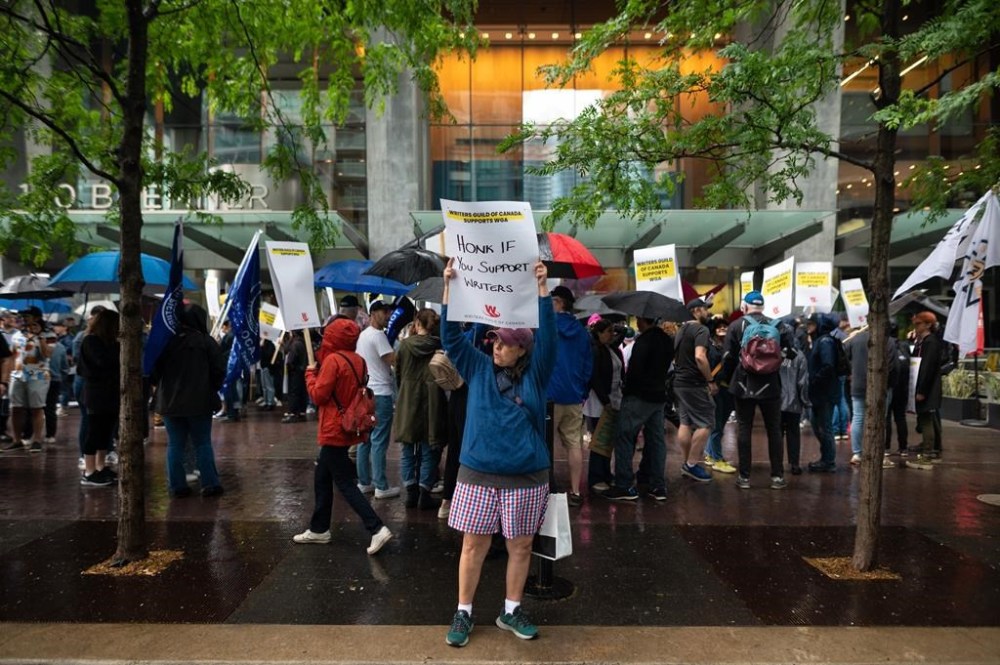
WGC president Alex Levine said unionized Canadian screen workers want their U.S. counterparts to know they support their fight for better compensation and working conditions.
He said the labour dispute has also disrupted American productions that shoot in Canada, putting Canadian crews out of work and raising uncertainty over the coming months.
The WGA walked off the job May 2 after negotiations failed with the Alliance of Motion Picture and Television Producers, which represents hundreds of film and TV producers including major networks and streamers.
The job action sparked immediate uncertainty over the status of current and upcoming U.S.-based productions north of the border, since striking WGA writers are no longer providing scripts or writing services on set.
“We’re seeing them running out of scripts,” Levine said Wednesday of unspecified U.S. productions in Canada.
“We’re seeing a slowdown — Canadians are getting hurt by this strike, and they’ll continue to get hurt more and more and more.”
Levine said issues cited by WGA members are also concerns in Canada, where many film and TV writers struggle to make a living wage. He said the WGC will be negotiating with Canadian producers in the fall.
“Producers in Canada should be taking notice, broadcasters in Canada should be taking notice about this work stoppage because we are facing these same issues. And if writers can’t make a living then this industry can’t continue.”
John Lewis, IATSE’s director of Canadian affairs, said the WGA strike has slowly halted work in British Columbia, Montreal and Toronto.
His union represents a wide swath of workers in jobs that include hair, makeup, costume, transportation, construction, paint and sound.
“Summer is usually a very busy time. We are very concerned. We have a lot of people out of work right now. We have a lot of people that are concerned about their future, about making sure they can pay the rent, making sure that they could put food on the table for their family,” said Lewis.
“But again, we stand in solidarity with the Writers Guild of America. This is a bigger fight than just the writers. This is about changing the conversation and making sure this is an industry that works for everybody that works in the industry.”
This report by The Canadian Press was first published June 14, 2023.