
Book Review: True crime meets history in Sara DiVello’s 1920s murder mystery ‘Broadway Butterfly’
Advertisement
Read this article for free:
or
Already have an account? Log in here »
We need your support!
Local journalism needs your support!
As we navigate through unprecedented times, our journalists are working harder than ever to bring you the latest local updates to keep you safe and informed.
Now, more than ever, we need your support.
Starting at $15.99 plus taxes every four weeks you can access your Brandon Sun online and full access to all content as it appears on our website.
Subscribe Nowor call circulation directly at (204) 727-0527.
Your pledge helps to ensure we provide the news that matters most to your community!
To continue reading, please subscribe:
Add Brandon Sun access to your Free Press subscription for only an additional
$1 for the first 4 weeks*
- Enjoy unlimited reading on brandonsun.com
- Read the Brandon Sun E-Edition, our digital replica newspaper
*Your next Free Press subscription payment will increase by $1.00 and you will be charged $20.95 plus GST for four weeks. After four weeks, your payment will increase to $24.95 plus GST every four weeks.
Read unlimited articles for free today:
or
Already have an account? Log in here »
Hey there, time traveller!
This article was published 31/07/2023 (1210 days ago), so information in it may no longer be current.
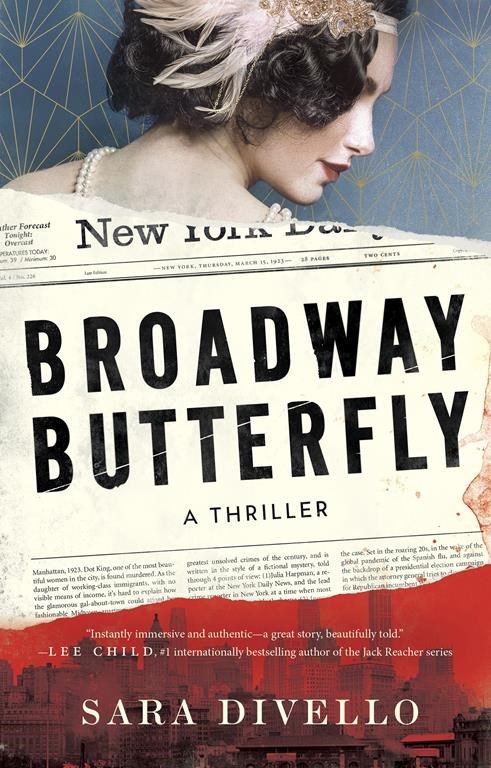
“Broadway Butterfly” by Sara DiVello (Thomas & Mercer)
The unsolved murder of the beautiful Dot King captivated New York. But the hype around the case proved insufficient motivation to catch the killer. So what happened?
In “Broadway Butterfly,” a jazzy true crime historical thriller, author Sara DiVello unearths piles of evidence and presents them through witnesses, detectives and journalists in an attempt to find out what happened to the fast-living, generous and ambitious young woman whose life was suddenly and mysteriously snuffed out.
All third person limited, the chapters go around between reporter Julia Harpman, inspector John D. Coughlin, and Dot’s maid and confidant Ella Bradford. Each takes on their own lexicon for a personal feel of character — Julia is obsessed with reporting and the hustle of being a pioneer newspaperwoman, and sees herself as a righteous champion of women. Coughlin is a hardened policeman whose preconceived ideas of others are solidified, and he’s constantly surprised at “girls these days” living and traveling alone, and at Broadway women’s apparent lack of moral values. Ella came from the South and, while she sees more opportunity and less overt racist violence and segregation in New York, is well aware of the dangers she and her family face simply by her connection with a murdered white woman.
Then there’s Frances Stotesbury Mitchell, a high society woman with equally high connections getting ready to host the scandal-ridden President Warren G. Harding in Palm Beach ahead of his renomination. For those not already familiar with the history, it’s not until about a third of the way through “Broadway Butterfly” that it becomes clear why her narrative is woven into the broader story at all. Then, it becomes integral.
Julia herself notes early on that people have a way of seeing themselves as a hero — a forecast of her own hubris. The Julia chapters always paint her as chasing justice, and she excuses occasional sensationalizing as necessary to keep the Dot King case on the front page, therefore making it more likely to get solved. “The singular life of a reporter” becomes her refrain. But time and again other characters read her words and reveal that, in practice, she isn’t the champion of women that her internal narrative makes her out to be.
So many things muddy the investigation: newbies on the force who make rookie mistakes, oldies who make assumptions, bad interrogation techniques, raw deals, classism, racism, sexism, and flat-out corruption. DiVello captures it all, revelations unfolding one by one as tips roll in from sources and shady deals are made, replete with all the ′20s slang and swanky synonyms a person could hope for, and smoking everywhere all the time. The tone is precise and transportive.
DiVello also has some fun with it, like when the inspector pointedly tells Julia that this is a murder investigation, not a detective novel. At once a jab at the character’s lust for front-page space, it’s also a self-aware criticism of true crime and, therefore, the author herself. DiVello’s passion for the genre is evident both in the writing and by her role as creator and host of a mystery and thriller podcast.
The end result is a fascinating murder mystery packed with history. However, its repetitiveness presents a sticking point. While it underscores characters, it undermines the pacing. The book feels unnecessarily long. Still, “Broadway Butterfly” is an enjoyable read loaded with factoids I might never have been aware of otherwise.