
Cleveland museum sues to stop seizure of statue believed to depict Marcus Aurelius
Advertisement
Read this article for free:
or
Already have an account? Log in here »
We need your support!
Local journalism needs your support!
As we navigate through unprecedented times, our journalists are working harder than ever to bring you the latest local updates to keep you safe and informed.
Now, more than ever, we need your support.
Starting at $15.99 plus taxes every four weeks you can access your Brandon Sun online and full access to all content as it appears on our website.
Subscribe Nowor call circulation directly at (204) 727-0527.
Your pledge helps to ensure we provide the news that matters most to your community!
To continue reading, please subscribe:
Add Brandon Sun access to your Free Press subscription for only an additional
$1 for the first 4 weeks*
*Your next subscription payment will increase by $1.00 and you will be charged $20.00 plus GST for four weeks. After four weeks, your payment will increase to $24.00 plus GST every four weeks.
Read unlimited articles for free today:
or
Already have an account? Log in here »
Hey there, time traveller!
This article was published 20/10/2023 (808 days ago), so information in it may no longer be current.
CLEVELAND (AP) — The Cleveland Museum of Art has sued New York City authorities over their seizure of a headless bronze statue believed to depict the Roman emperor and philosopher Marcus Aurelius.
A warrant signed by a judge in Manhattan on Aug. 14 ordered the seizure of the statue, which the museum acquired in 1986 and had been a highlight of its collection of ancient Roman art. The museum argues in its suit that the statue was lawfully obtained and that Manhattan District Attorney Alvin Bragg’s office has no legal authority to seize it.
The warrant was secured as part of an ongoing investigation into a smuggling network involving antiquities looted from Bubon in southwestern Turkey and trafficked through Manhattan, a spokesperson for Bragg has said. The 76-inch (1.9-meter) statue dates from A.D. 180 to 200 and is worth $20 million, according to the district attorney’s office.
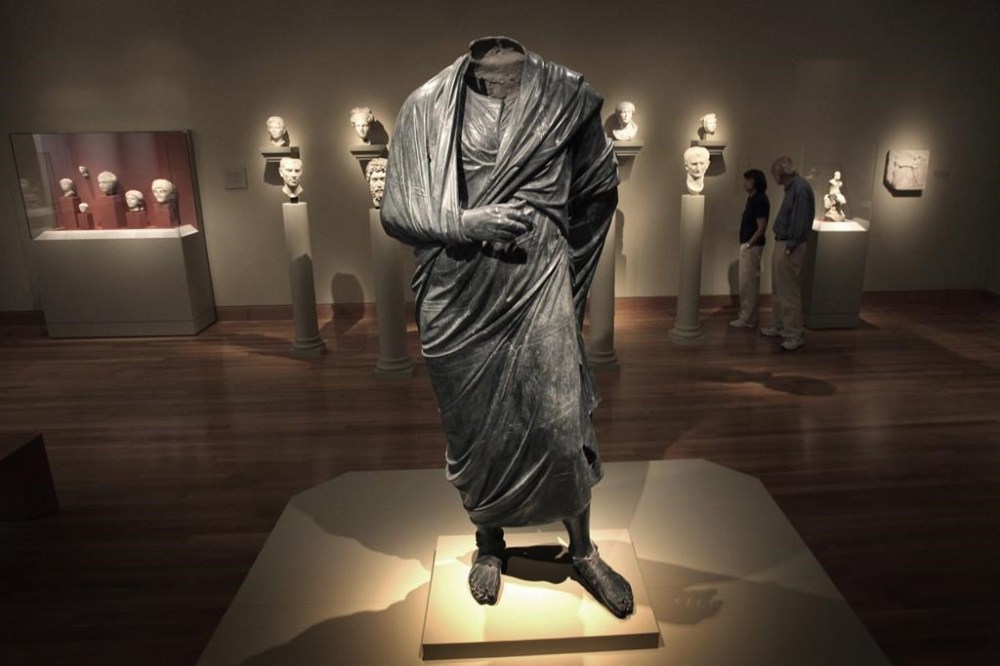
The suit filed Thursday asks a judge to declare that the museum is the rightful owner of the statue, which it calls “one of the most significant works in the (museum’s) collection” of some 61,000 objects. Museum officials have repeatedly told the district attorney that their evidence is insufficient and suggested other investigative avenues, according to the suit, but all have been refused.
The museum said it also has consulted experts who cast “significant doubt” on the identification of the statue as Marcus Aurelius, noting the experts believe it’s more likely a statue of another Greek philosopher.
A spokesman for Bragg said the office is reviewing the lawsuit and “will respond in court papers.” He also noted the office has successfully recovered more than 4,600 illegally traffic antiquities.
Museum spokesman Todd Mesek said it does not discuss ongoing litigation but noted the museum takes provenance issues very seriously.
The statue was removed from view earlier this year, and the museum changed the description of the piece on its website, where it calls the statue a “Draped Male Figure” instead of indicating a connection to Marcus Aurelius.
Turkey first made claims about the statue in 2012 when it released a list of nearly two dozen objects in the Cleveland museum’s collection that it said had been looted from Bubon and other locations. Museum officials said at the time that Turkey had provided no hard evidence of looting.
The Manhattan district attorney’s office has worked in recent years to repatriate hundreds of objects looted from countries including Turkey, Greece, Israel and Italy. It was unclear who might be targeted in the investigation of the statue seized in Cleveland.
Marcus Aurelius ruled as Roman emperor from A.D. 161 to 180 and was a Stoic philosopher whose “Meditations” have been studied over the centuries.
The seized statue shows a man in flowing robes holding one hand in front of him in a regal pose.