
Book Review: ‘White Holes’ by Carlo Rovelli reads more like poetry than science lesson
Advertisement
Read this article for free:
or
Already have an account? Log in here »
We need your support!
Local journalism needs your support!
As we navigate through unprecedented times, our journalists are working harder than ever to bring you the latest local updates to keep you safe and informed.
Now, more than ever, we need your support.
Starting at $15.99 plus taxes every four weeks you can access your Brandon Sun online and full access to all content as it appears on our website.
Subscribe Nowor call circulation directly at (204) 727-0527.
Your pledge helps to ensure we provide the news that matters most to your community!
To continue reading, please subscribe:
Add Brandon Sun access to your Free Press subscription for only an additional
$1 for the first 4 weeks*
*Your next subscription payment will increase by $1.00 and you will be charged $20.00 plus GST for four weeks. After four weeks, your payment will increase to $24.00 plus GST every four weeks.
Read unlimited articles for free today:
or
Already have an account? Log in here »
Hey there, time traveller!
This article was published 30/10/2023 (798 days ago), so information in it may no longer be current.
It doesn’t take a degree in astrophysics or expertise on Albert Einstein to appreciate “White Holes,” theoretical physicist Carlo Rovelli’s latest book. But brushing up on Dante Alighieri’s work might help.
Rovelli liberally sprinkles quotes from Dante throughout his slim book exploring the hypothesis that black holes eventually transform into an inverse white hole. It’s fitting for a book that says as much about imagination and exploration as it does about physics.
Oftentimes, Rovelli’s book feels more like poetry than a science lesson as he explains black holes in striking detail and the theoretical concepts behind white holes.
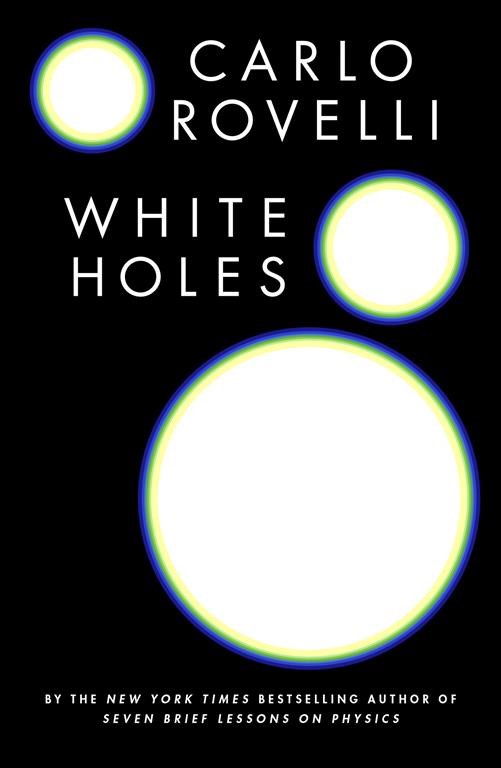
Unlike black holes, there is no proof that white holes exist. There are no satellite images of them. As Rovelli describes them, white holes are another solution of Einstein’s equation, “how a black hole would appear if we could film it and run the film in reverse.”
In the book, Rovelli says he keeps two readers in mind when he’s writing — those who know nothing about physics that he can communicate to, and those who know everything but he can offer new perspectives.
That’s why there are no equations to pore over as Rovelli explains the nature of black holes and how time and gravity operate differently in white holes. A handful of illustrations, however do help in walking readers through these concepts.
The book won’t turn lay readers into an expert on white holes or theoretical physics. But Rovelli helps readers grasp how important imagination is to seeing the universe in new ways is, for both artists and scientists.
“Science and art are about the continual reorganization of our conceptual space, of what we call meaning,” Rovelli writes.
___
AP book reviews: https://apnews.com/hub/book-reviews