
Fat Tuesday means big business for New Orleans bakers under exploding demand for king cakes
Advertisement
Read this article for free:
or
Already have an account? Log in here »
We need your support!
Local journalism needs your support!
As we navigate through unprecedented times, our journalists are working harder than ever to bring you the latest local updates to keep you safe and informed.
Now, more than ever, we need your support.
Starting at $15.99 plus taxes every four weeks you can access your Brandon Sun online and full access to all content as it appears on our website.
Subscribe Nowor call circulation directly at (204) 727-0527.
Your pledge helps to ensure we provide the news that matters most to your community!
To continue reading, please subscribe:
Add Brandon Sun access to your Free Press subscription for only an additional
$1 for the first 4 weeks*
- Enjoy unlimited reading on brandonsun.com
- Read the Brandon Sun E-Edition, our digital replica newspaper
*Your next Free Press subscription payment will increase by $1.00 and you will be charged $20.95 plus GST for four weeks. After four weeks, your payment will increase to $24.95 plus GST every four weeks.
Read unlimited articles for free today:
or
Already have an account? Log in here »
Hey there, time traveller!
This article was published 02/02/2024 (965 days ago), so information in it may no longer be current.
NEW ORLEANS (AP) — It’s Carnival season in New Orleans and that means lines are long outside local bakeries and the pace inside is brisk as workers strive to meet customer demand for king cakes — those brightly colored seasonal pastries that have exploded in popularity over the years.
“Mardi Gras is our busiest time of year,” says David Haydel Jr. of Haydel’s Bakery, who estimates the sale of king cakes in the few short weeks between Christmas and Lent accounts for about half the bakery’s income.
Behind him are racks holding dozens of freshly baked cakes ready for wrapping. Nearby, workers are whipping up batter in large mixers, rolling out lengths of dough, braiding and shaping them into rings and popping them into ovens.
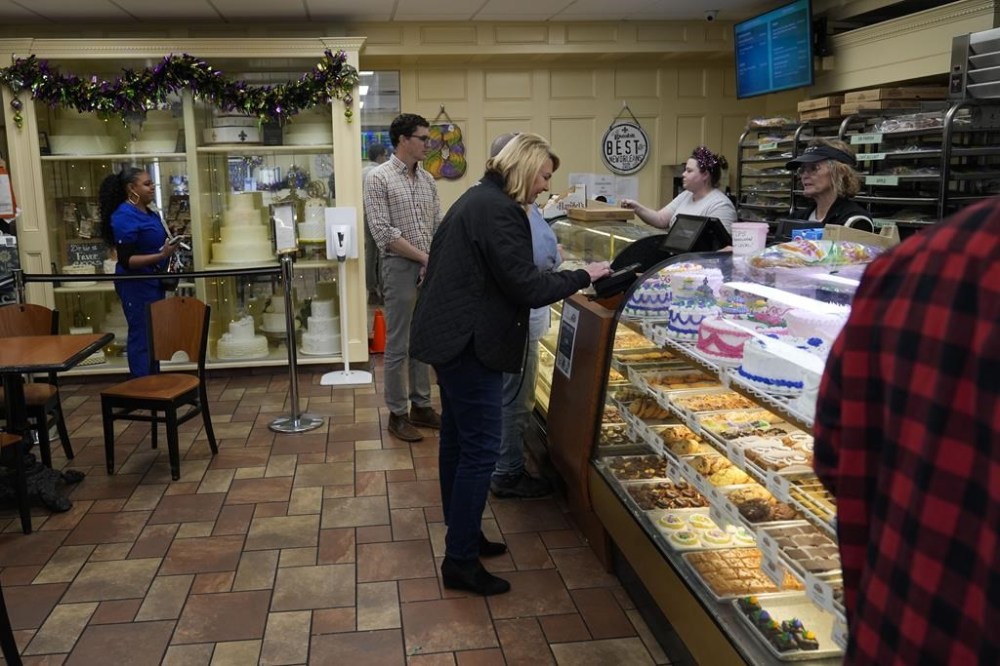
It’s a similar scene at Adrian’s Bakery in the city’s Gentilly neighborhood, where Adrian Darby Sr. estimates king cakes make up 40% of his business. “Without Mardi Gras, you know, you have to make cutbacks, and you don’t want to do that. You’ve got full-time employees and you want to maintain that.”
Food historian Liz Williams says the roots of king cake culture date to Saturnalia celebrations of ancient Rome, when a cake was baked with a bean inside and whoever got the slice with the bean was deemed king for a day.
Over the centuries the traditions developed and were adapted into European pre-Lenten festivals that evolved into the modern Mardi Gras traditions.
The evolution hasn’t stopped, according to Williams. King cakes in New Orleans were once uniform and simple — a ring of braided lightly sweet brioche topped with purple, green and gold sugar. Instead of a bean, tiny baby dolls — made of china at first, now plastic — were baked inside.
“There was not really one variation from one bakery to another,” Williams said. But by the 1970s, changes were happening. Some bakers began using Danish-style pastry dough. Some began filling their king cakes with cream cheese or fruit preserves.
The treat’s popularity grew from one Mardi Gras season to the next amid the usual frenzy of parades and colorful floats, costumed revelry and partying in the streets. Years ago, Williams said king cake was probably consumed a few times a year, perhaps during a king cake party during Carnival season.
Now, said Williams, Mardi Gras season means almost daily king cake consumption for some. “People will pick up a king cake and take it to work, and whoever gets the baby has to bring one the next day, so people are eating it all the time.”
Still, it’s not a year-round binge treat. Tradition holds that king cake is not to be eaten before Carnival season begins on Jan. 6 nor after Mardi Gras — Fat Tuesday — which falls this year on Feb. 13.
King cake’s popularity was evident one recent morning at Manny Randazzo’s bakery in New Orleans, where a line of more than 60 people stretched down the street. Customer Adrienne Leblanc loaded the back of an SUV with king cakes for friends and family in New Orleans and beyond.
“Some of these are going to go to Houston, some will go to Mississippi,” said LeBlanc. “And some will stay here in New Orleans.”