
Frank Stella, artist renowned for blurring the lines between painting and sculpture, dies at 87
Advertisement
Read this article for free:
or
Already have an account? Log in here »
We need your support!
Local journalism needs your support!
As we navigate through unprecedented times, our journalists are working harder than ever to bring you the latest local updates to keep you safe and informed.
Now, more than ever, we need your support.
Starting at $15.99 plus taxes every four weeks you can access your Brandon Sun online and full access to all content as it appears on our website.
Subscribe Nowor call circulation directly at (204) 727-0527.
Your pledge helps to ensure we provide the news that matters most to your community!
To continue reading, please subscribe:
Add Brandon Sun access to your Free Press subscription for only an additional
$1 for the first 4 weeks*
- Enjoy unlimited reading on brandonsun.com
- Read the Brandon Sun E-Edition, our digital replica newspaper
*Your next Free Press subscription payment will increase by $1.00 and you will be charged $20.95 plus GST for four weeks. After four weeks, your payment will increase to $24.95 plus GST every four weeks.
Read unlimited articles for free today:
or
Already have an account? Log in here »
Hey there, time traveller!
This article was published 04/05/2024 (732 days ago), so information in it may no longer be current.
NEW YORK (AP) — Frank Stella, a painter, sculptor and printmaker whose constantly evolving works are hailed as landmarks of the minimalist and post-painterly abstraction art movements, died Saturday at his home in Manhattan. He was 87.
Gallery owner Jeffrey Deitch, who spoke with Stella’s family, confirmed his death to The Associated Press. Stella’s wife, Harriet McGurk, told the New York Times that he died of lymphoma.
Born May 12, 1936, in Malden, Massachusetts, Stella studied at Princeton University before moving to New York City in the late 1950s.
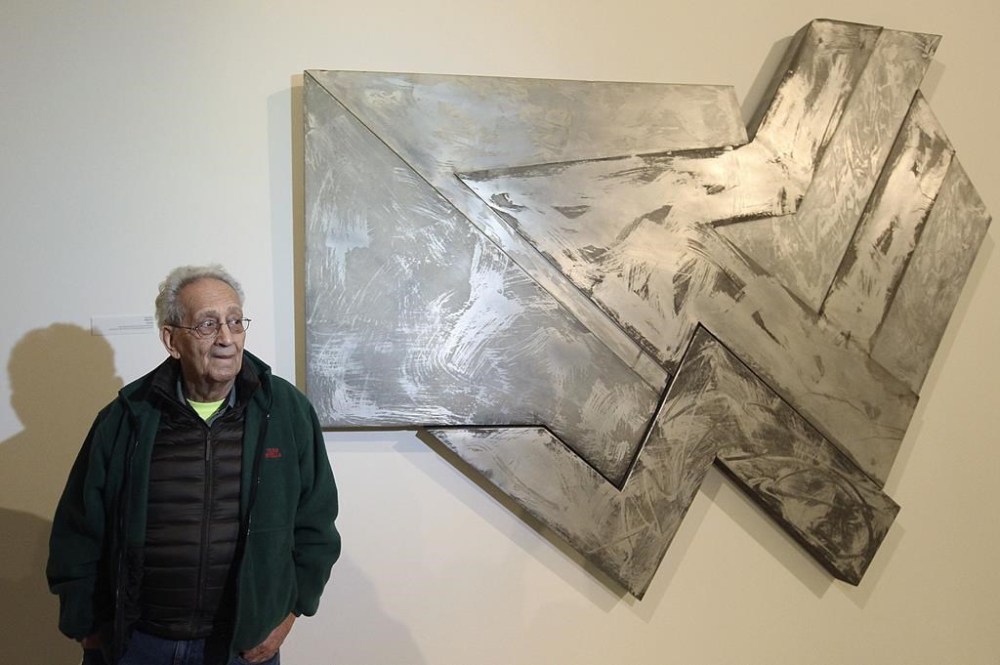
At that time many prominent American artists had embraced abstract expressionism, but Stella began exploring minimalism. By age 23 he had created a series of flat, black paintings with gridlike bands and stripes using house paint and exposed canvas that drew widespread critical acclaim.
Over the next decade, Stella’s works retained his rigorous structure but began incorporating curved lines and bright colors, such as in his influential Protractor series, named after the geometry tool he used to create the curved shapes of the large-scale paintings.
In the late 1970s, Stella began adding three-dimensionality to his visual art, using metals and other mixed media to blur the boundary between painting and sculpture.
Stella continued to be productive well into his 80s, and his new work is currently on display at the Jeffrey Deitch Gallery in New York City. The colorful sculptures are massive and yet almost seem to float, made up of shining polychromatic bands that twist and coil through space.
“The current work is astonishing,” Deitch told AP on Saturday. “He felt that the work that he showed was the culmination of a decades-long effort to create a new pictorial space and to fuse painting and sculpture.”