
Artist Kehinde Wiley puts power in a new frame with paintings of African leaders
Advertisement
Read this article for free:
or
Already have an account? Log in here »
We need your support!
Local journalism needs your support!
As we navigate through unprecedented times, our journalists are working harder than ever to bring you the latest local updates to keep you safe and informed.
Now, more than ever, we need your support.
Starting at $15.99 plus taxes every four weeks you can access your Brandon Sun online and full access to all content as it appears on our website.
Subscribe Nowor call circulation directly at (204) 727-0527.
Your pledge helps to ensure we provide the news that matters most to your community!
To continue reading, please subscribe:
Add Brandon Sun access to your Free Press subscription for only an additional
$1 for the first 4 weeks*
*Your next subscription payment will increase by $1.00 and you will be charged $20.00 plus GST for four weeks. After four weeks, your payment will increase to $24.00 plus GST every four weeks.
Read unlimited articles for free today:
or
Already have an account? Log in here »
Hey there, time traveller!
This article was published 15/04/2025 (381 days ago), so information in it may no longer be current.
RABAT, Morocco (AP) — American artist Kehinde Wiley unveiled a series of large-format portraits of African leaders in Morocco on Tuesday, building on his now famous 2018 portrait of former U.S. President Barack Obama sitting casually amid a wild cascade of leaves and flowers.
His exhibition, entitled “A Maze of Power,” opened at the Mohammed VI Museum of Modern and Contemporary Art in Rabat, Morocco’s capital, after previously showing in Paris and Dakar, Senegal.
The artwork borrows from classical easel painting techniques, posing African leaders in a style mainly associated with European royalty and aristocracy.
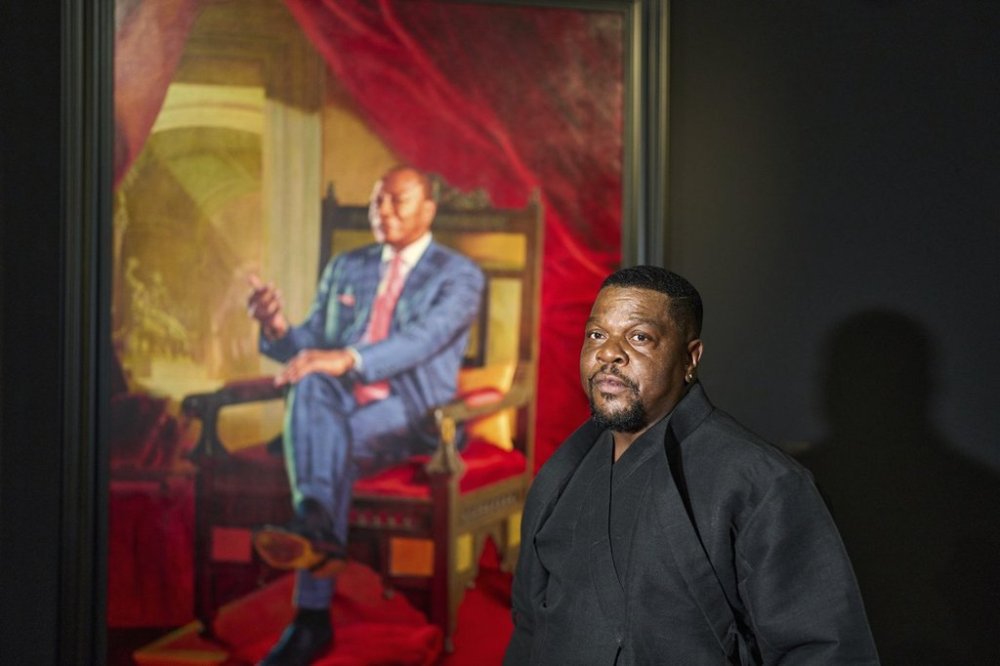
“What I wanted to do was to draw ideas in, to be able to look at the depiction of power, both beautifully and problematically,” Wiley said.
In one portrait, Ethiopia’s former president, Sahle-Work Zewde, stands before a window, her nation’s bustling capital stretching behind her as her hand clasps a dangling flower.
In another, Hery Rajaonarimampianina, former president of Madagascar, is depicted sitting confidently astride a horse. And Alassane Ouattara, president of Ivory Coast, is seen clenching his brow as he grips a sword in his right hand.
“I was thinking about the presidency at large as a symbol, as a seat of power,” Wiley told The Associated Press at the opening of his exhibition.
“A Maze of Power” arrived in Morocco seven months after first showing at Paris’ Musée du Quai Branly — Jacques Chirac. It’s part of the Moroccan museum’s efforts to become a hub for African art ahead of the next year’s opening of the Museum of the African Continent, across the street in Rabat.
Wiley said that after his Obama portrait, he was able to leverage his connections to gain audiences with leaders from across Africa and persuade them to sit for him.
In addition to Obama’s, the portraits also echo Wiley’s earlier works, in which young Black men appear in poses most associated with paintings of kings and generals.
Showing his would-be subjects a book full of classical paintings to draw inspiration from, Wiley said he prepares for painting by taking hundreds of photographs of each leader and then placing them in settings both real and abstract.
Although he wanted to show political power, the leaders’ individual political choices were not relevant to the series, Wiley said.
The leaders depicted include some marred by corruption scandals and others who ignored presidential term limits and repressed protestors. There are also two whose militaries are fighting each other in eastern Congo: Rwanda’s President Paul Kagame and Congo’s President Felix Tshisekedi.
Though Wiley said the role of some art can be to shed light on those affected by political decision-making, his goals were different.
“This project is more about pulling way back and having a sort of bird’s-eye view at the phenomena of the political portrait itself,” he said.