
Dutch beach beasts find a final resting place in a new exhibition
Advertisement
Read this article for free:
or
Already have an account? Log in here »
We need your support!
Local journalism needs your support!
As we navigate through unprecedented times, our journalists are working harder than ever to bring you the latest local updates to keep you safe and informed.
Now, more than ever, we need your support.
Starting at $15.99 plus taxes every four weeks you can access your Brandon Sun online and full access to all content as it appears on our website.
Subscribe Nowor call circulation directly at (204) 727-0527.
Your pledge helps to ensure we provide the news that matters most to your community!
To continue reading, please subscribe:
Add Brandon Sun access to your Free Press subscription for only an additional
$1 for the first 4 weeks*
*Your next subscription payment will increase by $1.00 and you will be charged $20.00 plus GST for four weeks. After four weeks, your payment will increase to $24.00 plus GST every four weeks.
Read unlimited articles for free today:
or
Already have an account? Log in here »
Hey there, time traveller!
This article was published 11/06/2025 (288 days ago), so information in it may no longer be current.
DELFT, Netherlands (AP) — The famous wind-powered beach beasts have scuttled along the Dutch North Sea coast, into a swanky Miami art show and even onto “The Simpsons.”
They now have a final resting place in a Dutch city most famous for “Girl with a Pearl Earring” painter Johannes Vermeer and blue-painted pottery.
The “bones” of Theo Jansen’s “strandbeesten” — beach animals in Dutch — have taken over a former cable factory in Delft, the small city in the western Netherlands that Jansen has called home for decades.
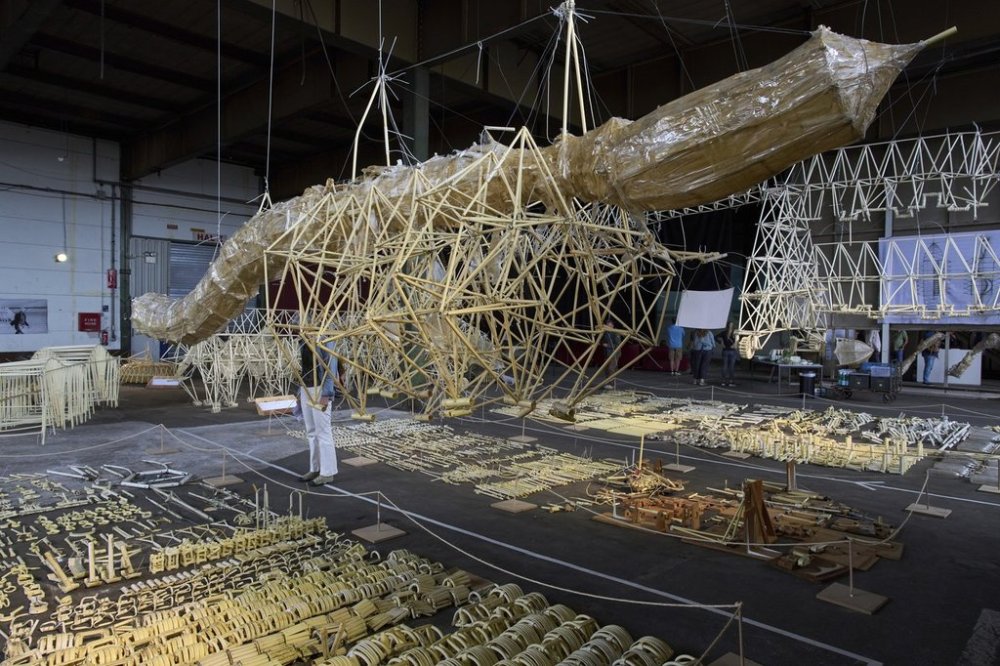
“During the years, there has been a sort of evolutionary history, you could say. And you could see these animals as sort of natural historical objects,” the 77-year old artist told The Associated Press before the installation’s opening.
The Strandbeesten Mortuary, as the exhibition is called, follows the various versions of the mobile sculptures since 1990 when Jansen created the first one from plastic pipes and tape. As the animals evolved, Jansen incorporated plastic bottles, wooden planks, cloth and cardboard.
The life and death cycle of these famous animals — formed mostly out of PVC pipes — has left behind an impressive fossil record, which is on display at the exhibition.
Marloes Koster, who organized the exhibition for Delft’s Prinsenhof Museum, said that Jansen’s ultimate goal is to create a beast that will live forever.
“He’s not there yet, so these are the ones that didn’t make it,” she added.
The museum is undergoing major renovations, so Koster and her colleagues have been putting together arts and culture events at alternative venues around the city while the building is shut.
Born near the North Sea, Jansen grew up captivated by the wind that often hits the Dutch coastline. He harnessed it to allow his animals to “walk” along the beach. Every year, he creates a new strandbeest and, at the end of the summer, declares the animal dead.
“All summer I do experiments, and in the fall I’m a little bit wiser (about) how these animals should survive in the future,” Jansen said.
Many of the visitors to the opening of the exhibition had followed Jansen’s work for years and were keen to understand how the strandbeesten had changed over time.
“You see a kind of development in the way he does things. So they start out very simple, and then it gets increasingly complicated. So they evolve,” said Cor Nonhof, a Delft local who had come to see the exhibition with his wife.
Even at the opening, Jansen was already keen to return to the beach to work on the latest evolution of his strandbeesten.
“I cannot do anything else,” Jansen said. “And I am very happy with that.”