
Movie Review: War, through one child’s extraordinary eyes, in ‘Don’t Let’s Go to the Dogs Tonight’
Advertisement
Read this article for free:
or
Already have an account? Log in here »
We need your support!
Local journalism needs your support!
As we navigate through unprecedented times, our journalists are working harder than ever to bring you the latest local updates to keep you safe and informed.
Now, more than ever, we need your support.
Starting at $15.99 plus taxes every four weeks you can access your Brandon Sun online and full access to all content as it appears on our website.
Subscribe Nowor call circulation directly at (204) 727-0527.
Your pledge helps to ensure we provide the news that matters most to your community!
To continue reading, please subscribe:
Add Brandon Sun access to your Free Press subscription for only an additional
$1 for the first 4 weeks*
*Your next subscription payment will increase by $1.00 and you will be charged $20.00 plus GST for four weeks. After four weeks, your payment will increase to $24.00 plus GST every four weeks.
Read unlimited articles for free today:
or
Already have an account? Log in here »
Hey there, time traveller!
This article was published 09/07/2025 (262 days ago), so information in it may no longer be current.
“Are we racists?” That’s the blunt question posed by Bobo, a white girl living on a farm in Africa, to her horrified (and defensive) mother.
There are so many ways this three-word line reading could land wrongly — or just seem forced or mannered. But it feels thoroughly organic when voiced by Lexi Venter, an extraordinary first-time actor who gives, at age 7, one of the more compelling child performances in recent memory in “Don’t Let’s Go to the Dogs Tonight.”
It’s a performance that was seeded, watered and nurtured by Embeth Davidtz, an extraordinary actor herself who wrote, directed and stars in this adaptation of Alexandra Fuller’s admired 2001 memoir. One imagines Davidtz, in her triple role (and as a first-time director), had hundreds upon hundreds of decisions to make. Her most important, though, was finding and casting this youngster possessed of a wild nature, a mop of unruly hair and a face like a broad canvas waiting to be painted.
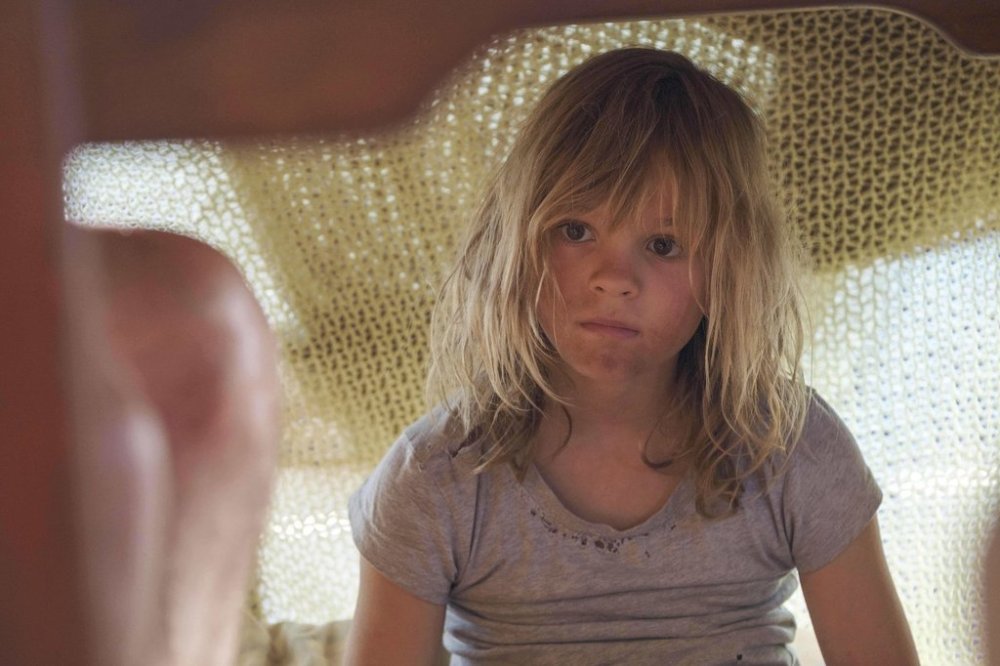
The movie, which chronicles one family’s life in the turbulent, waning days of white rule in Zimbabwe (formerly Rhodesia), was not always going to be narrated by a child. Davidtz’s first attempt at adapting the memoir, told in third person, was too remote, she herself has said. Then she zoomed in on the idea of telling the tale uniquely from Bobo’s perspective.
Davidtz, who spent much of her childhood in South Africa, was drawn to the project because it recalled her own experience growing up in a world where racial inequality and violence were everywhere, but none of the adult explanations made much sense.
The director’s own family life also included, like the Fuller family’s, mental illness and alcoholism; she has said that neither the outside world nor home life felt safe.
And that’s how it is for Bobo, 8 years old when we meet her, the younger of two daughters of Nicola and Tim Fuller. We will soon learn that another daughter died as a toddler in a tragic drowning — one of the reasons Nicola (Davidtz) is so emotionally tied to the family farm, as conveyed in one particularly brutal scene brimming with rage. She may not be native to the land, but her offspring is buried in its soil.
We begin with Bobo explaining how she’s afraid to go alone to pee in the night. “Terrorists,” as they’ve been described by the adults, might lurk anywhere, even on the way to the bathroom, carrying a gun or knife or spear.
But imaginary threats are accompanied by real ones. During the day, a trip into town with her mother necessitates an escort vehicle. “I really hope we don’t die in an ambush today,” Bobo says casually to an armed guard. This is a child who helps Dad pack his ammo at breakfast.
The film, shot in South Africa, is set in the days before and after the 1980 parliamentary election — a crucial vote that will bring the Black majority to power in Zimbabwe under Robert Mugabe. Visiting her parents’ home, Nicola patronizingly instructs their Black servants on which candidate to support.
At home, Nicola’s desperation rages. She drinks bourbon by the bottle and sleeps with a huge gun. She doesn’t spend much time with her daughters, which leaves Bobo plenty of time to hang out with the animals, ride her motorbike, and smoke cigarettes.
Such habits earn Bobo the disapproval of her most valued friend, Sarah (Zikhona Bali, in a warm and nuanced performance), one of two adult servants who work on the farm. The other is Jacob (Fumani N. Shilubana), who warns Sarah that her relationship with Bobo is too publicly affectionate in these precarious times. Besides, he tells her, Bobo thinks of her as a “stupid village girl.”
But there is real affection between the two. Privately, they laugh and share stories. And Sarah, conscious of the risks, tries to be the attentive parent Bobo lacks. When she catches the girl, messy-haired and smudgy-faced, smoking — at age 7! — she scolds her. “There’s nothing wrong with me, I’m perfect!” Bobo replies, with the self-belief that comes from a childhood spent bossing around people like Sarah.
You can direct moments like this, as Davidtz does expertly while somehow turning in a heartbreaking and increasingly unhinged performance of her own. But you can’t manufacture lightning in a bottle — for example, the infectious joy Venter exudes, even while her family is losing everything, singing a rowdy song about a stripper.
Davidtz has said she searched far and wide to find her star, interviewing experienced child actors but not finding the “feral” girl she needed. A Facebook search yielded Venter. Davidtz knew she was right before even meeting her in person. Working with the girl three hours a day, she did not give her a script, but rather provided guidance and let her improvise.
Nobody’s perfect, though Bobo may think she is. But in Venter’s performance, Davidtz has found something pretty close: a child actor who can carry an entire film and never seem like she’s acting. Bobo’s story has now been told; let’s hope we see young Venter telling many more.
“Don’t Let’s Go to the Dogs Tonight,” a Sony Pictures Classics release, has been rated R by the Motion Picture Association “for violent/bloody images, language, sexual assault, and some underage smoking/drinking.“ Running time: 98 minutes. Three stars out of four.