
Canadian-born renegade architect Frank Gehry dies at 96
Advertisement
Read this article for free:
or
Already have an account? Log in here »
We need your support!
Local journalism needs your support!
As we navigate through unprecedented times, our journalists are working harder than ever to bring you the latest local updates to keep you safe and informed.
Now, more than ever, we need your support.
Starting at $15.99 plus taxes every four weeks you can access your Brandon Sun online and full access to all content as it appears on our website.
Subscribe Nowor call circulation directly at (204) 727-0527.
Your pledge helps to ensure we provide the news that matters most to your community!
To continue reading, please subscribe:
Add Brandon Sun access to your Free Press subscription for only an additional
$1 for the first 4 weeks*
*Your next subscription payment will increase by $1.00 and you will be charged $20.00 plus GST for four weeks. After four weeks, your payment will increase to $24.00 plus GST every four weeks.
Read unlimited articles for free today:
or
Already have an account? Log in here »
TORONTO – Frank Gehry, the Canadian-born renegade architect behind some of the world’s most recognizable buildings, has died at 96.
He died on Friday morning at his home in Santa Monica, Calif., following a brief respiratory illness, said Meaghan Lloyd, chief of staff at Gehry Partners, LLP.
Known for his unconventional style and daring designs, Gehry brought unique life to cultural spaces including Toronto’s Art Gallery of Ontario, the Guggenheim Museum Bilbao in Spain, the Walt Disney Concert Hall in Los Angeles and Facebook headquarters in Menlo Park, Calif.
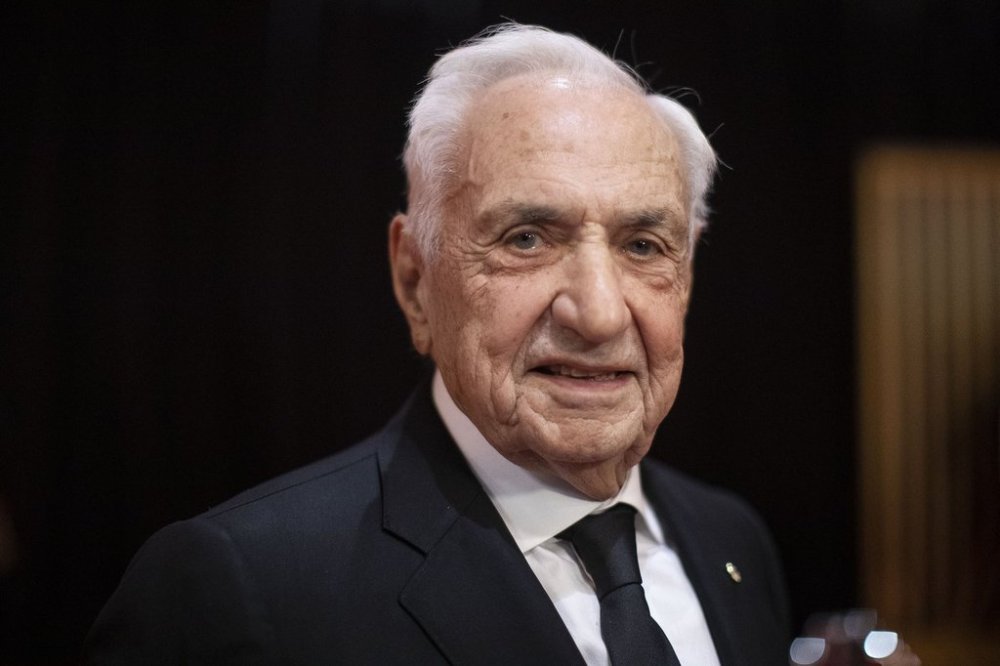
His unusual work on museums, office spaces and private homes generated the sort of attention that’s rarely experienced by architects, making his structural creations among the most recognizable in the world. He was even immortalized with a cartoon version of himself in an episode of “The Simpsons.”
Listening to critics lambaste his trademark out-there designs was just part of the job, Gehry said in 2012 while introducing the initial concept for a trio of condo buildings in his hometown of Toronto.
The buildings drew harsh criticism from some Torontonians when the models were unveiled and went through some redesigns before construction began. A revised plan for the project, which is still in the process of being built, includes two residential skyscrapers in the city’s entertainment district.
“In Bilbao, Spain, they wanted to shoot me when they saw the (Guggenheim design) and now they get $500 million a year in revenue to the city. I don’t know how to overcome (critics), it’s just part of the thing,” he said, noting the Walt Disney Concert Hall was also mocked as “broken crockery.”
He was remembered Friday as a visionary rulebreaker who left a distinctive mark on the world.
Gov. Gen. Mary Simon called Gehry a “true global architectural titan.”
“He was seen by many as one of Canada’s most brilliant artistic minds,” she said in a written statement.
Meanwhile, Prime Minister Mark Carney offered his condolences on social media.
“Frank Gehry was an architectural icon whose bold designs have shaped cityscapes all over the world,” he wrote.
Stephan Jost, CEO of the Art Gallery of Ontario, said Gehry helped solidify the Toronto institution’s position on the world stage, while reminding the world of the architect’s Canadian roots.
“People made the link between Frank Gehry and Toronto. Of course he’s a Torontonian, right? But people didn’t always know that,” Jost said on a video call Friday. “It was also a move for Frank Gehry to publicly tell people, yeah, he’s Canadian and yeah, he cares.”
Gehry was born Frank Owen Goldberg on Feb. 28, 1929, to Polish immigrant parents who lived in Toronto. His childhood had a strong emphasis on family, with his grandparents often credited as the earliest influence for his celebrated career.
His grandmother, Leah, would scatter oddly shaped wood scraps she bought at a nearby furniture shop across her kitchen floor and encourage the young Gehry to use them to construct imaginary buildings, bridges and cities before they went into the family’s wood stove.
“(It was) the most fun I ever had in my life. I realized it was a licence to play,” Gehry is quoted as saying in the 2015 biography “Building Art: The Life and Work of Frank Gehry,” by Paul Goldberger.
As a teenager, Gehry attended Friday lectures at the University of Toronto and became particularly fond of one speaker, who he later concluded was probably Finnish architect Alvar Aalto, another modern designer who thrived on breaking the rules.
Gehry and his family relocated to Los Angeles in 1947 and he became a U.S. citizen three years later. His early years in the U.S. were spent as a truck driver by day, while he took sculpture classes at night school and later got an architecture degree from the University of Southern California.
It wasn’t until the mid-1950s that Gehry reluctantly changed his last name at the urges of his first wife. She feared the name Goldberg would expose their children to antisemitism. He later said he regretted doing so.
Those years were filled with professional volatility as he balanced his aspirations with a tight budget and the responsibilities of raising his two children. He served in the U.S. army while building his contacts within the architecture community on weekends, and studied urban planning at Harvard University before dropping out.
His career began with a bang: he opened his Los Angeles business in 1962 and two years later worked on the Danziger Studio and Residence, a highly regarded Los Angeles landmark. Most of his early projects adhered to the modernist styles, which favour geometric lines and simplicity.
By 1967, Gehry’s reputation in the architecture community was at new heights. He was hired to design the Merriweather Post Pavilion, an amphitheatre in Columbia, Md. It became his first project to be featured in the New York Times, which called it “an unqualified architectural and acoustical success.”
Gehry focused most of his attention on projects in Southern California during those early years, including his first shopping mall, Santa Monica Place (1980), an expansion of the Cabrillo Marine Aquarium (1981) in San Pedro, Calif., and most notably his own private residence, which used plywood planks, chain-link fence and corrugated steel materials in a deconstructivist style (1978).
By the 1990s, Gehry’s daring designs were taking shape in cities around the world. The Frederick Weisman Museum of Art, his Guggenheim Bilbao and El Peix, the fish-like structure Gehry designed for the 1992 Summer Olympics in Barcelona, all showcased his playful and unconventional attitudes.
In giving him the prestigious Pritzker Architecture Prize in 1989, art critic and juror Ada Louise Huxtable wrote that Gehry allowed delight to break through in each structure he designed.
“One cannot think of anything he has done that doesn’t make one smile,” she wrote.
“These are light and lively designs and buildings that lift the spirit with revelations of how the seemingly ordinary can become extraordinary by acts of imagination.”
Gehry’s projects are too numerous to name, but among his other notable works are the redesign of the Art Gallery of Ontario, the Gehry Tower in Hannover, Germany, and the Louis Vuitton Foundation for Creation in Paris.
The enduring influence of Gehry’s grandmother inspired him to take a more active role in the next generation of creators. He joined Turnaround Arts, a U.S. program run by the Kennedy Center that aims to improve the academic performance of the country’s lowest-achieving schools by increasing engagement with the arts.
Gehry was among the leaders who taught classes on architecture to students he says were often uninspired by academia otherwise. He would put physical materials in front of them, just like his grandmother once did, and ask them to use their imaginations.
“You can get them involved with painting and making things — that tactile stuff,” he told The Canadian Press in a 2019 interview.
“When they make a little building, or a city … you can say, ‘If you put them together who runs the city?’ So you can teach civics and all that stuff. So, I think my grandma’s idea was perfect.”
Gehry was awarded the Presidential Medal of Freedom, America’s highest civilian honour, in 2016 by former U.S. president Barack Obama.
In his speech, Obama said Gehry inspired others through his advocacy for arts education and philanthropy.
“The idea of what architecture could be, he decided to upend,” Obama said.
“Frank’s work teaches us that while buildings may be sturdy and fixed to the ground, like all great art they can lift our spirits. They can soar, they can broaden our horizons.”
-With files from Nicole Thompson and Lauren La Rose
This report by The Canadian Press was first published Dec. 5, 2025.