
Canadian Bar Association speaks out against Smith’s judicial appointment demands
Advertisement
Read this article for free:
or
Already have an account? Log in here »
We need your support!
Local journalism needs your support!
As we navigate through unprecedented times, our journalists are working harder than ever to bring you the latest local updates to keep you safe and informed.
Now, more than ever, we need your support.
Starting at $15.99 plus taxes every four weeks you can access your Brandon Sun online and full access to all content as it appears on our website.
Subscribe Nowor call circulation directly at (204) 727-0527.
Your pledge helps to ensure we provide the news that matters most to your community!
To continue reading, please subscribe:
Add Brandon Sun access to your Free Press subscription for only an additional
$1 for the first 4 weeks*
*Your next subscription payment will increase by $1.00 and you will be charged $20.00 plus GST for four weeks. After four weeks, your payment will increase to $24.00 plus GST every four weeks.
Read unlimited articles for free today:
or
Already have an account? Log in here »
EDMONTON – A group that speaks for more than 5,000 lawyers, judges and others in the legal system says Alberta Premier Danielle Smith is trying to fix something that isn’t broken.
Christopher Samuel, president of the Canadian Bar Association’s Alberta branch, spoke Thursday on Smith’s threatening this week to pull provincial support money for future federally appointed judges unless Alberta gets more of a say in how those judges are picked.
Samuel, in an interview, said Alberta lawyers already have a strong voice in the current process, that those being appointed judges in the province are Albertans, and the rigorous, non-partisan appointment process has served the province well.
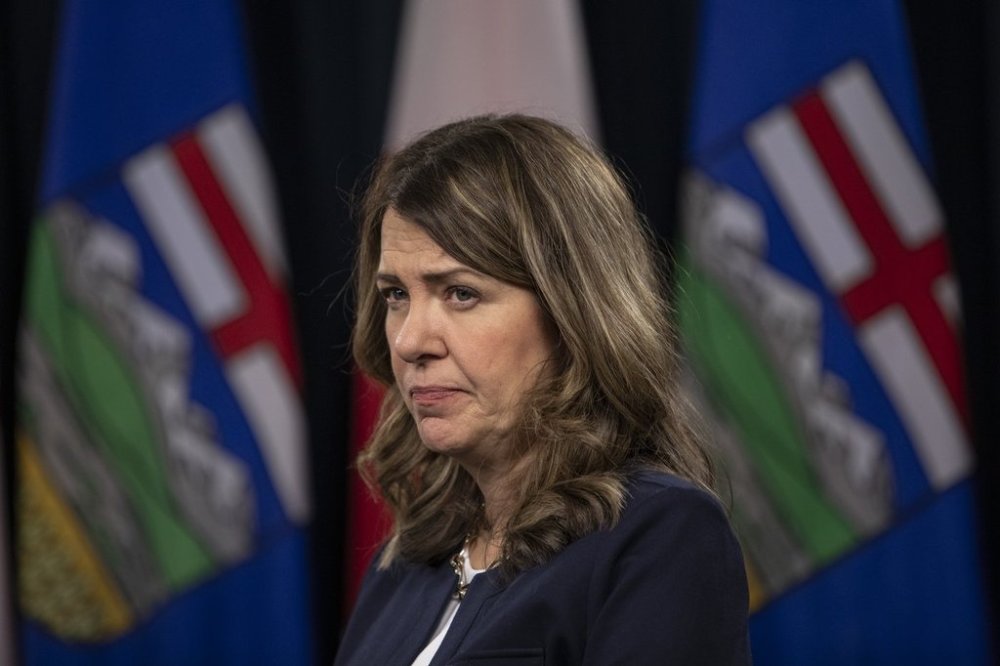
“We consider Alberta applicants, and we very much preserve Alberta legal traditions through this process,” he said.
“(If) it’s not broke, don’t fix it. I think that applies.”
Samuel’s remarks were echoed by his group’s umbrella organization, the Canadian Bar Association, which speaks for about 40,000 lawyers, judges and legal professionals.
In a joint letter Thursday, Samuel and national president Bianca Kratt said Smith’s proposal would compromise the non-partisan appointment process and judicial independence.
Smith made the demand for reform to Prime Minister Mark Carney in a letter released publicly earlier this week.
Smith’s proposal, she writes, would help ensure judicial appointments “appropriately reflect Alberta’s distinct legal traditions,” and strengthen public confidence in the administration of justice. The government has declined to specify what she meant by Alberta’s “distinct legal traditions.”
Her office has noted the current federal judicial advisory committee for Alberta’s superior courts only includes one provincial nominee, but three federal nominees. She wants a new four-person committee, with equal representation, requiring ministerial approval from both levels before appointments proceed.
Heather Jenkins, press secretary to Justice Minister Mickey Amery, added in a statement Thursday the government believes “there should be a truly collaborative process to select highly qualified candidates for judicial appointments.”
The remainder of the existing seven-seat committee consists of members appointed by the Law Society of Alberta, the Alberta chief justice and the Canadian Bar Association in Alberta.
Samuel said while the federal minister has the constitutional power to appoint judges, “the federal government doesn’t even have a majority on that committee.”
The bar association letter says they’re concerned Smith’s suggestion that judges don’t reflect the “values and expectations” of Albertans underscores the political nature of her proposal.
Samuel warned that suggesting there is some flaw in the appointment process as it currently exists, and implying that there is a problem with the lawyers being appointed as judges, is harmful.
“Comments that disparage or impugn the judicial appointment process necessarily impugn the institution itself, and it erodes that public trust, and that can take us down a very dark road,” he said.
Federal Justice Minister Sean Fraser has said he has confidence in the current independent appointment process, and he plans to maintain it.
Smith, in the letter to Carney, has also called on Ottawa to relax bilingualism requirements for judges on the Supreme Court of Canada, which since 2016 have required them to have a functional understanding of both official languages.
Smith has said the rule “further entrenches systemic barriers and alienation for western Canadians and does not reflect Canada’s broader linguistic diversity, including the many Canadians who are bilingual in other languages.”
Alberta’s French lawyers association and the provincial chapter of the French Canadian Association pushed back, saying the existing requirement protects and ensures access to justice.
The president of Alberta’s French lawyers association, Elsy Gagné, said Wednesday even without the bilingualism requirement, future Supreme Court judges would probably want to become bilingual to understand the hearings they oversee, since they are carried out in both English and French.
By law, three of nine seats on the Supreme Court are to be appointed from Quebec. The remaining seats, by tradition, are to be filled by three judges from Ontario, two from the western provinces or Northern Canada, and one from the Atlantic provinces.
The premier’s approach to the courts has garnered headlines and drawn fire from critics who worry her government’s actions threaten long-standing democratic principles.
Smith has criticized what she calls “activist” courts and “unelected” judges, and argued that elected officials have the final say as part of her belief in parliamentary supremacy.
On Thursday, an open letter to Smith signed by 180 Alberta lawyers says there’s been a pattern of attacks on the rule of law in the province that has led to an erosion of democratic institutions.
Smith’s government invoked the Charter’s notwithstanding clause four times in the fall to shield its laws from court challenges, and in their letter, the lawyers point to her readiness to invoke it “when court decisions prove unwelcome.”
This report by The Canadian Press was first published Feb. 5, 2026.