
What to know about the charge that former Prince Andrew and Peter Mandelson could face
Advertisement
Read this article for free:
or
Already have an account? Log in here »
We need your support!
Local journalism needs your support!
As we navigate through unprecedented times, our journalists are working harder than ever to bring you the latest local updates to keep you safe and informed.
Now, more than ever, we need your support.
Starting at $15.99 plus taxes every four weeks you can access your Brandon Sun online and full access to all content as it appears on our website.
Subscribe Nowor call circulation directly at (204) 727-0527.
Your pledge helps to ensure we provide the news that matters most to your community!
To continue reading, please subscribe:
Add Brandon Sun access to your Free Press subscription for only an additional
$1 for the first 4 weeks*
*Your next subscription payment will increase by $1.00 and you will be charged $20.00 plus GST for four weeks. After four weeks, your payment will increase to $24.00 plus GST every four weeks.
Read unlimited articles for free today:
or
Already have an account? Log in here »
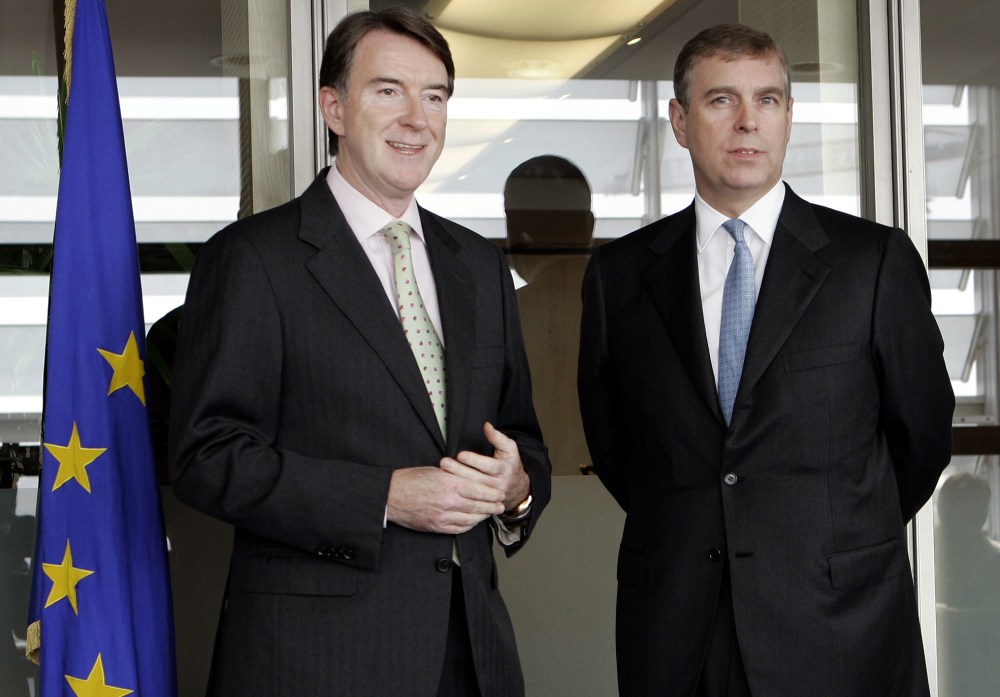
LONDON (AP) — The former Prince Andrew and Peter Mandelson, the U.K.’s former ambassador to Washington, were arrested within days of each other for their ties to the late sex offender Jeffrey Epstein, and both are under investigation for the same offense: misconduct in public office.
Neither of them has been charged, yet, but their high-profile arrests have shone a spotlight on an ancient law that experts say is ill-defined, too broad and direly in need of reform.
Police have not disclosed details of how they questioned the former prince, now known as Andrew Mountbatten-Windsor, and Mandelson. But documents recently released by the U.S. government suggest both of them were close to Epstein and may have leaked sensitive information to him.
The trove of files suggest Mountbatten-Windsor passed confidential trade reports, among other documents, to Epstein when he was serving as the U.K.’s trade envoy from 2001 to 2011.
In the case of Mandelson, the documents suggest the veteran Labour Party politician may have shared an internal government report with Epstein and told the financier that he would lobby for a cut on tax on bankers’ bonuses when he held the title of Business Secretary around 15 years ago.
Both men previously denied wrongdoing and have not commented on the most recent allegations.
A difficult offense to prove
The Crown Prosecution Service — which conducts criminal investigations in England and Wales — defines misconduct in public office as “serious willful abuse or neglect of the power or responsibilities of the public office held.” There must be a direct link between the misconduct and an abuse of those responsibilities, it said.
The offense carries a maximum sentence of life imprisonment.
Prosecutors must investigate all the evidence gathered on the men to consider if it is enough to prove misconduct in each case.
Experts say proving the offense, which can be traced back to medieval times, is notoriously difficult.
There is no simple definition of what constitutes a “public officer.” It may be particularly difficult to prove Mountbatten-Windsor was the holder of a public office when he was the U.K.’s special representative for international trade and investment — an unsalaried role with paid travel expenses.
Prosecutors must next establish if the suspects willfully neglected to perform their duties or willfully committed misconduct.
The neglect or misconduct must also be so serious that it amounts to an abuse of public trust.
Finally, the actions must be deemed to be “without reasonable excuse of justification,” according to the prosecution service.
‘The law is in need of reform’
The Law Commission, an independent legal body that makes reform recommendations to the government, says the wording of the offense is unhelpfully vague. The commission has called for years for it to be repealed and replaced by more specific offenses.
“The law is in need of reform, in order to ensure that public officials are appropriately held to account for misconduct committed in connection with their official duties,” the Law Commission said on its website.
Another of the commission’s concerns is that most prosecutions of the offense have been directed at low- to midranking officials and staff such as police and prison officers, rather than senior managers or politicians.
Both Mountbatten-Windsor and Mandelson were released after police questioning.
Marcus Johnstone, managing director of PCD Solicitors, a law firm that is not involved in the cases, said the bar is “extremely high” to reach a conviction, and that he does not expect to see any conviction against either man. He said if either was convicted, the sentences would probably be from one to 10 years in prison.
“It must be noted that cases involving government ministers or trade envoys charged with misconduct in public office are extremely rare, and there is no real guidance as to the expected sentence,” Johnstone said.
“Although an investigation is now taking place,” he added, “we are still a long way away from a potential prosecution.”