
Urban salsa music pioneer Willie Colón remembered at New York funeral
Advertisement
Read this article for free:
or
Already have an account? Log in here »
We need your support!
Local journalism needs your support!
As we navigate through unprecedented times, our journalists are working harder than ever to bring you the latest local updates to keep you safe and informed.
Now, more than ever, we need your support.
Starting at $15.99 plus taxes every four weeks you can access your Brandon Sun online and full access to all content as it appears on our website.
Subscribe Nowor call circulation directly at (204) 727-0527.
Your pledge helps to ensure we provide the news that matters most to your community!
To continue reading, please subscribe:
Add Brandon Sun access to your Free Press subscription for only an additional
$1 for the first 4 weeks*
*Your next subscription payment will increase by $1.00 and you will be charged $20.00 plus GST for four weeks. After four weeks, your payment will increase to $24.00 plus GST every four weeks.
Read unlimited articles for free today:
or
Already have an account? Log in here »
NEW YORK (AP) — Family, friends and fans gathered Monday morning in New York to pay tribute to Willie Colón, the Grammy-nominated architect of urban salsa music and social activist who died last month at 75.
A public funeral Mass was held at St. Patrick’s Cathedral in midtown Manhattan, following a weekend of private and public visitations. His burial will be private.
The trombonist, composer, arranger and singer born William Anthony Colón Roman died on Feb. 21. The cause was not publicly announced. His family said he passed away peacefully surrounded by relatives at New York Presbyterian Hospital in Bronxville, New York, just north of New York City. According to the official funeral program, he is survived by his wife of 49 years, Julia Colón Craig, their four sons William David (Rose) Colón, Adam Diego Colón, Alejandro Miguel (Nell) Colón, Patrick Antonio Colón, sister Isabell (Michael Johnson) Breston, six grandchildren, three great-grandchildren and many nieces and nephews.
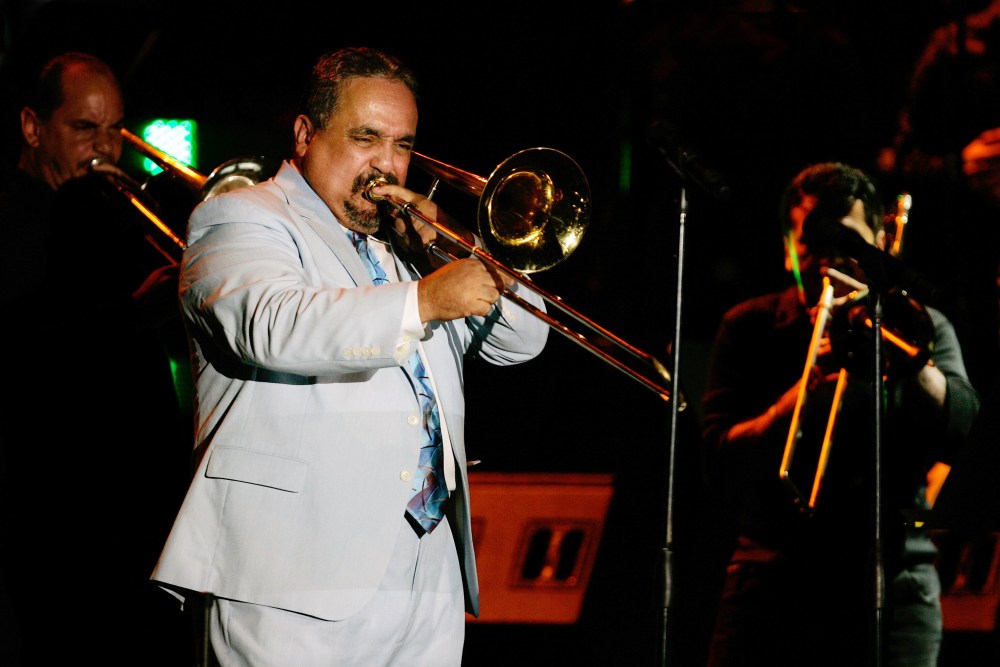
“While we grieve his absence, we also rejoice in the timeless gift of his music and the cherished memories that will live on forever,” his family said in a statement.
The funeral was livestreamed at https://www.saintpatrickscathedral.org/ and YouTube.
The mass, readings and songs were held in both Spanish and English. Here are some highlights.
Loving tributes from family and friends
Diego Colón, one of Willie’s four sons, gave the first eulogy. “He left a giant shadow,” he said. “The whole world was changed by his music … those who truly knew him were changed by his love.”
Alejandro Miguel (Nell) Colón, another son, took over, saying that Willie Colón always dreamt of having his funeral at the famed St. Patrick’s Cathedral. “We got it done,” he said.
Joking about his father’s political activism and support for law enforcement, he told the crowd that when he was a child, he used to tell people his dad was “half-singer and half-cop,” adding that the last thing he ate was a small piece of raspberry dark chocolate.
“Because of you, we all stand taller,” he concluded.
“I actually learned what the trombone was because of him,” Bishop Joseph A. Espaillat joked in his sermon, before adding that Colón was a son of the Bronx, or Puerto Rico, but “what is most important is that he is a son of God. And that’s why we’re gathered here today.”

“This is a very important moment,” he continued. “I hope all of you leave today with hope that this is not the end.”
Celebrating a lifelong legacy
Born in New York City’s Bronx borough, Colón produced more than 40 albums that sold more than 30 million copies worldwide and collaborated with a wide variety of artists, including the Fania All Stars, David Byrne and Celia Cruz.
He was nominated for 10 Grammys and one Latin Grammy and was known for songs including “El gran varón,” “Sin poderte hablar,” “Casanova,” “Amor verdad” and “Oh, qué será.”
His manager, Pietro Carlos, wrote on social media that Colón not only changed salsa, but also “expanded it, politicized it, clothed it in urban chronicles, and took it to stages where it hadn’t been heard before.”
Colón was also a community leader who fought for civil rights, mostly in the United States. He further dabbled in politics, serving as a special assistant to New York City Mayors David Dinkins and Michael Bloomberg. In 1994, he lost his challenge to then-U. S. Rep. Eliot Engel in the Democratic primary.