
‘Whatever it takes:’ Indigenous group seeks help repatriating items from Switzerland
Advertisement
Read this article for free:
or
Already have an account? Log in here »
We need your support!
Local journalism needs your support!
As we navigate through unprecedented times, our journalists are working harder than ever to bring you the latest local updates to keep you safe and informed.
Now, more than ever, we need your support.
Starting at $15.99 plus taxes every four weeks you can access your Brandon Sun online and full access to all content as it appears on our website.
Subscribe Nowor call circulation directly at (204) 727-0527.
Your pledge helps to ensure we provide the news that matters most to your community!
To continue reading, please subscribe:
Add Brandon Sun access to your Free Press subscription for only an additional
$1 for the first 4 weeks*
- Enjoy unlimited reading on brandonsun.com
- Read the Brandon Sun E-Edition, our digital replica newspaper
*Your next Free Press subscription payment will increase by $1.00 and you will be charged $20.95 plus GST for four weeks. After four weeks, your payment will increase to $24.95 plus GST every four weeks.
Read unlimited articles for free today:
or
Already have an account? Log in here »
WINNIPEG – Sacred pipes, intricately beaded regalia and firearms believed to be associated with the period of the Battle of the Little Bighorn are some of the thousands of Indigenous artifacts a group of First Nations leaders and advocates are trying to repatriate from Switzerland.
The items have been housed at a privately owned museum near Zurich, which closed its doors late last year after the collector decided he wanted to retire.
A delegation travelled to the country to visit the museum before it closed, and is now urging federal, First Nations and tribal governments in Canada and the United States to intervene and help bring these artifacts back to North America.
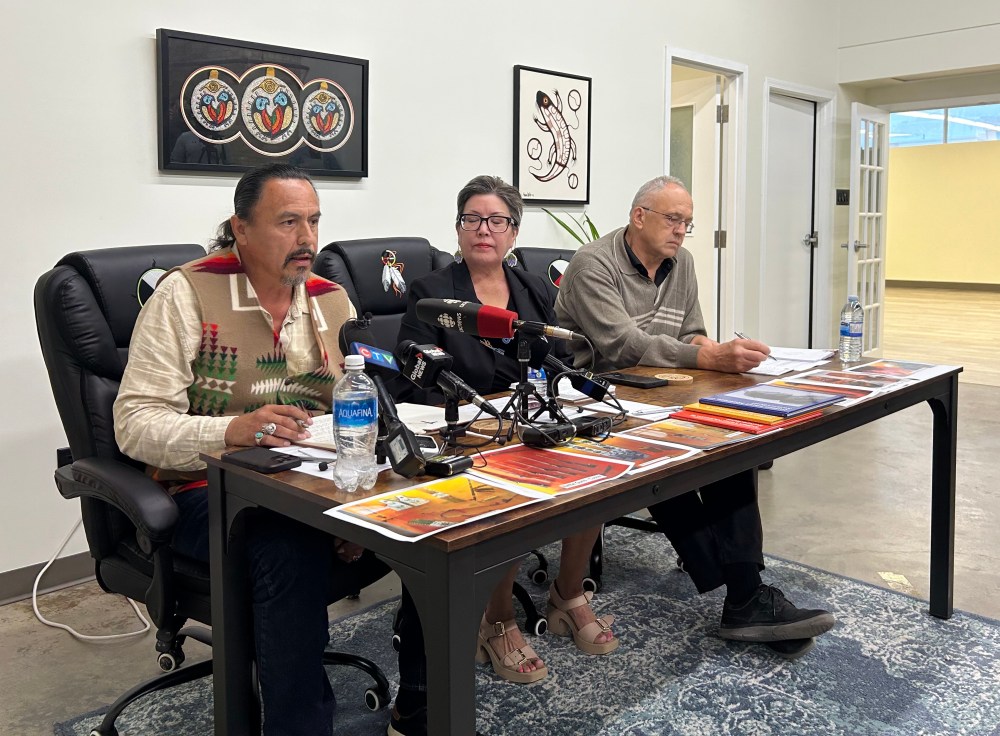
“We’ve got to do whatever it takes to reconnect our ancestral, sacred bundles back into our communities,” said Karl Stone, a councillor in Dakota Tipi First Nation, Man., referring to a group of sacred, cultural items.
“By bringing them home, that would reconnect our younger generation to the history of our people and it’ll bring back identity to who we are.”
Stone was part of the group that visited the museum a year ago after learning there could be belongings from Dakota communities in Manitoba.
Based on documentation the private collector has kept, the group has been told many of the items are believed to originate from First Nation communities in Manitoba, Saskatchewan, Alberta and Ontario, as well as Lakota nations in the United States.
The group said the owner amassed a collection of 10,000 items, with 70 per cent being Indigenous artifacts, over several decades. It is unclear how he obtained the items and how much they cost, the group said.
There has been a push in recent years for cultural institutes and religious groups to repatriate items back to First Nations, Inuit and Métis communities.
The Vatican returned several items to Indigenous groups earlier this year after a delegation visited its museum and stressed the importance of returning these artifacts.
National museums and universities across the country have also been coming to terms with their roles in holding sacred items and have been working with communities to repatriate them to traditional caretakers.
“One of our biggest fears is that if we don’t raise the money and bring all of these items back, (the collector) could put these on private auction sites and they could end up in Dubai or in New York or elsewhere in some billionaire’s office under glass as a showpiece,” said Coleen Rajotte, a Cree advocate.
The group said it needs to raise approximately $20 million – this includes the estimated cost of the artifacts and additional funds to hire experts to authenticate the items.
One of those items is a bandolier, or a belt worn across the shoulders. It stretches about 20 centimetres wide and consists of thousands of beads that create a floral design typically seen in Ojibwa and Cree designs.
Other artifacts include large, feathered headdresses and sewn, leather moccasins believed to come from Sioux tribes.
Gerald Neufeld was part of the delegation that travelled to Switzerland and has been helping advocate for the return of the collection.
The non-Indigenous, retired engineer grew up on a Manitoba First Nation and has worked with communities on efforts to trace their genealogy.
“We need to get them authenticated. We need them priced, and we need to bring them home,” he said.
Neufeld remains in contact with the seller and said he seems to be empathetic to the group’s desire to have the items returned to Indigenous communities.
He said the seller is hoping to get things settled in months, not years, or the items will be put on the market.
The private collector did not respond to an immediate request for comment.
The Canadian Press reached out to the governments of Manitoba and Canada, as well as the Assembly of First Nations, and also did not receive immediate responses.
This report by The Canadian Press was first published June 23, 2026.