
Salman Rushdie testifies at the terrorism trial of the man convicted of stabbing him
Advertisement
Read this article for free:
or
Already have an account? Log in here »
We need your support!
Local journalism needs your support!
As we navigate through unprecedented times, our journalists are working harder than ever to bring you the latest local updates to keep you safe and informed.
Now, more than ever, we need your support.
Starting at $15.99 plus taxes every four weeks you can access your Brandon Sun online and full access to all content as it appears on our website.
Subscribe Nowor call circulation directly at (204) 727-0527.
Your pledge helps to ensure we provide the news that matters most to your community!
To continue reading, please subscribe:
Add Brandon Sun access to your Free Press subscription for only an additional
$1 for the first 4 weeks*
- Enjoy unlimited reading on brandonsun.com
- Read the Brandon Sun E-Edition, our digital replica newspaper
*Your next Free Press subscription payment will increase by $1.00 and you will be charged $20.95 plus GST for four weeks. After four weeks, your payment will increase to $24.95 plus GST every four weeks.
Read unlimited articles for free today:
or
Already have an account? Log in here »
BUFFALO, N.Y. (AP) — Four years after being stabbed on an amphitheater stage, Salman Rushdie sat across a courtroom from his convicted attacker Thursday and told jurors for a second time about the ambush that nearly killed him.
The prize-winning author recalled feeling what he thought was a punch under his chin, not realizing at first that he was being stabbed.
Then “I was on the stage, lying down, with an enormous pool of blood all around me,” Rushdie testified. “It was an enormous and expansive lake of blood.”
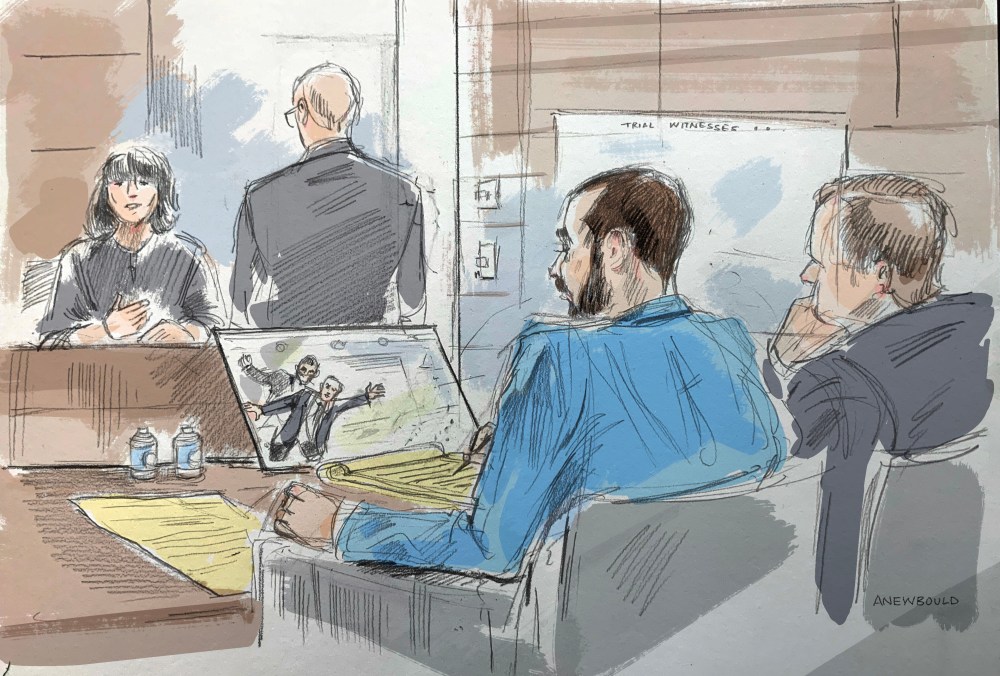
A Buffalo federal court jury watched Rushdie fixedly as he testified — and at one point removed his glasses to show his unseeing right eye — at Hadi Matar’s terrorism trial. He has pleaded not guilty.
Matar already was convicted of a state-level attempted murder charge in the 2022 attack at a cultural institution where Rushdie was poised to speak about threats to writers and artists. Federal prosecutors claim Matar was acting on such a threat — an Iranian leader’s 1989 call for Rushdie’s death because of his novel “The Satanic Verses.”
“I can’t say what his ambitions or his aim was, but the wounds were dispersed across my body,” Rushdie testified.
Rushdie, 79, was composed and straightforward during little more than an hour on the witness stand. He outlined the attack — which blinded him in one eye, damaged his liver and severed nerves in his arm — and his lengthy work to relearn daily tasks afterward. He described the stabbing and recovery previously during Matar’s earlier trial, in a memoir and in interviews with The Associated Press and other outlets.
Matar, 28, looked down at the defense table as Rushdie began testifying. Matar at times rested his hand on his chin and sometimes turned to speak to his lawyer, but not toward the witness stand, though the defendant did watch the author walk out a door. Rushdie glanced at Matar fleetingly, if at all.
Matar’s attorneys have argued that prosecutors can’t prove his intent or mindset at the time of the attack — a key element in their claim that it was an act of terrorism motivated by allegiance to Iran’s government and the Iranian-backed Hezbollah militant group.
When Matar’s lawyer asked whether Rushdie believed the defendant had ties to terrorism, the author replied: “I had no knowledge, but I had my suspicions.”
Matar faces charges that include engaging in an act of transnational terrorism. Currently serving a 25-year state prison sentence, he faces a potential life sentence if convicted in the federal case.
Iran’s late Ayatollah Ruhollah Khomeini issued the 1989 fatwa, or religious edict, calling for Rushdie to be killed over “The Satanic Verses,” which includes a dream sequence about Islam’s Prophet Muhammad that some Muslims considered blasphemous. The novel sparked often-violent protests against Rushdie, who was born into a Muslim family, and the fatwa drove him into hiding for years.
Barone, the defense lawyer, asked Rushdie Thursday whether he had anticipated blowback from the book.
“Probably, but I don’t believe the book to be on trial here. I believe someone else is on trial,” Rushdie said. At Barone’s request, the judge struck the comment from the court transcript.
Prosecutors say Matar was animated partly by comments that a former Hezbollah leader, the late Hassan Nasrallah, made about Rushdie and the fatwa in 2006. The U.S.-born Matar also holds citizenship in Lebanon, where Hezbollah is based, and Matar’s mother has said a 2018 trip there left him moody and withdrawn.
Matar started researching Rushdie in 2020 and eventually wrote to himself, “We need to kill him ASAP,” Assistant U.S. Attorney Timothy Lynch said in an opening statement Wednesday. He said Matar cast the killing as part of what he considered a jihad, or holy war.
Matar’s New Jersey bedroom and electronics held photos and other material showing his regard for Hezbollah, and he carried a fake driver’s license with a name similar to that of a Hezbollah figure, said Lynch. The U.S. government designates Hezbollah as a terrorist organization.
Matar declined to testify at his state court trial but may do so at the federal trial, Barone said outside court Thursday.
Rushdie was born in India, raised in Britain and is now a U.S. citizen. He won the Booker Prize in 1981 for his novel “Midnight’s Children.” His most recent work is “The Eleventh Hour,” a book of short stories and novellas published last year.
Iran’s government denied involvement in the 2022 stabbing, but its Foreign Ministry’s then-spokesperson suggested Rushdie invited trouble by insulting Islam. Hezbollah’s Nasrallah did not comment on the attack.
___
Peltz reported from New York.