
From folk rock to fundamental research: Dupras leads Quebec science
Advertisement
Read this article for free:
or
Already have an account? Log in here »
We need your support!
Local journalism needs your support!
As we navigate through unprecedented times, our journalists are working harder than ever to bring you the latest local updates to keep you safe and informed.
Now, more than ever, we need your support.
Starting at $15.99 plus taxes every four weeks you can access your Brandon Sun online and full access to all content as it appears on our website.
Subscribe Nowor call circulation directly at (204) 727-0527.
Your pledge helps to ensure we provide the news that matters most to your community!
To continue reading, please subscribe:
Add Brandon Sun access to your Free Press subscription for only an additional
$1 for the first 4 weeks*
- Enjoy unlimited reading on brandonsun.com
- Read the Brandon Sun E-Edition, our digital replica newspaper
*Your next Free Press subscription payment will increase by $1.00 and you will be charged $20.95 plus GST for four weeks. After four weeks, your payment will increase to $24.95 plus GST every four weeks.
Read unlimited articles for free today:
or
Already have an account? Log in here »
MONTREAL – Jérôme Dupras spent much of his twenties on the road, playing bass guitar across Quebec and beyond.
In 1997, he joined a band with friends. That summer, the folk rock group anonymously released 500 cassettes of its first album. Over the next few years, it would become Les Cowboys Fringants, one of Quebec’s most popular musical acts.
Their songs tell stories about Quebec and its people, mixing humour and nostalgia with a critical look at society.
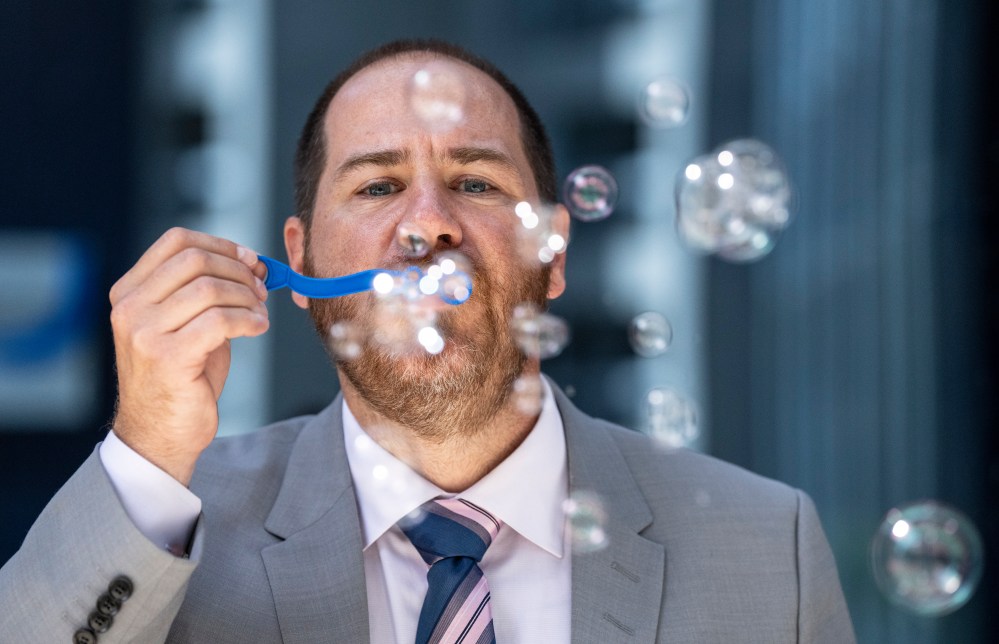
“(Touring) made me love music, but also really love Quebec, and want to talk about it elsewhere in the world,” Dupras said in an interview.
All the while, he pursued a second career in science, studying biochemistry and eventually becoming a researcher specializing in biodiversity and ecological economics. He became Quebec’s chief scientist in June, tasked with advising the government and championing research in an era of disinformation.
Now, as Quebecers prepare to elect a new government this fall, Dupras faces a challenge that brings his two sides as a musician and scientist together.
His ability to communicate beyond the scientific community could prove particularly valuable in his new job, according to members of Quebec’s research community.
One of Les Cowboys Fringants’ songs, “Plus rien,” which translates to “nothing left,” imagines a future devastated by climate change, while “8 secondes” takes aim at overconsumption and the environmental cost of modern life. Other songs explore inequality and Quebec identity — and an attachment to a place they worried was changing.
Luc-Alain Giraldeau, director general of the Institut national de la recherche scientifique, a Quebec university institution devoted to research and graduate education, said Dupras “combines scientific rigour and creativity.”
His scientific credibility and ability to reach a broad public are “an undeniable asset,” Giraldeau said, particularly at a time when disinformation is gaining ground worldwide.
Sophie Montreuil, executive director of the Association francophone pour le savoir, a Canadian organization based in Montreal that promotes French-language science and research, called Dupras’s unusual background “a great strength.”
The bassist succeeded Rémi Quirion, who held the chief scientist position since it was created in 2011.
Dupras says Quebec is at an “important crossroads,” and that its position as a research leader cannot be taken for granted.
As chief scientist and head of the Fonds de recherche du Québec, Dupras must remain politically neutral. But he is watching the election closely: “I’m curious to see what place innovation, research and science will have.”
After the election Oct. 5, his organization plans to brief the incoming government on the sector and its priorities. Among them is protecting fundamental research, which can take decades to produce practical results.
“We have areas of excellence that are recognized internationally,” he said, pointing to artificial intelligence, aerospace and environmental sciences.
But there’s no guarantee Quebec can remain a leader in those areas, Dupras said, noting how public institutions and science are coming under increasing political pressure in the United States.
“We shouldn’t think that we’re immune,” he said.
He also said the province faces a challenge in ensuring discoveries made in Quebec translate into intellectual property, companies and economic benefits that remain here.
“We really have a brain drain and capital flight,” Dupras said.
When an idea developed in Quebec attracts investment from elsewhere, and the company commercializing it ends up outside the province, he said, “the talent will follow, the products will follow, and the wealth will follow.”
Dupras also wants scientists to play a greater role in public life as social media and algorithms transform how people receive information. If researchers fail to keep pace with those changes, he said, “we risk losing ground.”
Thus, reaching young people is particularly important to him.
“Young people are a priority for me,” Dupras said. “A path in science is inspiring.”
His own path began in a family that valued education. Dupras comes from farming families on both sides and said an uncle interested in genealogy traced about 16 generations of farmers on his father’s side.
His grandfather was a farmer who emphasized education, and Dupras grew up seeing higher education as a natural possibility. He wants that opportunity to extend to everyone.
“We have to make sure everyone has the same equal chances, whether we’ve been here for 15 generations or we’re a newcomer,” he said.
He said teachers helped spark his fascination with biology and led him to biochemistry. Science became another outlet for the curiosity and creativity he had found in music, he added.
“Music and science are channels for dreaming, for being creative, for communicating with people,” Dupras said.
The two passions sometimes overlapped. In the mid-2000s, Dupras and his bandmates created the Fondation Cowboys Fringants, which supports nature conservation and the protection of threatened ecosystems in Quebec. The band’s lead singer, Karl Tremblay, died in 2023.
Both careers also took Dupras abroad and gave him a platform to promote Quebec.
Dupras sees public service as another way of giving back, and he embraces a vision that puts science at the heart of Quebec’s future.
“I’ve received so much in my life,” he said. “If, very humbly, I can give back to Quebec by serving it as a public servant, as part of the state, it’s a source of pride and a privilege.”
This report by The Canadian Press was first published Sept. 3, 2026.