
Only known woolly dog pelt returns to B.C. after more than 160 years
Advertisement
Read this article for free:
or
Already have an account? Log in here »
We need your support!
Local journalism needs your support!
As we navigate through unprecedented times, our journalists are working harder than ever to bring you the latest local updates to keep you safe and informed.
Now, more than ever, we need your support.
Starting at $15.99 plus taxes every four weeks you can access your Brandon Sun online and full access to all content as it appears on our website.
Subscribe Nowor call circulation directly at (204) 727-0527.
Your pledge helps to ensure we provide the news that matters most to your community!
To continue reading, please subscribe:
Add Brandon Sun access to your Free Press subscription for only an additional
$1 for the first 4 weeks*
- Enjoy unlimited reading on brandonsun.com
- Read the Brandon Sun E-Edition, our digital replica newspaper
*Your next Free Press subscription payment will increase by $1.00 and you will be charged $20.95 plus GST for four weeks. After four weeks, your payment will increase to $24.95 plus GST every four weeks.
Read unlimited articles for free today:
or
Already have an account? Log in here »
VANCOUVER – When Coast Salish artist Atheana Picha ran a gloved hand through the thick white pelt of an extinct woolly dog that has returned to British Columbia for the first time in more than 160 years, her thoughts turned to how her ancestors might have used the fur.
Perhaps they would have made a blanket or maybe a headband.
“And I thought, oh, it’s so amazing because this delicate material could make such beautiful blankets with the right hands,” said Picha. “As a weaver, that really resonated with me.”
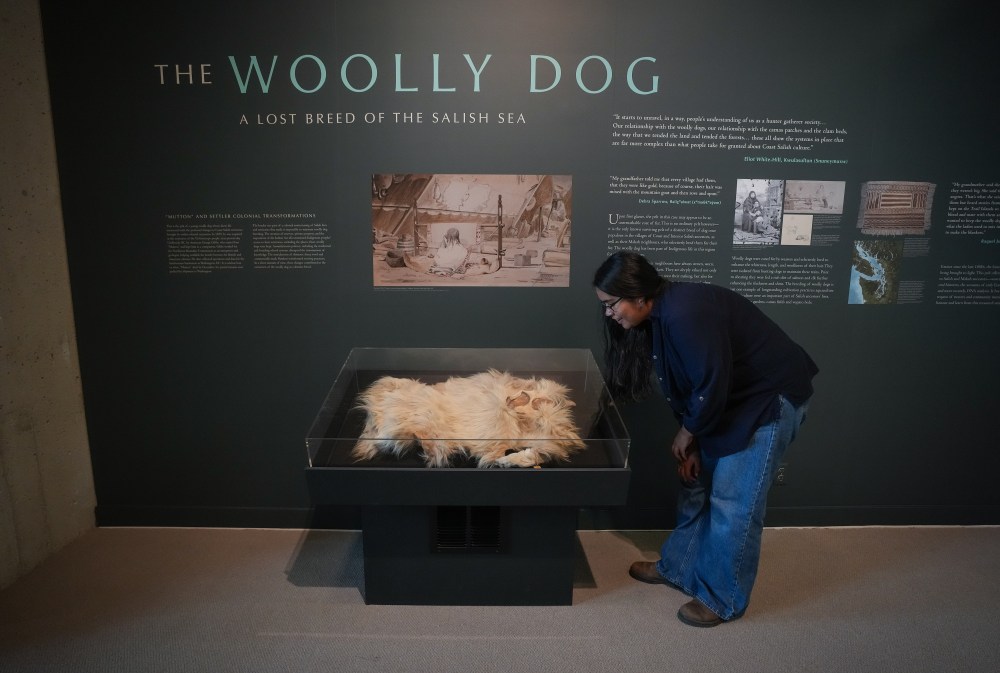
The pelt belonged to Mutton, a canine companion of American naturalist George Gibbs, and had been in the Smithsonian Institution in Washington, D.C., since Mutton died in 1859.
It’s now on display at the Museum of Anthropology at the University of British Columbia in Vancouver until next summer.
Known for their cloud-like coats, woolly dogs were bred by Coast Salish peoples for thousands of years, and were shorn like sheep for ceremonial blankets and textiles.
Debra Sparrow, a Musqueam weaver and artist, said her grandfather told her every village used to have them. The dogs were treated as though they were as valuable as gold because of their hair, which was spun after being mixed with mountain goat wool, she said in a statement.
It’s unclear how Gibbs obtained Mutton, but Jordan Wilson, curator of Pacific Northwest and Contemporary Indigenous Art at the museum, said Mutton is thought to have come from B.C.’s Lower Mainland.
Gibbs had participated in the four-year-long northwest boundary survey expedition in late 1850s to map out the international land boundary between the American Pacific Northwest and B.C.
“We know that (Mutton) came from the Chilliwack area, and we know that is part of Sto:Lo First Nation Chilliwack peoples’ territories, and so it’s close to home,” said Wilson, who is a member of the Musqueam First Nation.
Weavers and members of local Coast Salish communities had a chance to spend time with Mutton’s pelt on Friday before the display was opened to the public.
Wilson said seeing the pelt for the first time left him emotional, especially when he noticed Mutton’s little paws and nose.
“We had a lot of community members from different nations that were here this morning to visit with this pelt, and you can feel the intensity in the room and the emotion of being able to reconnect with this species that was so important to our ancestors,” Wilson said. “People were sharing stories and sharing teachings.”
Wilson said early historical accounts from explorers and fur traders described woolly dogs being transported in canoes, sometimes 10 at a time.
“Just the fact of taking these dogs with them where they went, I think underscores their importance,” said Wilson.
Wilson said Mutton’s pelt reflects a species’ extinction, one of many profound impacts of settler colonialism.
“It also speaks to the lives of our ancestors, their relationship with the more-than-human world, and their teachings and knowledge that continue to be passed forward,” he said.
A number of factors contributed to the decline and eventual extinction of woolly dogs, Wilson said, including the dispossession of land from Indigenous Peoples and the potlatch ban, implemented by the Canadian government from 1885 to 1951, to force cultural assimilation. It had a major effect on the transmission of cultural practices and knowledge, said Wilson.
But he said even though woolly dogs no longer exist, the Indigenous cultures and values can still be carried on.
A statement from the University of B.C. said interest in woolly dogs is booming as Salish weaving experiences a resurgence, prompting researchers to study the textiles to understand the dogs’ role in Salish and Makah weaving traditions.
Picha said it was a beautiful experience to touch Mutton’s fur.
“Very honestly, the first thing I thought was, ‘Oh, it’s bigger than I imagined.’ But then I think about when it’s wrapped around the body of a dog, it would be a cute little thing,” said Picha.
She said the fur felt a little brittle, given its age, but even through a glove she could feel it was soft, “a little bit squishy … It was nice.”
Picha said she had heard stories from her parents and grandparents about the important role in their community played by woolly dogs, which were tended “very carefully.”
“We nourished them with a very specific diet (consisting of salmon and elk) so that their hair would get long and smooth and soft. And I think about how much care and love was put into these dogs, but how much they also gave to us,” she said.
This report by The Canadian Press was first published Sept. 8, 2026.