
Movie Review: Falling rocks, avalanches, heroism and greed converge in ‘The Last First: Winter K2’
Advertisement
Read this article for free:
or
Already have an account? Log in here »
We need your support!
Local journalism needs your support!
As we navigate through unprecedented times, our journalists are working harder than ever to bring you the latest local updates to keep you safe and informed.
Now, more than ever, we need your support.
Starting at $15.99 plus taxes every four weeks you can access your Brandon Sun online and full access to all content as it appears on our website.
Subscribe Nowor call circulation directly at (204) 727-0527.
Your pledge helps to ensure we provide the news that matters most to your community!
To continue reading, please subscribe:
Add Brandon Sun access to your Free Press subscription for only an additional
$1 for the first 4 weeks*
- Enjoy unlimited reading on brandonsun.com
- Read the Brandon Sun E-Edition, our digital replica newspaper
*Your next Free Press subscription payment will increase by $1.00 and you will be charged $20.95 plus GST for four weeks. After four weeks, your payment will increase to $24.95 plus GST every four weeks.
Read unlimited articles for free today:
or
Already have an account? Log in here »
“He has to go and live on the edge,” explains Lina Móey about her husband, the Icelandic mountaineer John Snorri Sigurjonsson, in “The Last First: Winter K2.”
And she means it literally: He has to go live on the edge of a mountain.
In this case, it’s the most forbidding mountain on the planet: K2, on the border between Pakistan and China. Sigurjonsson, one of the main figures profiled in Amir Bar-Lev’s engrossing and sobering documentary, was already a celebrated climber when he returned to K2, the world’s second-highest peak after Mount Everest. He had scaled it in summertime. Now, four years later, Sigurjonsson aimed to scale it in winter.
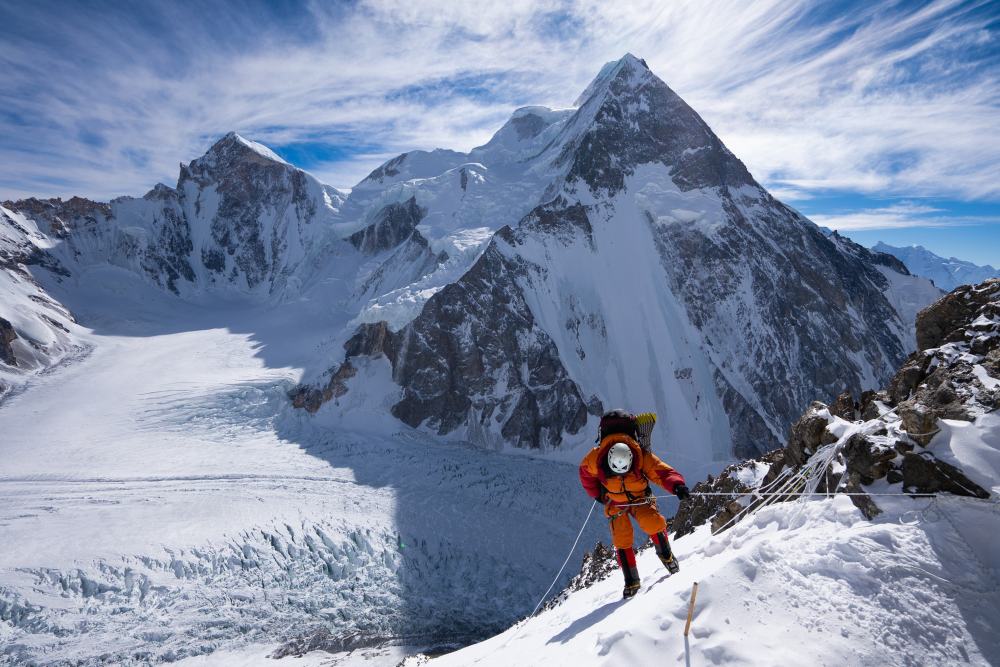
That’s a feat no climber had ever achieved on what one expert calls a “savage mountain.” But that winter in 2021, as Pakistan eased pandemic-era border restrictions, dozens of climbers — veterans and novices alike — saw a chance to achieve that “last first” in extreme climbing.
Ultimately, 10 would make the summit. But Bar-Lev’s film is far from the usual inspiring look at how determination and grit resulted in a triumph of spirit and body.
It’s a movie that instead looks at the cynical opportunism that has led to a dangerous — and in this case, utterly catastrophic — commercialization of extreme climbing.
That there were deaths on the 2021 climb is well-documented. But Bar-Lev, who has pieced together some extraordinarily intimate footage (he himself did not shoot on site), chooses to assume the viewer doesn’t know, keeping the final tragedy a mystery until the end.
His message comes through immediately, though, in a pre-credits sequence. We hear the crackling of a radio, and the voice of American climber Colin O’Brady, far up the mountain.
“I want to be on the record, I’m very worried about people’s safety,” O’Brady says. “Please, please, please help.”
We then go back two months, with Sigurjonsson saying an emotional goodbye to Moey and their six children as he departs Iceland on his dream mission.
“Finally this day has come,” he writes on Facebook.
Once at K2 base camp, he bonds with his team: noted Pakistani climber Ali Sadpara and his son, Sajid. The trio starts the slow process of acclimating to the mountain air and preparing for the ordeal ahead.
There’s laughter, some quips about urine freezing midair, even a bit of dancing.
Then the Nepali team arrives. Their star, Nimsdai Purja, is on his own mission: making history for his nation. Historically, climbers from Nepal have been crucial in helping Westerners reach climbing greatness, with no glory for themselves.
So, though Purja gives Ali a big hug upon arrival and all seems collegial, there are sharp egos at stake, and nationalist pride.
“Nimsdai,” one climber says, “was there to win it.” And he did — though his team seemingly betrayed the others to do it, setting off alone one morning despite an agreement with Sigurjonsson and the Sadparas to summit together.
We see the trio’s reaction in their tent: shock and disappointment. “It was over,” says Moey.
Not long after, an experienced climber dies in a fall. Now, there’s talk of everyone going home. But things get complicated. Pakistani officials arrive for a visit and make it clear the country is counting on their two countrymen to show they can match the Nepalis.
On top of that, filmmaker Elia Saikaly has arrived, planning a movie on Ali Sadpara and his heroic attempt.
Says Moey: “There was so much pressure on them.”
Meanwhile, the true villain of the tale — the travel company Seven Summit Treks — has brought a group of fee-paying clients, many woefully inexperienced. And ill-equipped: When they reach Camp Three, from where climbers make the final push to the summit, they lack tents and food to survive the night.
So they plead their way into the tents of more experienced climbers, making it impossible for them to get any rest or prepare properly.
The next day, only three climbers make a final push to the summit.
There’s some deeply poignant footage here. Some of it — such as people learning close friends or partners have died — was apparently too intimate to make the final cut.
But such personal moments are key to keeping the film moving. And they show how the risks of climbing K2 in winter extend far beyond falling rocks, avalanches, killer storms and deathly cold.
They include human qualities like jealousy, competitiveness, and ego.
As one climber says: “Mountaineering is not only a discovery of the mountain — it’s a discovery of yourself.”
But for us, it’s also uncomfortable to be so close to such tragedy. As filmmaker Saikaly himself says at one point: “I had gone overboard. What am I doing right now? Nobody wants to see a camera.”
“The Last First: WinterK2,” an Apple TV release, is unrated by the Motion Picture Association. Running time: 98 minutes. Three stars out of four.