
Anne Carson 101: Where experts suggest starting in the new Nobel laureate’s oeuvre
Advertisement
Read this article for free:
or
Already have an account? Log in here »
We need your support!
Local journalism needs your support!
As we navigate through unprecedented times, our journalists are working harder than ever to bring you the latest local updates to keep you safe and informed.
Now, more than ever, we need your support.
Starting at $15.99 plus taxes every four weeks you can access your Brandon Sun online and full access to all content as it appears on our website.
Subscribe Nowor call circulation directly at (204) 727-0527.
Your pledge helps to ensure we provide the news that matters most to your community!
To continue reading, please subscribe:
Add Brandon Sun access to your Free Press subscription for only an additional
$1 for the first 4 weeks*
- Enjoy unlimited reading on brandonsun.com
- Read the Brandon Sun E-Edition, our digital replica newspaper
*Your next Free Press subscription payment will increase by $1.00 and you will be charged $20.95 plus GST for four weeks. After four weeks, your payment will increase to $24.95 plus GST every four weeks.
Read unlimited articles for free today:
or
Already have an account? Log in here »
Where do you start with Anne Carson, the newly minted Nobel literature laureate?
The Toronto-born writer has more than 20 books under her belt, including collections of poems and essays — and essays that are essentially poems. She’s known to blend and bend genre, while infusing the ancient with the modern.
Some of her work can sound pretty intimidating, so to help newbies out, The Canadian Press asked a handful of experts where they’d recommend starting with Carson’s oeuvre.
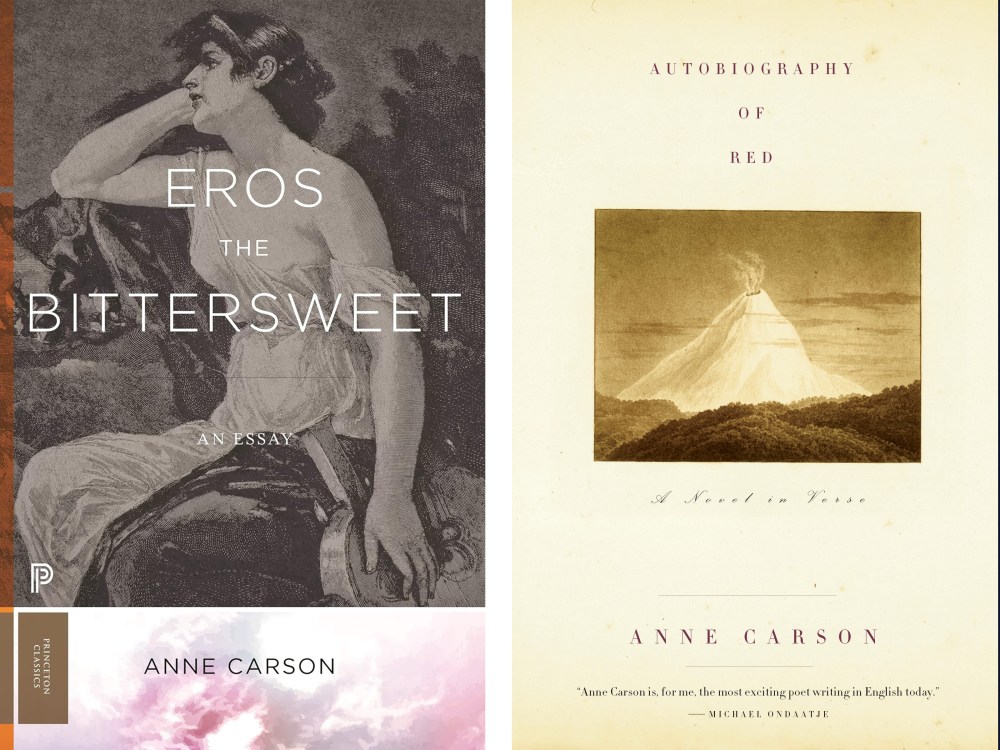
“Eros the Bittersweet”
Start at the beginning, says Louis Ruprecht, director of the Hellenic Studies Institute at Georgia State University. “Eros the Bittersweet” was Carson’s debut. It’s a meditation on love in ancient Greek literature and philosophy, and Ruprecht says it sets the stage nicely for the rest of her work.
“You see so many themes there developed in an extremely … inviting and inclusive way of engaging in deep reflection. And it shows you a lot of themes she will return to over and over again,” he said by phone from Atlanta.
“It’s only 173 pages long and it accomplishes more in that than a lot of people accomplish in a lifetime. And it’s so beautifully written, it draws you in and it’s actually easy to get into. So I say start where she started.”
“Autobiography of Red”
Carson’s 1998 novel in verse is one of several picks Elizabeth Harvey lists off. The retired University of Toronto English professor says there’s a Carson for every person and every mood.
“‘Autobiography of Red’ is often cited because it has a narrative that is very engaging about a monster with red wings,” she said. (Narrative is not always a given in Carson’s work.)
The book is a reimagination of the 10th labour of Hercules, in which he must steal the red cattle of Geryon. Carson tells Geryon’s life story starting from when the winged red monster is a little boy.
“Float”
“Float” is a collection of 22 chapbooks of varying lengths, enclosed in a transparent slipcase. They are not in any particular order and the pages don’t have numbers, so there’s no way to refer to them.
This is another of Harvey’s picks.
“The idea is that the experience of reading is a kind of floating and a kind of randomness, which she encourages. And I think it also speaks to the playful aspect of her writing,” Harvey said.
“Short Talks”
Concetta Principe, an assistant professor of English at Trent University, suggests beginning in the same place she did: “Short Talks.”
This was Carson’s first poetry collection and true to its name, it is very short, said Principe.
“It’s something like 90 pages,” she said. “They’re prose poems. They are totally accessible and the paradoxes that you find there, I think, are quintessential Carson.”
This report by The Canadian Press was first published Oct. 8, 2026.