
Movie Review: In the family drama ‘Gentle Monster,’ the evil is coming from inside the house
Advertisement
Read this article for free:
or
Already have an account? Log in here »
We need your support!
Local journalism needs your support!
As we navigate through unprecedented times, our journalists are working harder than ever to bring you the latest local updates to keep you safe and informed.
Now, more than ever, we need your support.
Starting at $15.99 plus taxes every four weeks you can access your Brandon Sun online and full access to all content as it appears on our website.
Subscribe Nowor call circulation directly at (204) 727-0527.
Your pledge helps to ensure we provide the news that matters most to your community!
To continue reading, please subscribe:
Add Brandon Sun access to your Free Press subscription for only an additional
$1 for the first 4 weeks*
- Enjoy unlimited reading on brandonsun.com
- Read the Brandon Sun E-Edition, our digital replica newspaper
*Your next Free Press subscription payment will increase by $1.00 and you will be charged $20.95 plus GST for four weeks. After four weeks, your payment will increase to $24.95 plus GST every four weeks.
Read unlimited articles for free today:
or
Already have an account? Log in here »
“Gentle Monster” lets you fall a little bit in love with Lucy, Philip and their young son Johnny, before blowing everything up. This is a film about moral and societal evils and the webs we might spin to give a loved one the benefit of the doubt. Filmmaker Marie Kreutzer is not interested in letting the audience off the hook with a villain that looks like a villain.
Instead, Philip (Laurence Rupp) seems to be a loving father to Johnny (Malo Blanchet) and partner to Lucy ( Léa Seydoux ), a popular avant garde musician who plays experimental covers of well-known songs. Philip is a filmmaker who has had to work in television to pay the family bills. And we meet them in a moment of transition — Lucy has been practicing at the piano, a slowed down, melancholy version of Charles & Eddie’s “Would I Lie To You” when Philip comes home sobbing. He is in the midst of some kind of breakdown.
We next see them relocating to a peaceful home in the German countryside, where they make love on a mattress on the floor, build a trampoline for Johnny and talk about getting rid of their cellphones altogether. It is a quiet, peaceful and bohemian life and there is evident love and joy in this family. And then, one day, several police cars descend on the house with a warrant to confiscate Philip’s computer and hard drives. He’s ashen but does not seem to protest. This is a man who knows why the police are there. Lucy does not.
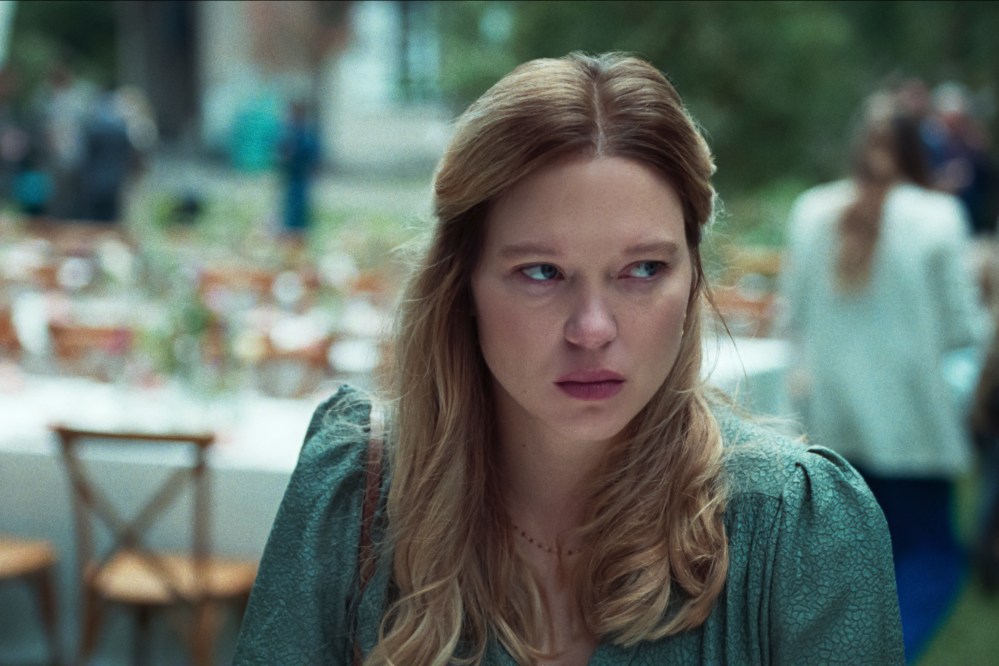
But we’ll all learn together when she heads to the police station and looks for department K17. In the elevator she pushes the button for the second floor. K17, we discover, deals in sexualized violence against children and child sexual abuse images. She’s barely had time to register the words when the elevator door cruelly opens and she wanders into the office in a daze.
Philip has left and she gazes out through a window to see him in the parking lot, with his lawyer, lighting a cigarette. But he quit smoking, she says.
An officer, a young woman, Elsa Kuhn (Jella Haase), informs Lucy that Philip is active in online forums, and there’s an investigation into whether he may have produced content himself. This is about 20 minutes into a nearly two-hour film in which we and Lucy process this information.
Lucy leaves their countryside home with Johnny immediately, going straight to her mother’s house ( Catherine Deneuve plays mom), but avoids telling her, or anyone else, the specifics of this sudden separation. She is, you suspect, holding out hope that it’s all a big misunderstanding, that there is some explanation and that she’d rather not risk having their friends and family know anything. It’s also certainly a bit of denial, and she’s eager to grasp at threads that might make it a little less bad in her mind. But really, how much solace is there in believing that Philip might have done it for money instead of pleasure? And then there is the looming question of whether Johnny might also be a victim.
Seydoux is movingly understated in this difficult film and role, with the camera often lingering on her face in harsh close-up. There are no obvious Oscar reels here, monologues or breakdowns. Instead, she masterfully draws you in and keeps your attention in a slow-burn film where not all that much happens.
We also get a bit of a glimpse into Elsa’s home life, where her senile father seems to be developing a habit of harassing his female caretakers. Elsa, for whom the issue is so black and white in her job, offers a nurse on her way out the door more money to stay and look the other way.
Kreutzer, the Austrian writer-director, was inspired to start working on this idea by distressing reports of a pedophile network in Germany. Then she too found herself uncomfortably close to the situation. A principal actor in her excellent Empress Elisabeth film “Corsage,”
Florian Teichtmeister, was charged with possessing and producing child sex abuse images and would be found guilty.
Some have criticized “Gentle Monster” for not digging deeper, for not offering any resolution, for positing the uncomfortable idea that we’re the ones who are enabling the villains and maybe even suggesting that no men are to be trusted.
I don’t think Kreutzer is saying that all men are secret pedophiles or sex pests, even if you might walk out of “Gentle Monster” with that gnawing feeling. Lines blur when loved ones are involved, and mothers will always want to protect their sons.
There’s always that neighbor who will say things like “he was always nice to me” or “he was the last guy I’d suspect would do this.” “Gentle Monster” is a film that wants you to question your own complicity, to remove the blinders that obscure and excuse and to just look a little more closely at our world. Similar to Lucy’s songs, it’s a deconstructed social horror in a minor, haunting key.
“Gentle Monster,” a Netflix release in theaters Friday and streaming Nov. 18, is rated R by the Motion Picture Association for “graphic nudity, some language and sexuality.” Running time: 114 minutes. Three stars out of four.