
Flooded farmers’ seeding plans in jeopardy
Advertisement
Read this article for free:
or
Already have an account? Log in here »
We need your support!
Local journalism needs your support!
As we navigate through unprecedented times, our journalists are working harder than ever to bring you the latest local updates to keep you safe and informed.
Now, more than ever, we need your support.
Starting at $15.99 plus taxes every four weeks you can access your Brandon Sun online and full access to all content as it appears on our website.
Subscribe Nowor call circulation directly at (204) 727-0527.
Your pledge helps to ensure we provide the news that matters most to your community!
To continue reading, please subscribe:
Add Brandon Sun access to your Free Press subscription for only an additional
$1 for the first 4 weeks*
- Enjoy unlimited reading on brandonsun.com
- Read the Brandon Sun E-Edition, our digital replica newspaper
*Your next Free Press subscription payment will increase by $1.00 and you will be charged $20.95 plus GST for four weeks. After four weeks, your payment will increase to $24.95 plus GST every four weeks.
Read unlimited articles for free today:
or
Already have an account? Log in here »
Hey there, time traveller!
This article was published 29/04/2011 (5652 days ago), so information in it may no longer be current.
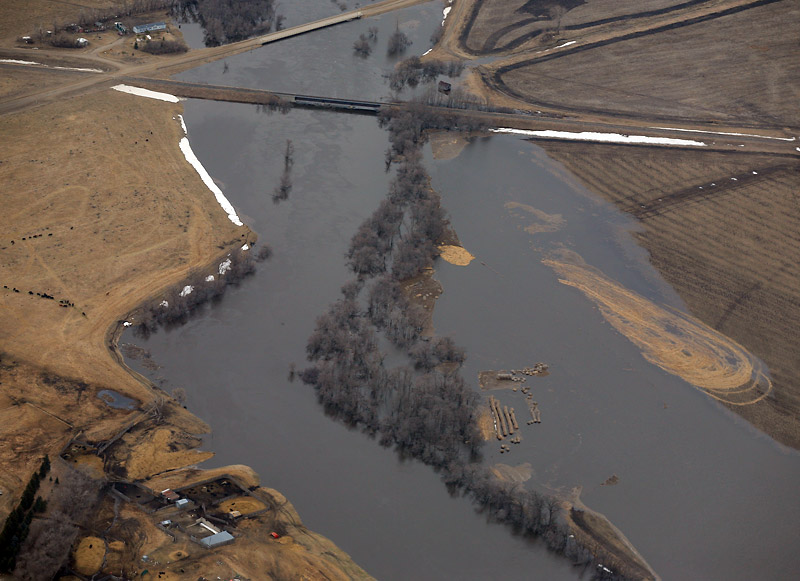
With all of the flood water in the Assiniboine and Souris River valleys, farmers may not get access to their land in time to seed their crops in May.
Flooding in the Assiniboine River valley could last for between six to eight weeks because of high water volumes in the watershed in Saskatchewan, said Steve Topping, Manitoba Water Stewardship’s executive director for regulatory and operational services.
The Souris River will also see "extended or prolonged" high water for five to seven weeks before the water recedes within its banks, Topping said.
Two reservoirs in Saskatchewan that feed the Souris are high, with the Rafferty Reservoir near Estevan spiking up a metre on Thursday to 554 metres above sea level, according to the Saskatchewan Watershed Authority website. At the Alameda Reservoir near Alameda, water levels continue to rise above 564 metres above sea level.
"They just started to release at 2,500 cubic feet per second in the last few days," Topping said. "Those flows take approximately two to three weeks before they reach the Assiniboine River."
The water flows along the Assiniboine River this flood season are projected to be 50 per cent higher than the 1976 flood of record, said Steve Ashton, Manitoba’s infrastructure and transportation minister. Those levels are impacted by the Qu’Appelle River and the Assiniboine River at Kamsack, Sask., where flows are approximately 13,240 cubic feet per second.
At this point, neither Ashton nor Topping are prepared to say how many acres of farmland are under water. However, last year’s wet growing season left about 10 million acres across the Prairies unseeded, said Bruce Burnett, the Canadian Wheat Board’s director of weather and crop surveillance. This year’s flood impact on agriculture is not yet known.
"You would have to be an extreme optimist to think that in Western Canada, we’ll plant all of our area," Burnett said. "We think between two and five million acres likely will be unseeded depending on weather co-operation."
Burnett said seeding delays are currently 10 days to three weeks behind the normal across the Prairies, and weather will have an impact on how quickly farmers get on their fields.
"We need to get warm, dry weather to get planting started in all three Prairie provinces," Burnett said.
"In Manitoba, seeding may start the second or third week of May in the areas that are flooding. It will take significantly longer for those areas to dry out."
Last year, 15 per cent of Manitoba’s crops were in the ground, nowhere near this year’s numbers. Burnett said the worst-case scenario is another season where 10 million available acres go unseeded in Western Canada because of moisture.
That’s especially bad news for farmers that can’t take advantage of above average commodity prices.
Yesterday’s Canadian Wheat Board flex-pro contract price for No. 1 Canada Western Red Spring Wheat (13.5) reached $360.55 per metric tonne.
"When you are covered by water until the end of May, it’s devastating to your production year because you have lost the most important seeding window you have," said Doug Chorney, president of the Keystone Agricultural Producers.
"Later in the season, you start to see more disease problems because of the weather and growing seasons we’ve been getting. You really see this in oats, where you see a drop in quality rapidly, and the weight and milling quality is affected."
A Bank of Montreal study entitled Canadian Agricultural Prospects projected the agriculture sector of the economy would grow between 3.5 to four per cent this year. However, those numbers were crunched before flood season hit Alberta, Saskatchewan and Manitoba.
"The data there assumes a status quo status, and the flooding is a wild card," said David Rinneard, BMO’s national manager for agriculture.
"Alberta and to a lesser extent, Saskatchewan is starting to dry out. Compounding the flooding problem is last year was not a good one for eastern Saskatchewan and parts of Manitoba. It’s been a trying time."
According to BMO economists, crop production dropped 3.5 per cent in 2010 because of excessive moisture.
"Flooding will have a negative impact on the agricultural sector if the weather doesn’t turn around," Rinneard said.