
Theories abound on how Hoop and Holler got its name
Advertisement
Read this article for free:
or
Already have an account? Log in here »
We need your support!
Local journalism needs your support!
As we navigate through unprecedented times, our journalists are working harder than ever to bring you the latest local updates to keep you safe and informed.
Now, more than ever, we need your support.
Starting at $15.99 plus taxes every four weeks you can access your Brandon Sun online and full access to all content as it appears on our website.
Subscribe Nowor call circulation directly at (204) 727-0527.
Your pledge helps to ensure we provide the news that matters most to your community!
To continue reading, please subscribe:
Add Brandon Sun access to your Free Press subscription for only an additional
$1 for the first 4 weeks*
*Your next subscription payment will increase by $1.00 and you will be charged $20.00 plus GST for four weeks. After four weeks, your payment will increase to $24.00 plus GST every four weeks.
Read unlimited articles for free today:
or
Already have an account? Log in here »
Hey there, time traveller!
This article was published 12/05/2011 (5441 days ago), so information in it may no longer be current.
HOOP AND HOLLER BEND — As recently as Mother’s Day, this obscure stretch of highway along the Assiniboine River was unknown to almost everyone outside the Portage la Prairie area.
But that all changed when Manitoba Water Stewardship decided to make Hoop and Holler Bend the site of the riskiest manoeuvre of the 2011 flood fight — the now-infamous “controlled breakout” of the Assiniboine River into the La Salle River watershed.
While many Manitobans remain transfixed upon the question of what will happen when the Hoop and Holler Cut is finally made, another question of vital importance remains unanswered.
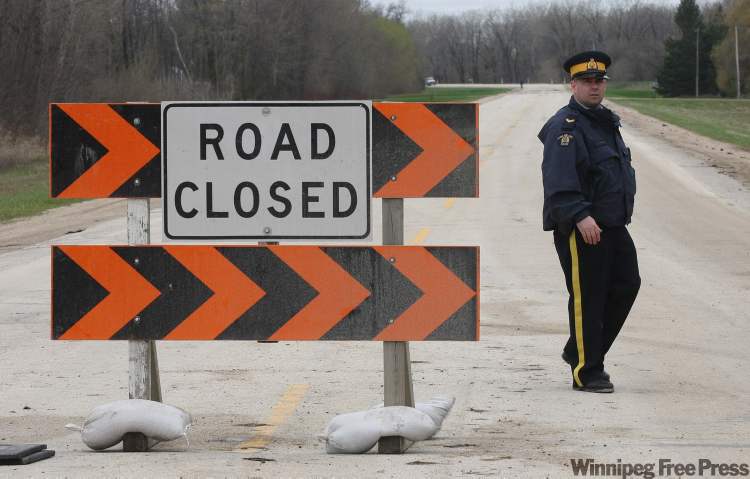
Specifically, why does this non-descript stretch of Provincial Road 331 southeast of Portage deserve its own place name on the central Manitoban road map? And how did it get that name in the first place?
The answer depends on who you talk to in the area. Here are the leading three theories, according to residents of the rural municipality of Portage la Prairie:
1. The Barn-Dance Theory
According to the most popular theory, Hoop and Holler Bend was once the site of a party venue that saw the locals hoot and holler. In some variations, this was just a barn where impromptu parties were held. In others, it was an actual club. Still others suggest it was just a bend in the road where teenagers held parties.
2. The Phantom Barn-Dance Theory
A minority account suggests a supernatural origin to the name. According to this account, there was indeed a popular barn at Hoop and Holler Bend, but the venue wound up getting burned down. Years later, you can still hear the hooting and hollering, even though no revellers remain.
3. The Kids-in-the-Back Theory
The least exciting etymology of Hoop and Holler Bend involves simple geography. According to this theory, children riding in the back of horse-driven buggies back in the day would shout excitedly when their vehicles rounded the bend in the road.
Where does the truth lie? Perhaps someone has the definitive answer. Feel free to write to letters@freepress.mb.ca.
bartley.kives@freepress.mb.ca
Related Articles
Deliberate dike breach delayed until Saturday
Advertisement Advertise With Us