
Producer: Livestock plan ‘doesn’t make sense’
Advertisement
Read this article for free:
or
Already have an account? Log in here »
We need your support!
Local journalism needs your support!
As we navigate through unprecedented times, our journalists are working harder than ever to bring you the latest local updates to keep you safe and informed.
Now, more than ever, we need your support.
Starting at $15.99 plus taxes every four weeks you can access your Brandon Sun online and full access to all content as it appears on our website.
Subscribe Nowor call circulation directly at (204) 727-0527.
Your pledge helps to ensure we provide the news that matters most to your community!
To continue reading, please subscribe:
Add Brandon Sun access to your Free Press subscription for only an additional
$1 for the first 4 weeks*
- Enjoy unlimited reading on brandonsun.com
- Read the Brandon Sun E-Edition, our digital replica newspaper
*Your next Free Press subscription payment will increase by $1.00 and you will be charged $20.95 plus GST for four weeks. After four weeks, your payment will increase to $24.95 plus GST every four weeks.
Read unlimited articles for free today:
or
Already have an account? Log in here »
Hey there, time traveller!
This article was published 14/07/2011 (5581 days ago), so information in it may no longer be current.
Westman livestock producers were shut out of a federal government tax relief plan for farmers suffering from flooded-out land.
The federal tax relief plan will be allocated to municipalities primarily around Lake Manitoba and offers income tax deferrals on the sale of breeding livestock for one year.
Herds reduced by 15 per cent qualified for a 30 per cent tax deferral, while herds reduced by 30 per cent or more qualified for a 90 per cent tax deferral.
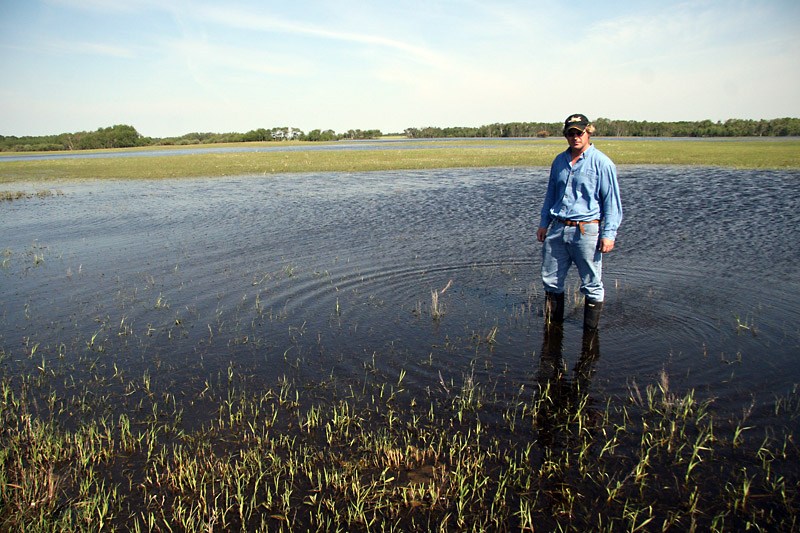
"They should allow the tax deferral on your feeder calves instead, and maintain your productive capacity," said Terry Schuddemat, a cattle producer who has land in the RM of Cameron and RM of Albert, 27 kilometres northwest of Melita. "What this is doing is selling off your productive capacity and deferring tax on that in hopes that you can buy it back another year. This doesn’t make sense. They could have deferred (tax) on calves, or something else. If people sell now, because they don’t have the feed for them, they won’t be buying later and now they are stuck paying income tax on them."
Instead, a similar compensation package to the one offered to grain producers — a $30-per-acre payout for excess moisture — would be more useful.
"I wish we could have been treated equally to my grain operation," Schuddemat said. "I have pasture acres under four feet of water and grain land that’s under four feet of water and the grain land is eligible for $65-per-acre from crop insurance and another $30 from the government. So far, we haven’t heard anything for our pasture acres. It would be nice to get something similar for our cattle acres."
The tax deferral program may be a first step towards further assistance for farmers, said Patrick Girard, a senior Agriculture and Agri-Food Canada spokesman.
"Additional assessments will be conducted to determine what other areas will be added later in the season," Girard said in an email.
Arthur-Virden Conservative MLA Larry Maguire said previous agriculture support programs have been revised to include as many of the affected farmers as possible.
"These things are cut and dried but I am hoping they continue to look at southwestern Manitoba in regards to the seriousness of this situation," Maguire said. "The nature of the rainfall we’ve had was so much that we had overland flooding. It was way worse than we had in 1995."
Maguire said the overland flooding, overfilled aquifers and overflowing creeks and rivers in Westman aren’t the same as the artificial flooding suffered by Lake Manitoba area communities, but a flood’s a flood.
"We do have a tremendous amount of flooding here in the Souris River and the Assiniboine River valley, and there’s a lot of hay land and pasture land that won’t be available at all this year," Maguire said. "There’s overland flooding that won’t likely dry up in time to allow for proper pasturing of cattle, or produce hay that can be taken off this year."
Flooding issues are acute in the RMs of Albert, Edward, Arthur, Brenda, Winchester, Morton, Cameron, Sifton Glenwood and Pipestone, where producers, "basically don’t have any pasture and have no hay because it’s all under water," said Glen Franklin a Keystone Agriculture Producers director, who will be at KAP’s general council meeting in Brandon today.
Franklin said this issue will likely be part of the discussions at today’s KAP meeting, where various stakeholders within the agriculture sector will gather to discuss matters of interest.