
Channel progressing, secondary one in works
Sub-channel would drain right into Lake Winnipeg
Advertisement
Read this article for free:
or
Already have an account? Log in here »
We need your support!
Local journalism needs your support!
As we navigate through unprecedented times, our journalists are working harder than ever to bring you the latest local updates to keep you safe and informed.
Now, more than ever, we need your support.
Starting at $15.99 plus taxes every four weeks you can access your Brandon Sun online and full access to all content as it appears on our website.
Subscribe Nowor call circulation directly at (204) 727-0527.
Your pledge helps to ensure we provide the news that matters most to your community!
To continue reading, please subscribe:
Add Brandon Sun access to your Free Press subscription for only an additional
$1 for the first 4 weeks*
- Enjoy unlimited reading on brandonsun.com
- Read the Brandon Sun E-Edition, our digital replica newspaper
*Your next Free Press subscription payment will increase by $1.00 and you will be charged $20.95 plus GST for four weeks. After four weeks, your payment will increase to $24.95 plus GST every four weeks.
Read unlimited articles for free today:
or
Already have an account? Log in here »
Hey there, time traveller!
This article was published 12/10/2011 (5451 days ago), so information in it may no longer be current.
WORK on a channel to lower swollen Lake St. Martin and Lake Manitoba is going so swimmingly that engineers are already contemplating construction of a secondary outlet to boost its efficiency.
The sub-channel would divert water from Buffalo Creek directly into Lake Winnipeg, easing pressure on the Dauphin River. Work could begin later this fall or over winter.
Favourable fall weather has given the province confidence that it can complete its ambitious $100-million emergency channel by Nov. 1.
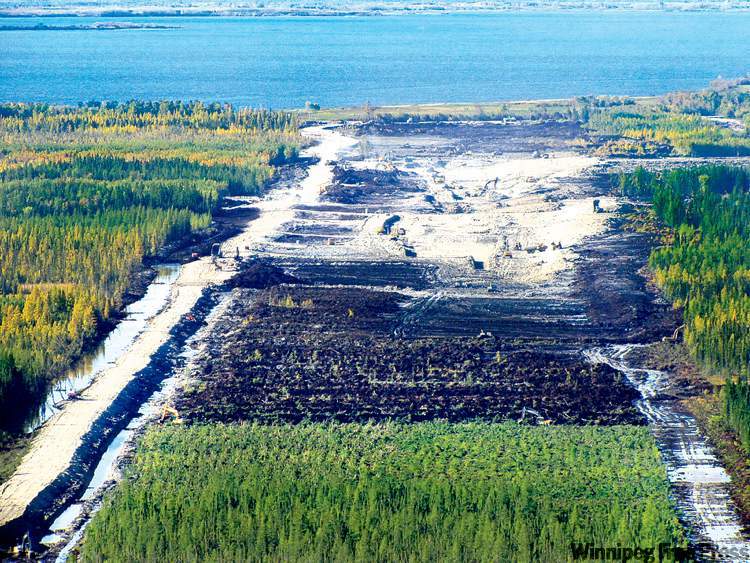
Engineers are looking at moving up construction of the sub-channel, although a final decision has not yet been made, said Paul White, a spokesman for the provincial Water Stewardship department.
When completed, the second outlet would make the new main channel more efficient, especially during spring runoff. “It’s like putting a second drain in your bathtub. You’d drain it a lot faster,” White said.
Premier Greg Selinger said Tuesday the secondary drain would not necessarily put the project over budget. “They still think they can do it for $100 million,” he said of the project’s managers.
Selinger briefed Prime Minister Stephen Harper about the channel and other emergency flood mitigation and relief work before the Winnipeg Jets’ inaugural game at the MTS Centre on Sunday. The two leaders also discussed the Canadian Wheat Board, the Port of Churchill, health-care funding — and, of course, hockey. “It did seem to come up once or twice,” the premier joked on Tuesday.
Earlier this year, the province pegged the cost of flood-fighting and compensation programs for the 2011 flood at $632 million. Manitoba anticipates Ottawa will cover about $478 million of that. (The overall estimate is expected to rise as the full extent of the flood damage is assessed.)
Selinger said he and Harper did not get into detail on who will pay for what. “I just gave him a big-picture look at what we’re doing and why we’re doing it.”
The premier said senior provincial bureaucrats have been keeping their federal counterparts informed on the ambitious outlet channel and projected disaster financial assistance (DFA) payments. He said the talks have been cordial and that Ottawa will soon front up to $100 million to the province, which has been using its own money, so far, to make DFA payments and make emergency road repairs.
Meanwhile, Selinger said that while Manitoba is adamantly opposed to Ottawa’s decision to pass a law to eliminate the Canadian Wheat Board’s marketing monopoly, the premier and the prime minister did find some “common ground” in the need to keep the Port of Churchill viable. The wheat board is the northern port’s biggest customer.
Selinger said he also made sure Harper was aware of the potential impact on CWB corporate head office jobs in Winnipeg from a greatly changed wheat board.
larry.kusch@freepress.mb.ca