
‘It’s just magical’: Lots to see in Iceberg Alley off northern Newfoundland
Advertisement
Read this article for free:
or
Already have an account? Log in here »
We need your support!
Local journalism needs your support!
As we navigate through unprecedented times, our journalists are working harder than ever to bring you the latest local updates to keep you safe and informed.
Now, more than ever, we need your support.
Starting at $15.99 plus taxes every four weeks you can access your Brandon Sun online and full access to all content as it appears on our website.
Subscribe Nowor call circulation directly at (204) 727-0527.
Your pledge helps to ensure we provide the news that matters most to your community!
To continue reading, please subscribe:
Add Brandon Sun access to your Free Press subscription for only an additional
$1 for the first 4 weeks*
- Enjoy unlimited reading on brandonsun.com
- Read the Brandon Sun E-Edition, our digital replica newspaper
*Your next Free Press subscription payment will increase by $1.00 and you will be charged $20.95 plus GST for four weeks. After four weeks, your payment will increase to $24.95 plus GST every four weeks.
Read unlimited articles for free today:
or
Already have an account? Log in here »
Hey there, time traveller!
This article was published 27/06/2016 (3600 days ago), so information in it may no longer be current.
ST. ANTHONY, N.L. – It’s not quite peak iceberg season and already people from around the world are heading to tiny St. Anthony in northeastern Newfoundland for one of the best spectacles in years.
“People are just amazed,” said Paul Alcock, who for 19 years has led Northland Discovery Boat Tours. “They’ve heard of icebergs all of their life, especially I guess after watching the movie ‘Titanic.'”
There are more than 20 icebergs not far from the rocky Northern Peninsula coastline instead of the usual 10 or so, he said. Among them is a mammoth tabular slab Alcock estimates is about 215 metres long and 21 metres high.
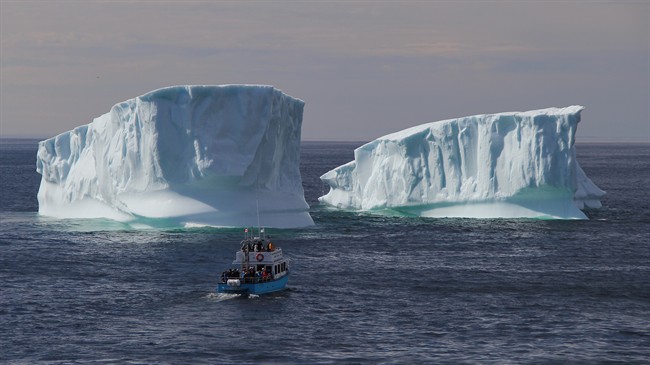
Most icebergs don’t reach more than 60 metres in length, he said just after wrapping up a full morning tour with 48 guests.
Iceberg hunters are arriving from across Canada and the U.S., and as far away as Europe, China and Japan.
“Once they get out there they just can’t believe it. You can see the deep blue lines and the waves pounding against the ice. Sometimes you can see faces or animals carved in the ice. It’s just magical, really.”
Wind and currents have shaped the hunks of Greenland glaciers into fantastic carvings that feature two, sometimes three towers, archways and delicately sloped flat surfaces that run with waterfalls as they melt. Seals can often be spotted on the ice as minke and humpback whales cruise past, Alcock said.
Icebergs are believed to be at least 12,000-year-old specimens of some of the purest fresh water on Earth.
They’re formed as creeping glaciers that cover much of Greenland crawl towards seaside cliffs and snap off.
Icebergs are less dense than sea water, allowing them to float with the Labrador Current that brings them south to Newfoundland and Labrador. The meandering journey typically takes around two years or more.
Gabrielle McGrath, commander of the United States Coast Guard International Ice Patrol formed after the Titanic disaster in 1912, said the numbers are way up for northern Newfoundland this year.
A surveillance flight Thursday that included the Strait of Belle Isle and the northeastern coast of Newfoundland noted about 176 icebergs in the region. At this time last year, there were around 17 just outside the strait compared to 50 last week, McGrath said.
“There does seem to be a very high number within the strait and just outside the strait, probably more than we’ve seen in the recent past.”
A late spring thaw of Labrador sea ice that protects the icebergs before they head farther south could help explain the comparatively large numbers now visible off St. Anthony, she said in an interview Monday. Wind direction and weather patterns ultimately determine how far south down Newfoundland’s eastern coast the big ice travels.
“We have not seen them come around the Avalon like we have in previous years,” McGrath said of the heavily populated southeastern Avalon Peninsula which includes the capital of St. John’s.
While some bergs have made it to Cape Spear and Bay Bulls, time will tell if anything like the natural display wowing people farther north will show up.
“It is a good season for sure,” said Brad Durnford, superintendent of the Atlantic region operations centre for the Canadian Coast Guard.
“If we tend to get a more northerly or northeasterly flow of wind, you will have a great year here off St. John’s, Bonavista, Fogo Island, St. Anthony — all the areas that are the usual, typical Iceberg Alley.”
Alcock said visitors should contact local tour operators directly for the most updated sightings. For him, icebergs never get old.
“It’s just the natural splendour. It’s purity,” he said. “When you think of the history of its formation and how it’s sculpted, it’s just a spectacle to see.”
—By Sue Bailey in St. John’s, N.L.
Follow @suebailey on Twitter.