
A glossy ibis drifts off course to a Nova Scotia marsh and draws a crowd
Advertisement
Read this article for free:
or
Already have an account? Log in here »
We need your support!
Local journalism needs your support!
As we navigate through unprecedented times, our journalists are working harder than ever to bring you the latest local updates to keep you safe and informed.
Now, more than ever, we need your support.
Starting at $15.99 plus taxes every four weeks you can access your Brandon Sun online and full access to all content as it appears on our website.
Subscribe Nowor call circulation directly at (204) 727-0527.
Your pledge helps to ensure we provide the news that matters most to your community!
To continue reading, please subscribe:
Add Brandon Sun access to your Free Press subscription for only an additional
$1 for the first 4 weeks*
- Enjoy unlimited reading on brandonsun.com
- Read the Brandon Sun E-Edition, our digital replica newspaper
*Your next Free Press subscription payment will increase by $1.00 and you will be charged $20.95 plus GST for four weeks. After four weeks, your payment will increase to $24.95 plus GST every four weeks.
Read unlimited articles for free today:
or
Already have an account? Log in here »
Hey there, time traveller!
This article was published 11/05/2019 (2578 days ago), so information in it may no longer be current.
BROOKFIELD, N.S. – Nature photographers are gathering in a central Nova Scotia marsh this weekend capturing images of the latest bird species to fly off course and find itself in a foreign — but nourishing — location.
The glossy ibis is a wading bird that feeds on larval insects, amphibians and other creatures of the wetlands it can snag with its sickle-shaped beak.
A sole member of the species has been spotted in wetlands in Brookfield, N.S., about 80 kilometres north of Halifax.
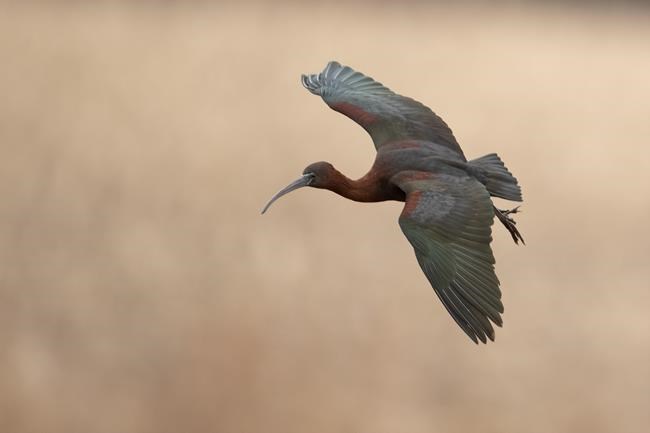
David Currie, the president of the Nova Scotia Bird Society, said the bird is among the growing number of nomadic species being noted outside their usual range by birdwatchers, though he cautioned these are anecdotal observations.
He said the glossy ibis’s northern limit is usually near Portland, Maine, but it is now being sighted and photographed in the Maritimes, usually after storms or when the bird loses its way during migration.
“It’s very bittersweet. What we understand when we see these rare things is that they’re here because of an accident,” Currie said in an interview.
“They’ve been disoriented … and the other part of this is the major storms we’re having, especially in the fall, when we’re finding birds are swept away out to the ocean and only a fraction of them are making it back to shore.”
Currie, a veteran of four decades of birdwatching, said this time the latest ibis has landed in a highly accessible spot where observers can gather discreetly and follow its movements as it feasts in the marshlands.
The 65-year-old birdwatcher, who first spotted an ibis in the province about two decades ago, said when the bird lands in Nova Scotia it is referred to as a “vagrant,” as it’s far from the group it usually roosts and associates with.
Currie said gull-billed terns and black skimmers, also a kind of tern, are two other species normally not seen in the Maritimes that are being spotted in the region.
When strong storms hit the northeast of Canada and the United States, Nova Scotia becomes a final refuge for some species, he said.
“Anecdotally we’re looking a far greater number of vagrant birds hitting the province in spring and the fall.”
Blair Greenan, a federal oceanographer who oversaw portions of a recent national report on climate change, said there is a slight northward shift in storm tracks being observed.
However, he said, “it is doubtful that this is sufficient to explain the increase in these bird species that normally don’t migrate to our region.”
“There is some evidence of an increase in the frequency of extreme storms in the fall for Atlantic Canada, but not for other seasons. This is consistent with observations of an increasing trend since the 1970s in North Atlantic hurricane activity. This could explain some of the fall birder observations,” Greenan added in an email sent Saturday.
Currie said he hopes that after feeding for a few more days the ibis will re-orient itself and find its way back across the Bay of Fundy to be with others of its species and find a mate.
Photographers have been posting images of the bird flying and feeding, seemingly unconcerned by the cameras observing its every movement.
Some of the more striking images show in detail the reddish-brown colours on the bird’s outstretched neck as it glides in graceful flight.
— Follow (at)mtuttoncporg on Twitter.