
N.S. government says study to protect Chignecto Isthmus from rising seas complete
Advertisement
Read this article for free:
or
Already have an account? Log in here »
We need your support!
Local journalism needs your support!
As we navigate through unprecedented times, our journalists are working harder than ever to bring you the latest local updates to keep you safe and informed.
Now, more than ever, we need your support.
Starting at $15.99 plus taxes every four weeks you can access your Brandon Sun online and full access to all content as it appears on our website.
Subscribe Nowor call circulation directly at (204) 727-0527.
Your pledge helps to ensure we provide the news that matters most to your community!
To continue reading, please subscribe:
Add Brandon Sun access to your Free Press subscription for only an additional
$1 for the first 4 weeks*
*Your next subscription payment will increase by $1.00 and you will be charged $20.00 plus GST for four weeks. After four weeks, your payment will increase to $24.00 plus GST every four weeks.
Read unlimited articles for free today:
or
Already have an account? Log in here »
Hey there, time traveller!
This article was published 13/01/2022 (1513 days ago), so information in it may no longer be current.
HALIFAX – The Nova Scotia government says a study looking at options to protect the province from potentially being cut off by flooding at the Chignecto Isthmus has been completed and is being reviewed.
However, Public Works Minister Kim Masland offered no significant details today on what solutions exist to counter the risk that rising seas and more frequent storms will overwhelm the narrow band of land.
The engineering study was commissioned by Nova Scotia, New Brunswick and the federal government to develop “three viable solutions.”
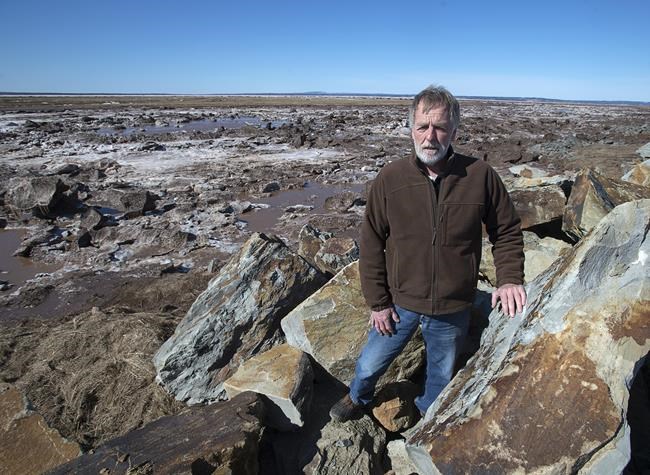
The minister didn’t say when the study would be released to the public, and she didn’t provide the cost range of the options suggested.
Mark Taylor, a spokesman for the New Brunswick government, said the two Maritime governments are briefing Ottawa on the results of the study.
The slowness of the study’s release has been criticized by the Green party in New Brunswick and Elizabeth Smith-McCrossin, the Independent member of the Nova Scotia legislature for Cumberland North — the riding on the provincial boundary.
They have said the delays are unacceptable given the risks to about 20 kilometres of crucial rail, road, energy and communications infrastructure in the low-lying region that connects the two provinces.
Experts have for decades warned that the combination of a high tide with a powerful storm up the Bay of Fundy could overwhelm aging dikes and flood large portions of the Amherst, N.S., area, as well as nearby Sackville, N.B. Meanwhile, the sea level at the mouth of the Bay of Fundy has been rising at a rate of about 2.4 millimetres a year over the past century, even as the dikes and coastal land continue to subside.
The New Brunswick government has taken the lead on overseeing the engineering study being funded by Ottawa and the two provinces.
Experts have said options include raising and reinforcing the dikes; removing the dikes and restoring salt marshes; and moving infrastructure, such as highways and the rail line, to higher ground.
Potential costs remain largely unknown. A 2016 federal study concluded possible costs ranged from $90 million to build up and alter the existing dikes to $345 million to completely reroute highways and railways.
This report by The Canadian Press was first published Jan. 13, 2022.