
Jordan’s restoration efforts push back on degrading land
Advertisement
Read this article for free:
or
Already have an account? Log in here »
We need your support!
Local journalism needs your support!
As we navigate through unprecedented times, our journalists are working harder than ever to bring you the latest local updates to keep you safe and informed.
Now, more than ever, we need your support.
Starting at $15.99 plus taxes every four weeks you can access your Brandon Sun online and full access to all content as it appears on our website.
Subscribe Nowor call circulation directly at (204) 727-0527.
Your pledge helps to ensure we provide the news that matters most to your community!
To continue reading, please subscribe:
Add Brandon Sun access to your Free Press subscription for only an additional
$1 for the first 4 weeks*
*Your next subscription payment will increase by $1.00 and you will be charged $20.00 plus GST for four weeks. After four weeks, your payment will increase to $24.00 plus GST every four weeks.
Read unlimited articles for free today:
or
Already have an account? Log in here »
Hey there, time traveller!
This article was published 27/04/2022 (1343 days ago), so information in it may no longer be current.
SABHA, Jordan (AP) — Efforts to restore damaged but once fertile land in Jordan’s desert are sprouting hope for one of the world’s most water-scarce nations, as a land assessment report Wednesday warned of the growing scale of global degradation.
Local organizations believe projects that reintroduce native plants and implement smart water harvesting systems will cushion the impacts of climate change and desertification, which are only set to worsen, according to the United Nations report.
The U.N. desertification agency says 40% of land globally is currently degraded, blaming unsustainable land and water management, poor agricultural practices, mining, urbanization and infrastructure development for the land’s deterioration.
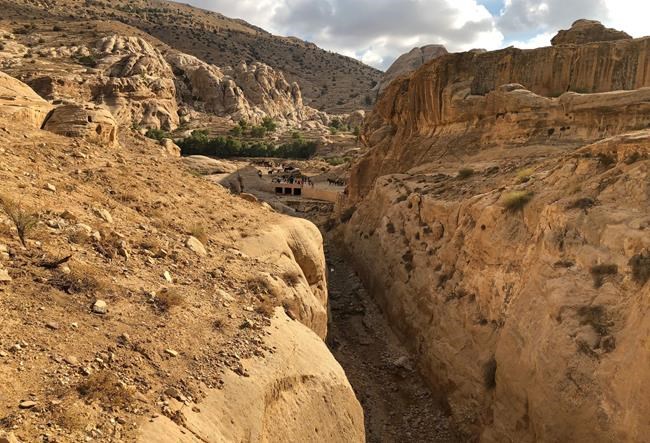
Mira Haddad, from the International Center for Agricultural Research in the Dry Areas said several other factors, including “overexploitation of vegetation cover, overgrazing, and…new land practices” as well as climate change are also contributing to land degradation in Jordan.
But environmentalists are already pursuing options to ward off further damage. One of the efforts, run by the Watershed and Development Initiative, is introducing four native plants to 10,000 acres (41 square kilometers) of desert in the Sabha reserve, roughly 56 miles (90 kilometers) east of the Jordanian capital Amman.
“We’re working on the water, we’re working on the green cover and we’re working also with the habitats of the creatures, from insects to animals and all living parts of that ecosystem,” Deyala Tarawneh, a WADI founding member, said. “The success rate of these plants is 85%, which is considered a very high percentage, and they only need to be watered once, which is also reducing the amount of water needed for the irrigation of the green areas.”
But despite the success of WADI’s planting initiative, land restoration in Jordan is still facing several challenges: the number of land unit areas available for restoration is lacking, and the willingness of local communities to leave the land for at least one or two rainy seasons without grazing is also hindering efforts, said ICARDA’s Haddad.
Jordan is one of several countries already grappling with the effects of degradation, with more than 2.3 billion people currently living in water-stressed countries, according to the U.N. report. It warned that more food supply disruptions, forced migration and greater pressure on species survival are also expected as climate change intensifies and poor land management practices continue. By 2030, it warns that 700 million people could be displaced by drought.
“The situation we have right now is unhealthy and certainly not acceptable,” Ibrahim Thiaw, the executive secretary of the U.N. desertification agency, told the Associated Press. “The more you degrade land the more you emit carbon and the more you contribute to climate change.”
The report calls for financial support to bolster conservation and restoration in developing countries. It says the expansion of protected areas and conservation hotspots, better water management, smart agriculture, and the rewilding of biodiversity can be boosted by appropriate funding.
If these kinds of measures are implemented on a wider scale, the U.N. agency’s restoration scenario predicts reduced biodiversity loss and improved soil health, with the benefits particularly felt in North and Sub-Saharan Africa, the Middle East, and Latin America.
But it also notes that inaction would lead to 16 million square kilometers (6 million square miles) — nearly the size of the entire South American continent — of land degradation by 2050.
The report also recommends scaling up land rights for Indigenous peoples and local communities, urging farmers to draw on ample lessons about land restoration, crop adaptation and livestock from established customs and traditional knowledge.
“We welcome new allies to this battle, including economic actors who are increasingly interested in avoiding climate risk, but we must make clear that we will not be used for greenwashing,” José Gregorio Diaz Mirabal, the leader of the Congress of Indigenous Organizations of the Amazon Basin, said in a statement. “Partnering with Indigenous peoples requires embracing transformative change.”
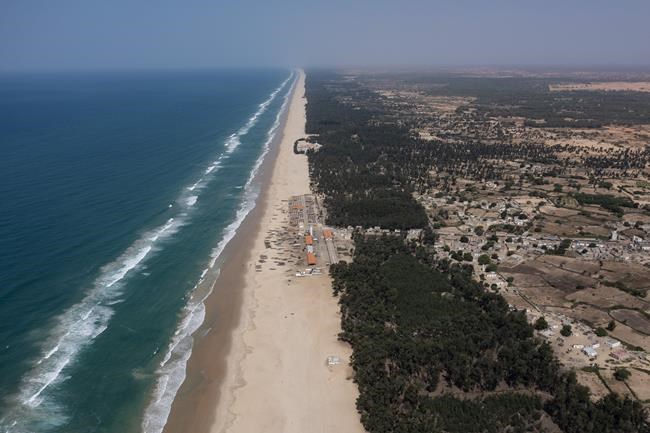
The U.N.’s Thiaw agreed that support for restoration projects should be ramped up. He said addressing land degradation is “the cheapest solution to the climate crisis and biodiversity loss. It is possible to do it by 2050, which is just one generation.”
He added: “It does not require high tech nor a PhD to undertake. Land restoration is accessible and democratic.”
Several countries, like Jordan, are already addressing their own land issues, from drought preparedness programs in Mexico, the USA and Brazil, to the 11-country Great Green Wall in Africa aimed at restoring 100 million hectares (390,000 square miles) of degraded landscapes along the Sahel.
“Land restoration is a win for the environment, economy, society, and for biodiversity,” said Thiaw. “What we are calling for now is the acceleration of such programs.”
___
Wanjohi Kabukuru reported from Mombasa, Kenya.
___
Associated Press climate and environmental coverage receives support from several private foundations. See more about AP’s climate initiative here. The AP is solely responsible for all content.