
Pope cracks down on new Catholic religious start-ups
Advertisement
Read this article for free:
or
Already have an account? Log in here »
We need your support!
Local journalism needs your support!
As we navigate through unprecedented times, our journalists are working harder than ever to bring you the latest local updates to keep you safe and informed.
Now, more than ever, we need your support.
Starting at $15.99 plus taxes every four weeks you can access your Brandon Sun online and full access to all content as it appears on our website.
Subscribe Nowor call circulation directly at (204) 727-0527.
Your pledge helps to ensure we provide the news that matters most to your community!
To continue reading, please subscribe:
Add Brandon Sun access to your Free Press subscription for only an additional
$1 for the first 4 weeks*
*Your next subscription payment will increase by $1.00 and you will be charged $20.00 plus GST for four weeks. After four weeks, your payment will increase to $24.00 plus GST every four weeks.
Read unlimited articles for free today:
or
Already have an account? Log in here »
Hey there, time traveller!
This article was published 15/06/2022 (1360 days ago), so information in it may no longer be current.
ROME (AP) — Pope Francis has taken another step to reign in new religious groups in the Catholic Church after their unregulated proliferation in recent decades led to abuses in governance that allowed spiritual and sexual misconduct to go unchecked.
Francis issued a new decree published Wednesday that requires prior Vatican approval for bishops to erect new associations of the faithful, often the first step in the creation of a new apostolic society or institute of consecrate life.
The decree follows a similar one issued in 2020 that required prior Vatican approval for d iocesan-level religious orders, suggesting the Vatican was now cracking down even further to better regulate the origins of these new forms of religious life and take the decisions about them out of the hands of local bishops.
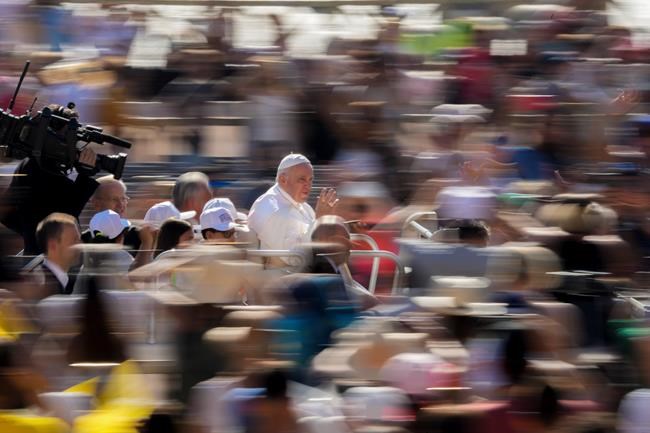
Francis has taken a series of disciplinary and regulatory actions in recent years after some founders and leaders of religious orders and new lay institutes turned out to be religious frauds who sexually and spiritually abused their members.
Some groups have been suppressed, others have been taken over by the Vatican for periods of reform while all have become subject to greater Vatican oversight.
In 2021, the Vatican also imposed term limits on the leaders of lay movements, which proliferated following the second Vatican Council in the 1960s as a new way for rank-and-file Catholics to get involved in the church beyond typical parish life. The Vatican said the term limits were necessary to prevent personality cults from arising around charismatic leaders.
One lay group targeted by the new reform was Communion and Liberation, an influential group in Italy that has a consecrated branch with a few members who help run the household of Emeritus Pope Benedict XVI.
The term limits last year forced out Communion and Liberation’s Spanish head, the Rev. Julian Carron, who had been in charge since 2005.
Just this week, the head of the Vatican’s laity office, Cardinal Kevin Farrell, wrote to Carron’s successor complaining that Carron and his followers were still exercising influence against the Vatican’s reforms. According to a copy of the letter, Farrell faulted what he said was the “false doctrine” Carron promoted, claiming the unique spirit of the group passed from the founder through leaders like himself.
Farrell said Communion and Liberation’s new leadership must accept the Vatican’s line and “recognize the problems and review the teachings, practices, methods of government and internal organization forms that were shown to be inadequate or even harmful.”
Related Articles
Pope's health is an 'extreme concern': Miller
Advertisement Advertise With Us