
New network launched in Calgary to study, improve neurological rehabilitation
Advertisement
Read this article for free:
or
Already have an account? Log in here »
We need your support!
Local journalism needs your support!
As we navigate through unprecedented times, our journalists are working harder than ever to bring you the latest local updates to keep you safe and informed.
Now, more than ever, we need your support.
Starting at $15.99 plus taxes every four weeks you can access your Brandon Sun online and full access to all content as it appears on our website.
Subscribe Nowor call circulation directly at (204) 727-0527.
Your pledge helps to ensure we provide the news that matters most to your community!
To continue reading, please subscribe:
Add Brandon Sun access to your Free Press subscription for only an additional
$1 for the first 4 weeks*
- Enjoy unlimited reading on brandonsun.com
- Read the Brandon Sun E-Edition, our digital replica newspaper
*Your next Free Press subscription payment will increase by $1.00 and you will be charged $20.95 plus GST for four weeks. After four weeks, your payment will increase to $24.95 plus GST every four weeks.
Read unlimited articles for free today:
or
Already have an account? Log in here »
Hey there, time traveller!
This article was published 02/05/2023 (1247 days ago), so information in it may no longer be current.
CALGARY – Alberta Health Services and the University of Calgary are partnering to support people with spinal cord injuries, strokes and movement issues.
The Researching Strategies for Rehabilitation, or RESTORE, Network is to work with a specialized group of academics and experts to conduct clinical trials and test new therapies and technologies to improve the quality of life for those with neurological disorders.
The network is working to “ensure continuity of care and access to novel neuro-rehabilitation techniques for people of all ages,” research manager Kelly Larkin-Kaiser said Tuesday.
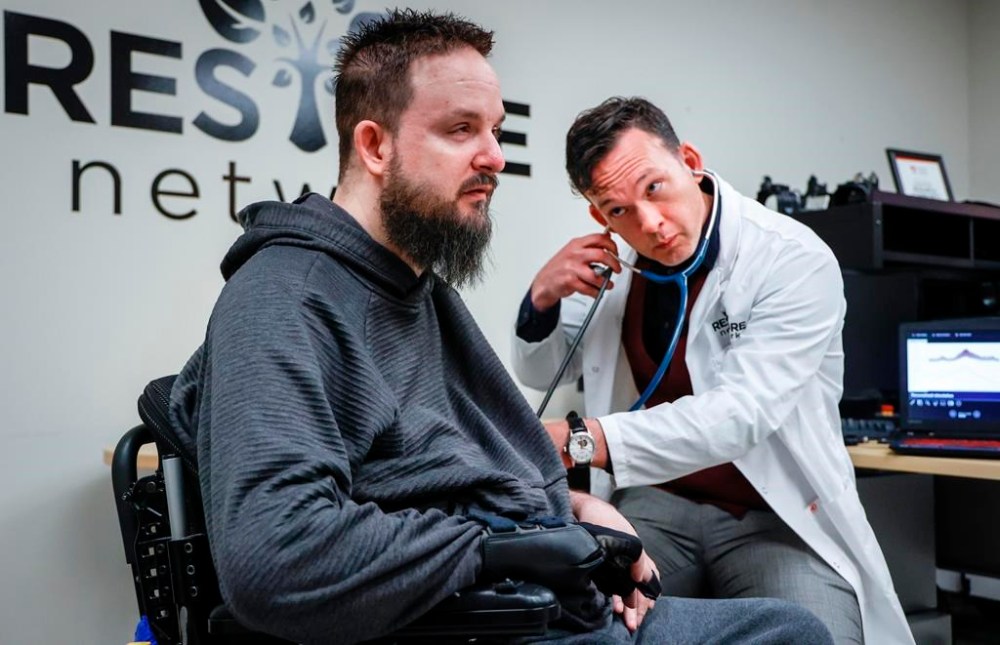
“Our vision is to develop a centre where we can develop our own biotechnology, so that we can innovate further and use less off-the-shelf technology,” she said.
The network is focused on three areas of rehabilitation study — spinal cord injuries, stroke and movement impairment — each with its dedicated team of researchers to conduct clinical studies or pilots.
Researchers are also looking into methods to stabilize blood pressure among people with spinal cord injuries in what the network says would be a first-ever trial in humans. Larkin-Kaiser said the researchers would implant epidural stimulators over the spinal cord to reawaken them after injury.
“When people generally think of somebody with a spinal cord injury, they tend to think spinal cord injuries are focused on moving again, like being able to walk again,” she said.
“But the reality is that these folks have a lot of autonomic dysfunction … like managing your blood pressure, managing your bladder or managing your sleep.”
The network is also working on other pilots, including a virtual-reality treadmill at the Foothills Medical Centre in Calgary, in partnership with AHS, for enhancing stroke recovery.
Another pilot includes children with mobility challenges at Alberta Children’s Hospital in Calgary that helps them move around with a robotic-assisted walking device.
Larkin-Kaiser said both pilots are being expanded to include more participants.
“This is a powerful example of how collaboration between health-care providers, researchers and the community translates to real-world treatment that can dramatically improve the lives of many patients with neurological conditions,” Dr. Mark Anselmo, medical director for AHS Calgary Zone, said in a statement.
Dr. Aaron Phillips, the network’s director, said it would be “one of the key centres in the world for the development of new technology for rehabilitation.”
He said that over the next five years, the network’s vision is to “develop a fully operational engineering space for next-generation technology to be ideated, fabricated, validated and, finally, disseminated so that our clinical community can benefit from our new discoveries.”
This report by The Canadian Press was first published May 2, 2023.
— By Ritika Dubey in Edmonton.
___
This story was produced with the financial assistance of the Meta and Canadian Press News Fellowship.