
Experts foresee more heat waves outside summer as May hot spell shatters records
Advertisement
Read this article for free:
or
Already have an account? Log in here »
We need your support!
Local journalism needs your support!
As we navigate through unprecedented times, our journalists are working harder than ever to bring you the latest local updates to keep you safe and informed.
Now, more than ever, we need your support.
Starting at $15.99 plus taxes every four weeks you can access your Brandon Sun online and full access to all content as it appears on our website.
Subscribe Nowor call circulation directly at (204) 727-0527.
Your pledge helps to ensure we provide the news that matters most to your community!
To continue reading, please subscribe:
Add Brandon Sun access to your Free Press subscription for only an additional
$1 for the first 4 weeks*
- Enjoy unlimited reading on brandonsun.com
- Read the Brandon Sun E-Edition, our digital replica newspaper
*Your next Free Press subscription payment will increase by $1.00 and you will be charged $20.95 plus GST for four weeks. After four weeks, your payment will increase to $24.95 plus GST every four weeks.
Read unlimited articles for free today:
or
Already have an account? Log in here »
Hey there, time traveller!
This article was published 15/05/2023 (1292 days ago), so information in it may no longer be current.
The ongoing May heat wave that shattered almost 40 daily temperature records across B.C. and Alberta on Sunday should be seen as a warning of more out-of-season hot spells in the future, climatologists say.
The unseasonal hot weather, which has sent temperatures soaring 10 to 15 degrees higher than normal in some communities, broke more than 30 records in B.C., in towns including Cache Creek, Hope and Lillooet. The temperature peaked at 35.9 C in Lytton.
In Alberta, Sunday’s temperature spike broke daily highs in places including Edmonton, Edson, Hinton and Jasper, all of which pushed close to 30 degrees for the day.
Joseph Shea, an associate professor in environmental geomatics at the University of Northern British Columbia, said Western Canada residents “need to adapt to a hotter future” with more extended, out-of-season heat waves.
He said that includes the possibility of another “heat dome” weather event this generation, referring to the excruciating 2021 phenomenon that killed hundreds of people in B.C. The odds of such an event occurring in any given year were once thought to be vanishingly small.
“I believe they attributed that heat dome event to be like a one-in-1,000-year event,” Shea said. “… But climate change is proceeding right in front of our eyes, and those odds, I think, are changing. They’re going to become more frequent.”
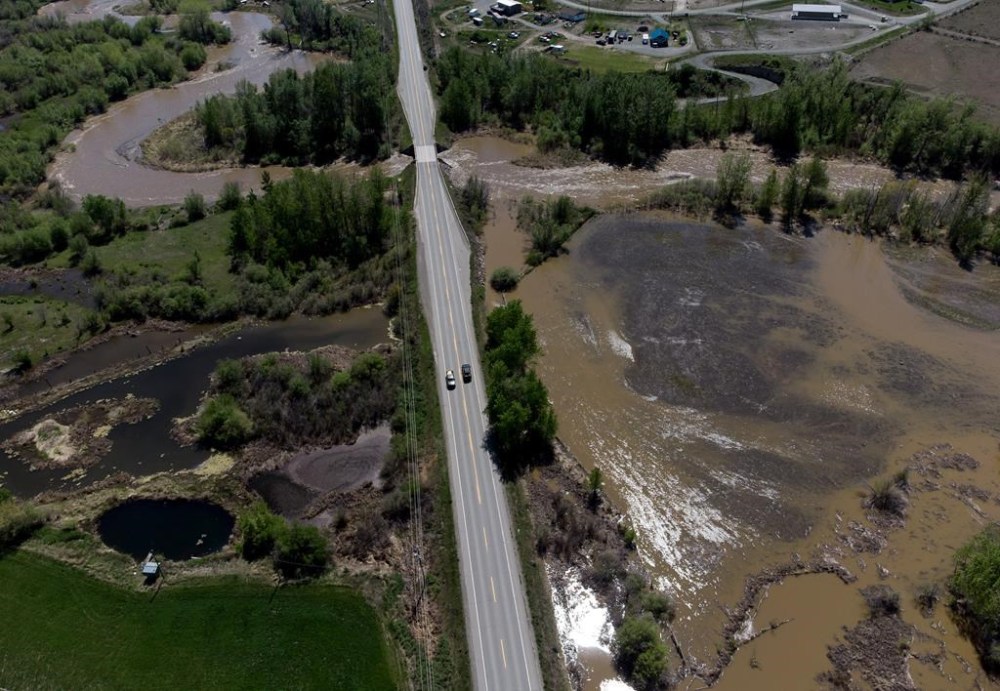
The current heat wave is not as severe as the 2021 heat dome event that set the all-time Canadian temperature record of 49.5 C in Lytton. But it has exacerbated both the wildfire and flooding situations in B.C. and Alberta, as snow packs melt prematurely in large quantities while forests dry up and become susceptible to large blazes.
Shea said that as temperature spikes become longer and more frequent, wildfire seasons could also become longer and more expansive, impacting everything from forest ecosystems to water supply.
“If we get this (current) event in a month from now, we’re gonna wind up in a very similar heat dome situation,” he said.
Environment Canada has issued a heat warning for most of the northern half of Alberta starting just north of Edmonton, covering communities ranging from Grande Prairie and High Level to Fort McMurray and Cold Lake.
A warning has also been issued for B.C.’s north coast, including Kitimat and Terrace, with high temperatures in the forecast stretching into the long weekend.
The warning from Environment Canada says a plume of hot air is to remain in place over parts of B.C. through Thursday, bringing daytime highs to near 30 C and overnight lows near 15 C.
Much of the rest of the B.C. coastal and Interior regions remain under special weather statements after temperatures spiked above 30 C in many communities on the weekend.
Andreanne Doyon, an assistant professor in the School of Resource and Environmental Management at Simon Fraser University, said the current temperature trends are very concerning, even if temperatures are not at heat-dome levels.
“We are not supposed to have heat like 10 to 15 degrees hotter than average in May,” Doyon said. “… We know that things like heat waves are going to be more frequent, they are going to be more severe and they’re going to happen at times of the year where they previously haven’t.”
Doyon said she was especially concerned about cities such as Vancouver, Calgary and Edmonton, where infrastructure such as pavement and concrete absorbs more heat than foliage and natural landscapes.
“Heat waves are sometimes referred to as the deadliest of natural disasters … because they are something that people don’t focus on,” she said.
“With the wildfires that B.C. and Alberta are experiencing right now, the photos are very extreme, and it’s really tragic where we haven’t been able to communicate the severity of heat waves and those impacts in the same way.”
The Peace River Regional District says there was “significant fire activity” on Saturday that necessitated evacuation orders and alerts, and Fort St. John on Monday issued an alert for the entire city, asking all 21,000 residents to be ready to evacuate.
B.C.’s River Forecast Centre also issued several high streamflow advisories for the Skeena River, the Upper Columbia and East and West Kootenay rivers and others, as the high temperatures accelerated the spring snow melt.
The Regional District of Kootenay Boundary has also issued an evacuation order for six properties in the Manly Meadows area east of Grand Forks.
People are being warned to stay away from fast-moving waters and unstable banks.
B.C.’s Interior has been particularly hard-hit by flooding and fires this spring, including Cache Creek, where flooding earlier this month forced people from their homes and damaged highways.
Cache Creek Mayor John Ranta said the provincial government had started working on part of Highway 97 that was washed out due to flooding but he’s not sure whether returning that area to pre-flood condition will be enough to address future flooding concerns.
He said Cache Creek had flooded four of the last five years and some sort of permanent solution is needed.
“I don’t know exactly what that is. People have talked about a bridge, people have talked about just forget the bridge and leave a channel there for the river to go through and don’t use that road anymore, those sorts of ideas,” he said.
He said the town is planning to start collecting donations for people impacted by the flooding who could not afford expensive overland flood insurance.
This report by The Canadian Press was first published May 15, 2023.