
Made-in-Saskatchewan satellite heading to orbit on SpaceX rocket
Advertisement
Read this article for free:
or
Already have an account? Log in here »
We need your support!
Local journalism needs your support!
As we navigate through unprecedented times, our journalists are working harder than ever to bring you the latest local updates to keep you safe and informed.
Now, more than ever, we need your support.
Starting at $15.99 plus taxes every four weeks you can access your Brandon Sun online and full access to all content as it appears on our website.
Subscribe Nowor call circulation directly at (204) 727-0527.
Your pledge helps to ensure we provide the news that matters most to your community!
To continue reading, please subscribe:
Add Brandon Sun access to your Free Press subscription for only an additional
$1 for the first 4 weeks*
*Your next subscription payment will increase by $1.00 and you will be charged $20.00 plus GST for four weeks. After four weeks, your payment will increase to $24.00 plus GST every four weeks.
Read unlimited articles for free today:
or
Already have an account? Log in here »
Hey there, time traveller!
This article was published 29/05/2023 (1040 days ago), so information in it may no longer be current.
SASKATOON – Saskatchewan engineering students will have their eyes on the sky as the province’s first homegrown satellite is to be launched on board a SpaceX rocket headed for the International Space Station.
“I am so excited about it,” said Rylee Moody, a third-year student at the University of Saskatchewan.
“It’s something I would never have dreamed of doing.”
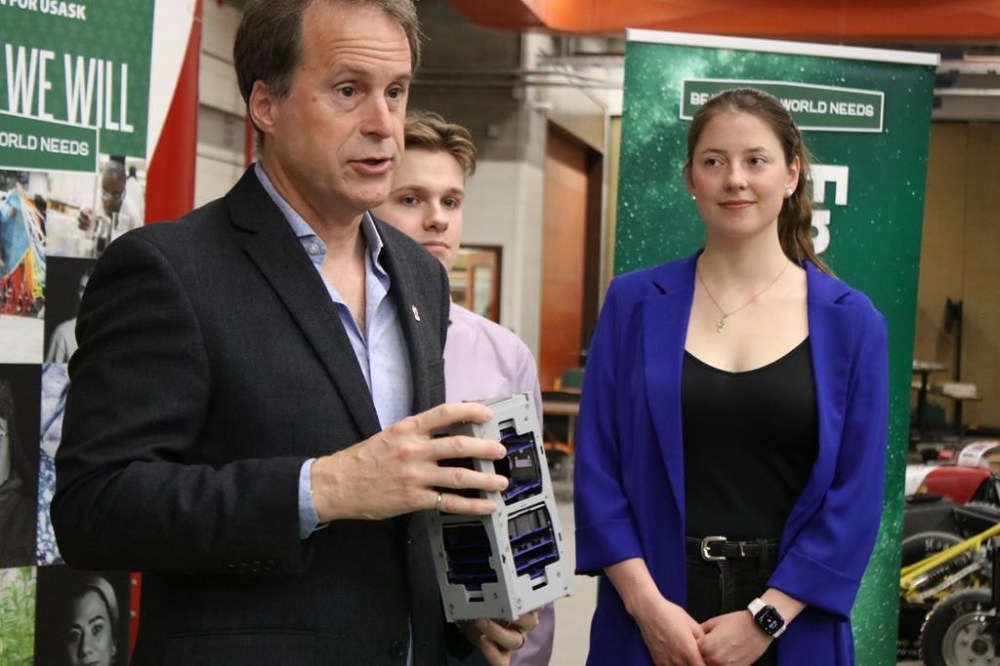
Engineering students at the University of Saskatchewan spent five years developing the cube satellite called RADSAT-SK. It is set to be launched into space Saturday.
RADSAT-SK will be sent into its own orbit for a year, where it will collect radiation data that will be analyzed at a ground station located near the university’s campus.
The project was part of a Canadian Space Agency project that saw 15 universities get grants to build CubeSats — cubical, standard-sized miniature satellites that generally weigh about a kilogram.
Sean Maw, a principal investigator and chair in innovative teaching at the College of Engineering, said Saskatchewan’s project began in 2018 with about 20 engineering undergraduate students. Since then, hundreds of students have put in tens of thousands of hours to ensure ideas became reality.
It was no easy task to get from a satellite concocted in a Saskatchewan university to infinity and beyond. Students designed, built, tested and integrated the satellite.
They also navigated the complicated international regulatory environment to get it approved for launch. A global pandemic certainly didn’t make it easier, Maw added.
“Students persevered through the whole COVID crisis to get this project done,” Maw said. “Especially in the last 12 months or so they fought tooth and nail to get RADSAT-SK to the finish line.”
The team came up with a motto to get through the tough times: fail hard, fail fast, recover.
The satellite’s payload, what it carries as it orbits earth, is focused on radiation research. A Saskatchewan-made dosimeter board will measure radiation from space and a fungal melanin coating on board will test the feasibility of the polymer to shield space radiation.
Arliss Sidlowksi, a fourth-year student, said it has been an incredible and challenging experience getting the satellite ready for orbit.
“I am so proud of our team for their resilience,” she said.
“We experienced numerous challenges over the years. Our members viewed each setback as an opportunity to learn, adapt and proving time and time again their perseverance and intelligence.”
Sidlowksi said she hopes it will inspire other students to see themselves working in the space industry while also showing the rest of the country what Saskatchewan has to offer.
“I think it’s really opening up Saskatchewan to the space sector.”
It’s very important students have the support to dream for the stars, Maw added. Decades ago when he was getting his undergraduate degree at the University of Waterloo he brought a group of students together to build a satellite.
The project wasn’t supported. And the satellite never got off ground.
“I wasn’t going to let that happen to these guys,” Maw said.
“Their efforts were truly remarkable.”
This report by The Canadian Press was first published May 29, 2023.