
Tackling B.C.’s largest ever wildfire means letting some of it burn, province says
Advertisement
Read this article for free:
or
Already have an account? Log in here »
We need your support!
Local journalism needs your support!
As we navigate through unprecedented times, our journalists are working harder than ever to bring you the latest local updates to keep you safe and informed.
Now, more than ever, we need your support.
Starting at $15.99 plus taxes every four weeks you can access your Brandon Sun online and full access to all content as it appears on our website.
Subscribe Nowor call circulation directly at (204) 727-0527.
Your pledge helps to ensure we provide the news that matters most to your community!
To continue reading, please subscribe:
Add Brandon Sun access to your Free Press subscription for only an additional
$1 for the first 4 weeks*
- Enjoy unlimited reading on brandonsun.com
- Read the Brandon Sun E-Edition, our digital replica newspaper
*Your next Free Press subscription payment will increase by $1.00 and you will be charged $20.95 plus GST for four weeks. After four weeks, your payment will increase to $24.95 plus GST every four weeks.
Read unlimited articles for free today:
or
Already have an account? Log in here »
Hey there, time traveller!
This article was published 21/06/2023 (1176 days ago), so information in it may no longer be current.
Mark Healey, an incident commander with the BC Wildfire Service, says he took a 2 1/2 hour flight over the southern flank of the enormous Donnie Creek fire in northeastern British Columbia.
“I never saw either end of the fire,” says Healey, who’s in the middle of a two-week stint managing what is B.C.’s largest ever wildfire. At 5,500 square kilometres, it is almost as big as Prince Edward Island.
Tackling it demands a shift in tactics. Instead of striving to extinguish the vast blaze, the BC Wildfire Service is focused on protecting homes and infrastructure, while letting other areas burn.
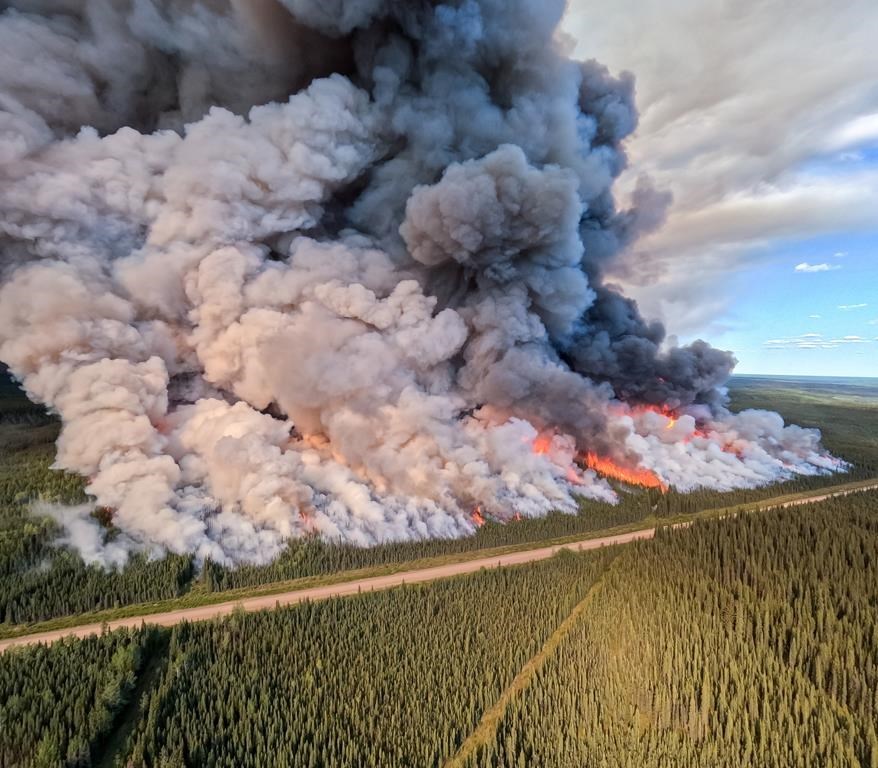
The service says it may be winter before the fire is out.
With a perimeter of more than 900 kilometres, the fire is burning across a remote area about 160 kilometres north of Fort St. John, where the forests and vegetation are thick and numerous roads are only available in the winter, Healey says.
He says those factors add to the challenge of ensuring the safety of more than 250 wildfire service personnel currently assigned to the blaze.
The service is using controlled burns to steer the fire toward rivers, lakes, areas that have burned in previous years, or patches of deciduous trees that are less flammable than the conifers prevalent throughout the boreal forest, Healey says.
“We use our planned ignitions to bring the fire to somewhere on our terms, rather than have that happen with a wind event or as the forest dries out.”
Around homes, communications towers and other infrastructure, including gas-industry operations, Healey says, “that’s where we’re actively fighting the fire.”
An update from the wildfire service says tackling such a large blaze means “monitoring” the fire where it’s not threatening communities and infrastructure.
The service says it expects the Donnie Creek blaze will burn into the fall, before possible extinguishment in winter. It could also continue smouldering, only to re-emerge next spring.
That usually occurs where there’s a thick layer of “duff” or decaying needles, leaves and other woody debris coating the forest floor, it says.
The Donnie Creek blaze accounts for more than 60 per cent of nearly 8,700 square kilometres of land charred by wildfires in B.C. since April 1. That dwarfs the 20-year average of about 162 square kilometres for the same time of year.
The lightning-caused fire that was discovered on May 12 grew as it overtook six smaller blazes that added to its record-breaking size, the wildfire service says.
On Vancouver Island, crews are preparing to reopen Highway 4 this weekend to single-lane alternating traffic after a fire forced its closure earlier this month.
The province said in a statement it will temporarily close three day-use parks in the area to help reduce traffic congestion until the route can be fully reopened.
The Ministry of Environment says MacMillan Provincial Park, the home of centuries-old trees in Cathedral Grove, and the picnic areas of Cameron Lake and Beaufort in Little Qualicum Falls will be closed to the public until the highway fully reopens.
The wildfire service lists more than 60 active fires throughout the province.
Despite a recent cooling trend with some localized precipitation, it says drought conditions will persist in many areas until there’s a period of prolonged rain.
This report by The Canadian Press was first published June 21, 2023.