
Canada, United States expand agreement to help each other fight wildfires
Advertisement
Read this article for free:
or
Already have an account? Log in here »
We need your support!
Local journalism needs your support!
As we navigate through unprecedented times, our journalists are working harder than ever to bring you the latest local updates to keep you safe and informed.
Now, more than ever, we need your support.
Starting at $15.99 plus taxes every four weeks you can access your Brandon Sun online and full access to all content as it appears on our website.
Subscribe Nowor call circulation directly at (204) 727-0527.
Your pledge helps to ensure we provide the news that matters most to your community!
To continue reading, please subscribe:
Add Brandon Sun access to your Free Press subscription for only an additional
$1 for the first 4 weeks*
*Your next subscription payment will increase by $1.00 and you will be charged $20.00 plus GST for four weeks. After four weeks, your payment will increase to $24.00 plus GST every four weeks.
Read unlimited articles for free today:
or
Already have an account? Log in here »
Hey there, time traveller!
This article was published 22/06/2023 (928 days ago), so information in it may no longer be current.
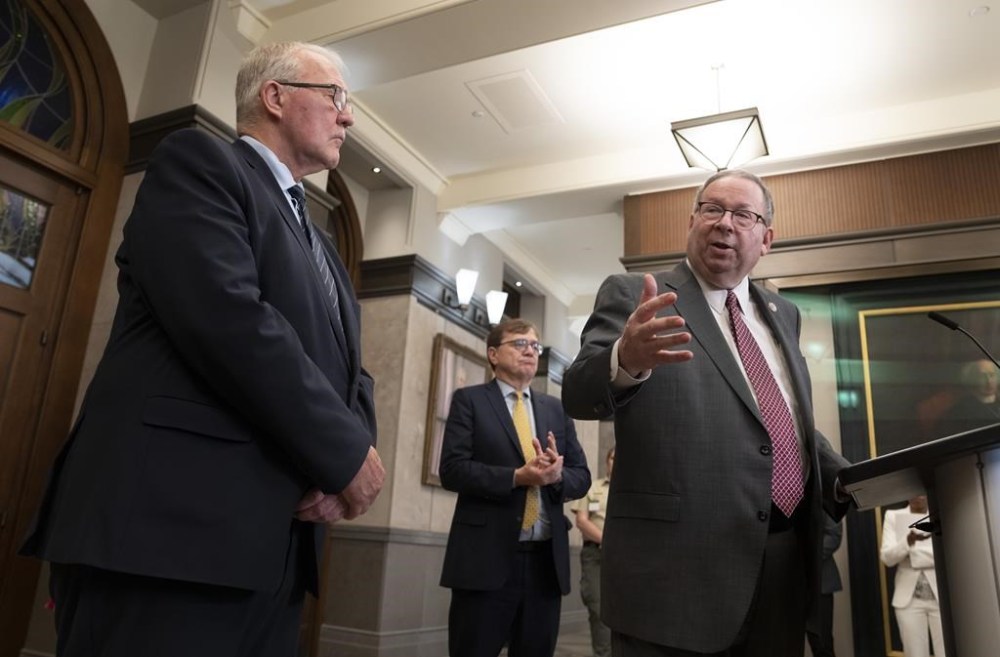
OTTAWA – Canada and the United States agreed to replace an “ad hoc” approach to helping each other battle forest fires with a formal agreement Thursday that spells out a plan to more efficiently share resources and expertise across the border.
The agreement comes as Canada continues to face a record-setting fire season, with more than 63,000 square kilometres of land burned so far this year.
Several thousand international firefighters from at least nine different countries have been seconded to help.

U.S. Ambassador David Cohen said more than 1,500 American firefighters have come north to help Canada this year.
But both he and Natural Resources Minister Jonathan Wilkinson said the agreements the two countries had in place to help guide how fire resources are shared were outdated and inefficient.
They signed a memorandum of understanding on the matter Thursday that outlines the process both must follow to request and send resources.
It also promises that the two countries will co-operate on technology, training and research, given that climate change is increasing the risk of fires.
“In the past, the wildland fire resources sharing between our two countries was pretty much ad hoc,” said Wilkinson.
“It relied on a number of different arrangements, and they were only focused on fire suppression. This MOU will allow better co-ordination with our partners at the provinces and territories to ensure adequate firefighting resources.”
The new agreement includes a list of all the organizations that would co-operate, including the organization or department in each province responsible for fighting wildfires as well as multiple national departments.
Those include the U.S. National Park Service, Parks Canada, the Canadian Forest Service, the U.S. Fish and Wildlife Service and the U.S. Department of Agriculture Forest Service.
Cohen said he thinks laying out that list is the most critical part of the agreement, and it spells out “that there is a will here to help.”
“That has never been the issue,” he added.
“But sometimes getting it organized in a time of crisis takes more time than we would like. And so this provides a structure and a commitment by both governments, and multiple agencies within both governments, that we will work together. We will respond.”
Unlike the United States, Canada does not have a national agency charged with responding to disasters, be they of the human or natural cause.
The U.S. has the Federal Emergency Management Agency, or FEMA, and Canada is in discussions about creating something similar on this side of the border.
But right now, firefighting is a provincial responsibility and provinces ask Ottawa for help when they can’t manage on their own.
Cohen said it’s up to Canada to decide whether a northern FEMA is the right answer, but the agreement on fires is a bit of a step toward that.
“Part of what we’re doing in this agreement is to create a bit of (room) to give Canada the benefit and advantage of being able to function with a co-ordination within its government as a result of the arrangement, as if there was a FEMA in Canada,” he said.
Blair said Thursday he does not want Canada to break any records for the number of fires or area burned, but the spring has been brutal for the hot, dry weather fires love and the summer looks to bring more of the same.
The most area ever burned in a single year was in 1995 at 71,000 square kilometres.
On Thursday, Canada surpassed 63,000 square kilometres, making it the second-worst year on record before the hottest months of the year have even begun.
The Canadian Interagency Forest Fire Centre said that as of Thursday, 2,769 fires had burned in Canada so far this year, and 422 remained active. There were 209 fires out of control.
Over the last 25 years, the average amount of land that has usually burned by this point in the year has been about 4,600 square kilometres.
This report by The Canadian Press was first published June 22, 2023.