
Quebec wildfires: Evacuation orders being lifted, but poor air quality persists
Advertisement
Read this article for free:
or
Already have an account? Log in here »
We need your support!
Local journalism needs your support!
As we navigate through unprecedented times, our journalists are working harder than ever to bring you the latest local updates to keep you safe and informed.
Now, more than ever, we need your support.
Starting at $15.99 plus taxes every four weeks you can access your Brandon Sun online and full access to all content as it appears on our website.
Subscribe Nowor call circulation directly at (204) 727-0527.
Your pledge helps to ensure we provide the news that matters most to your community!
To continue reading, please subscribe:
Add Brandon Sun access to your Free Press subscription for only an additional
$1 for the first 4 weeks*
- Enjoy unlimited reading on brandonsun.com
- Read the Brandon Sun E-Edition, our digital replica newspaper
*Your next Free Press subscription payment will increase by $1.00 and you will be charged $20.95 plus GST for four weeks. After four weeks, your payment will increase to $24.95 plus GST every four weeks.
Read unlimited articles for free today:
or
Already have an account? Log in here »
Hey there, time traveller!
This article was published 30/06/2023 (1174 days ago), so information in it may no longer be current.
MONTREAL – Evacuation orders were starting to lift on Friday for Quebec residents directly affected by wildfires, but the blazes were still causing poor air quality across much of the province.
Quebec’s Public Security Department said that almost all of the 2,300 people evacuated from their homes would be able to return no later than Saturday because rainfall during the past week has decreased the forest fire threat.
In the northern town of Lebel-sur-Quévillon, home to more than 2,000 people, essential workers began returning on Thursday, with a full return scheduled for Saturday.
“We’re looking forward to seeing you tomorrow,” Mayor Guy Lafrenière said in a video message on Friday.
The western edge of a massive fire burning east of the town is under control, he said. The town’s website said the fire was 24 times the size of the city of Montreal.
Four fires north of Lebel-sur-Quévillon had not grown in 24 hours, Lafrenière said, adding that another fire, burning near a mine around 115 kilometres east of the town, had been contained.
The northern Quebec town has been evacuated twice since June 2.
The Cree First Nation Of Waswanipi, where poor air quality led officials to evacuate vulnerable people starting June 23, allowed all residents to return Friday.
Quebec officials said the only evacuation order that was not scheduled to lift by this weekend was in the city of Senneterre, where 60 cottages — located around 30 kilometres north of the city centre — remained off limits.
About 100 fires were burning in Quebec on Friday, according to the province’s forest fire prevention agency — SOPFEU. Five fires were considered out of control.
The Canadian Interagency Forest Fire Centre said there were 499 active fires burning across the country as of Thursday afternoon, with about 230 of them out of control. It said 67 were in Ontario.
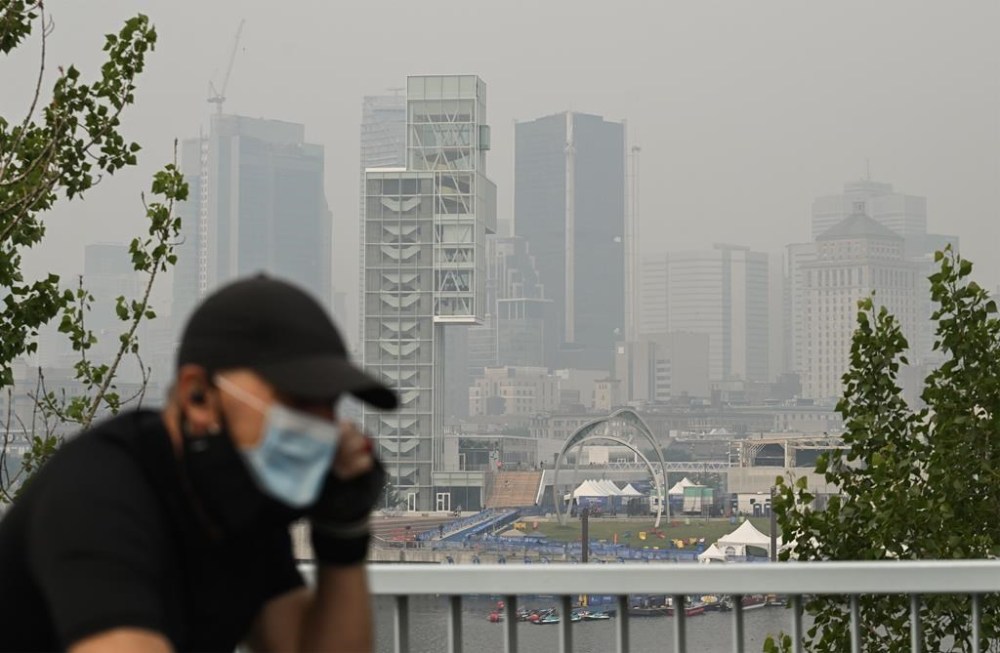
Meanwhile, Environment Canada issued smog warnings Friday for the regions around the cities of Montreal and Gatineau and for western Quebec. It said poor air quality could also be expected in northern Quebec, including parts of the Far North, as well as in eastern and southern Ontario.
Real-time data from the United Nations Environment Programme showed that the level of pollutants in the air in Montreal, Ottawa and Toronto was at least 10 times higher than recommended.
Scott Weichenthal, a professor at McGill University’s department of Epidemiology and Biostatistics who studies environmental risk factors for chronic illness, said the poor air quality will have the most short-term impact on the very young and very old, as well as on people with heart or lung diseases.
“We will almost certainly see small increases in mortality and small increases in things like hospital admissions for, say, cardiovascular or respiratory outcomes,” he said in an interview Friday. “Not everyone is sensitive to the same extent, but there will be a measurable impact on health.”
For healthier members of the population, exposure to air pollution from wildfires could damage health over the long-term, especially if fires burn for extended periods, or if wildfires start to occur more frequently.
While there’s a lack of studies on the long-term effects of air pollution from wildfires, he said, “there’s almost certainly a long-term health risk.”
Weichenthal said his research group conducted a study last year that analyzed census data on the health effects of wildfires on Canadians. He said they found increases in the risk of lung cancer and brain tumours among people who lived near fires.
Air pollution may not cause significant individual risks, but because it impacts everyone, it increases risk at a population level, he said. “We all have to breathe, so everyone is exposed.”
The air quality-monitoring website IQAir said that as of 3 p.m. Friday, Toronto and Montreal ranked third and fourth for the worst air quality among major world cities, with only Jakarta, Indonesia, and New York City faring worse.
Environment Canada has issued air quality alerts for northern Quebec almost every day this month, said Simon Legault, a meteorologist at the federal department.
“Until the end of those fires, until they are completely put out, there won’t be any real improvement close to those regions,” he said in an interview Friday.
No significant rain is forecast in those areas for at least two weeks, he said, adding that the month of July is expected to be drier than usual.
This report by The Canadian Press was first published June 30, 2023.