
New study says fireworks have small effect on air quality, but doctors not impressed
Advertisement
Read this article for free:
or
Already have an account? Log in here »
We need your support!
Local journalism needs your support!
As we navigate through unprecedented times, our journalists are working harder than ever to bring you the latest local updates to keep you safe and informed.
Now, more than ever, we need your support.
Starting at $15.99 plus taxes every four weeks you can access your Brandon Sun online and full access to all content as it appears on our website.
Subscribe Nowor call circulation directly at (204) 727-0527.
Your pledge helps to ensure we provide the news that matters most to your community!
To continue reading, please subscribe:
Add Brandon Sun access to your Free Press subscription for only an additional
$1 for the first 4 weeks*
- Enjoy unlimited reading on brandonsun.com
- Read the Brandon Sun E-Edition, our digital replica newspaper
*Your next Free Press subscription payment will increase by $1.00 and you will be charged $20.95 plus GST for four weeks. After four weeks, your payment will increase to $24.95 plus GST every four weeks.
Read unlimited articles for free today:
or
Already have an account? Log in here »
Hey there, time traveller!
This article was published 29/03/2024 (975 days ago), so information in it may no longer be current.
MONTREAL – Almost a year after smog from wildfires led officials in Montreal to cancel two major fireworks shows, groups representing pyrotechnics companies have released a study that concludes the displays have a small effect on air quality.
But doctors and an environmental health specialist warn the fireworks can still pose dangers to human health.
The study published Wednesday was commissioned by the Regroupement des événements pyrotechniques du Québec and carried out by the company AtkinsRéalis. Using 2023 air quality data gathered near fireworks launch sites and records from Quebec’s Environment Department, the consulting firmanalyzed the prevalence of atmospheric pollutants known as PM2.5 — fine particles with a diameter of less than 2.5 millionths of a metre.
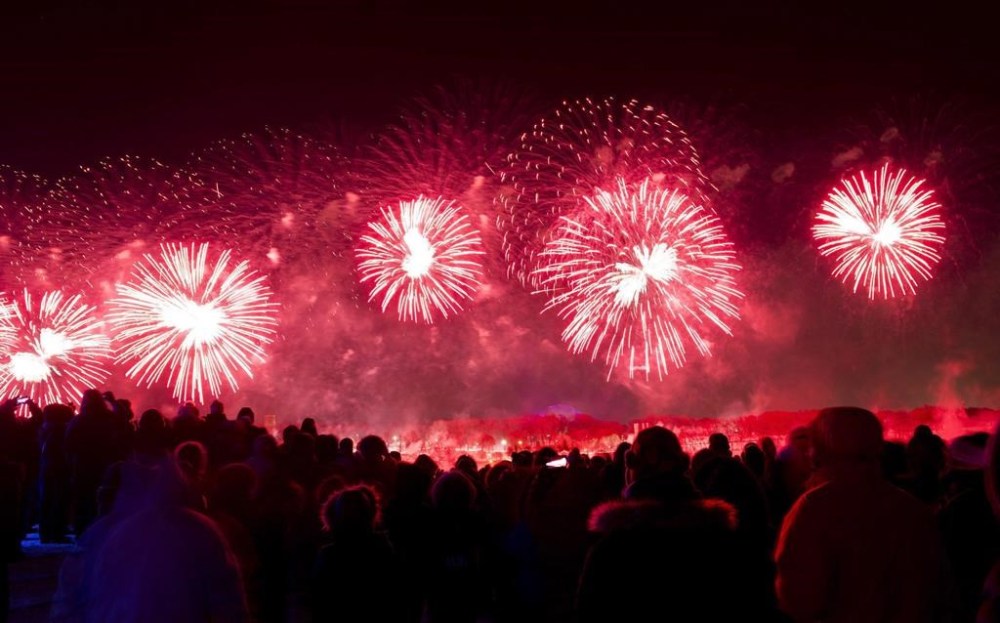
In every case, the analysis found that pollution from fireworks shows respected provincial norms,AtkinsRéalis engineer Jean-Luc Allard said Wednesday. Effects on air quality, he said, are “very localized in area and time.”
The Regroupement des événements pyrotechniques du Québec and Canadian Pyrotechnic Council celebrated the results.
“The study confirms that the impact on air quality is much more limited than what we might have thought,” Sophie Emond, spokesperson for the Quebec association and president of Montreal amusement park La Ronde, said in a statement.
Last year, La Ronde cancelled the first night of an international fireworks competition after Montreal’s public health agency recommended postponing events that could worsen already poor air quality due to raging wildfires in northern Quebec. Organizers of the city’s Canada Day fireworks also cancelled that display.
The public health agency said Thursday it would take time to review the study before commenting on its findings. An association of doctors that advocates for the environment, however, cast doubt on the study’s use of what they say are the province’s outdated air quality standards.
“We have a big quibble with that,” Ève Riopel, a member of the Association québécoise des médecins pour l’environnement and doctoral student in public health at Johns Hopkins University, said in an interview.
She said the study “would have been more complete and convincing” if it had used World Health Organization standards, whose recommended maximum daily PM2.5 average — 15 micrograms per cubic metre — is half that of Quebec’s.
But the study recorded only one instance in which estimated daily average PM2.5 levels after fireworks shows exceeded the WHO recommendation.
In response, Riopel says any level of air pollution can affect human health.
“It doesn’t matter if it stays within the standards,” she said. “There is no safe level of air pollution for health, and even below the standards, the population is exposed to pollutants and this still leads to the development of health problems.”
Short-lived rises in the presence of atmospheric pollutants have been associated with increased hospital visits for asthma and respiratory conditions, according to Paul Villeneuve, an epidemiologist and Carleton University professor who studies air pollution.
The study published Wednesday didn’t examine other potential hazards of fireworks, such as their loud sound. But noise can also affect the human cardiovascular system, and it disturbs wildlife, Villeneuve explained.
“When someone tries to do a health assessment of fireworks … they’re not sort of giving the full picture when they ignore other environmental exposures like noise,” he said.
Emond said Wednesday that the Regroupement des événements pyrotechniques du Québec plans to “look at the whole picture of environmental impact” of fireworks with further analyses to come.
In the meantime, the association said in a statement that several events are working to reduce particulate matter emissions by limiting their quantity of pyrotechnics, shortening the duration of displays and limiting the use of more polluting products.
Villeneuve said some jurisdictions are turning to substitutes for fireworks that don’t produce air pollution, such as drone displays. “There are other alternatives out there that don’t have the same environmental impacts in terms of air quality and noise that these fireworks have,” he said.
This report by The Canadian Press was first published March 29, 2024.
— With files from Thomas MacDonald in Montreal.