
‘I forgot how tall I was’: Injured Bronco Ryan Straschnitzki walks using exoskeleton
Advertisement
Read this article for free:
or
Already have an account? Log in here »
We need your support!
Local journalism needs your support!
As we navigate through unprecedented times, our journalists are working harder than ever to bring you the latest local updates to keep you safe and informed.
Now, more than ever, we need your support.
Starting at $15.99 plus taxes every four weeks you can access your Brandon Sun online and full access to all content as it appears on our website.
Subscribe Nowor call circulation directly at (204) 727-0527.
Your pledge helps to ensure we provide the news that matters most to your community!
To continue reading, please subscribe:
Add Brandon Sun access to your Free Press subscription for only an additional
$1 for the first 4 weeks*
- Enjoy unlimited reading on brandonsun.com
- Read the Brandon Sun E-Edition, our digital replica newspaper
*Your next Free Press subscription payment will increase by $1.00 and you will be charged $20.95 plus GST for four weeks. After four weeks, your payment will increase to $24.95 plus GST every four weeks.
Read unlimited articles for free today:
or
Already have an account? Log in here »
Hey there, time traveller!
This article was published 12/06/2025 (354 days ago), so information in it may no longer be current.
CALGARY – It’s been a while since Ryan Straschnitzki looked at the world from a different perspective.
The former Humboldt Broncos hockey player has been using a wheelchair since 2018, when he was paralyzed from the chest down in a bus crash in rural Saskatchewan that killed 16 people and injured 13 others.
On Thursday, he demonstrated an exoskeleton that allowed him to walk along a 12-metre track in Calgary.
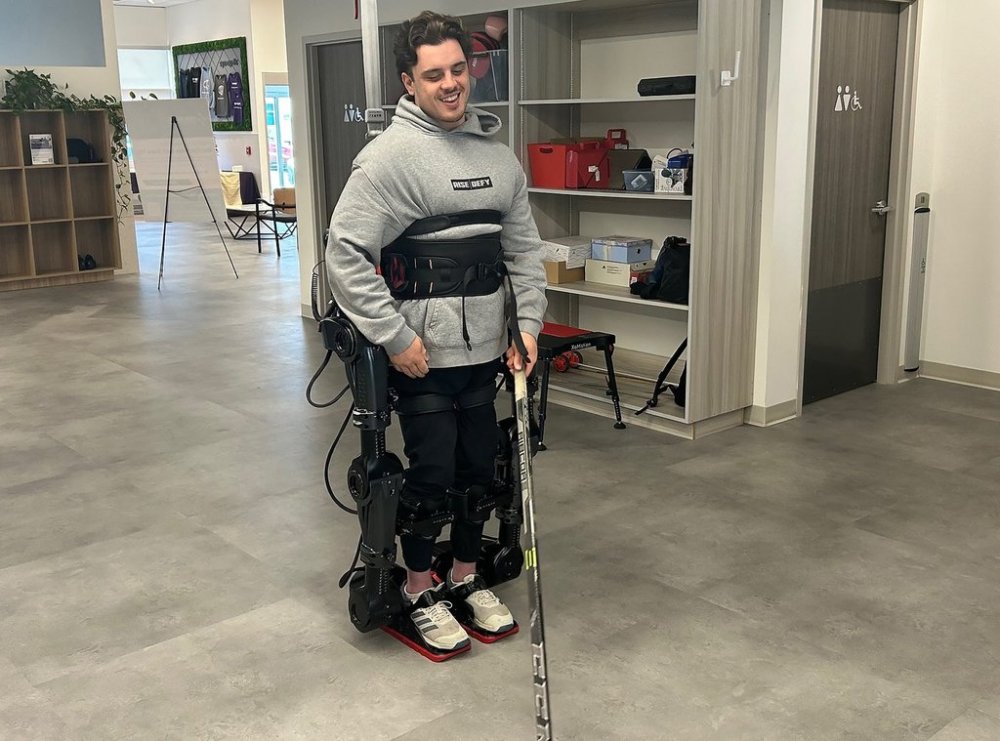
“I forgot how tall I was. I’m usually sitting really low, so I don’t see people above their heads. Now being here, I get to see everybody’s head. It’s cool,” Straschnitzki said while standing in the wearable device.
“I feel like Iron Man in this thing. Just missing the helmet,” he added with a laugh.
Vancouver-based Human in Motion Robotic’s XoMotion system enables people with spinal cord injuries and in neurological rehabilitation to stand and walk with robotic support.
Straschnitzki had been in the device before but got to control it Thursday.
He used a small remote to move the device forward, backward and turn sideways.
It also helped him handle a hockey stick and throw a football to staff at the rehab centre.
“It’s pretty cool. I’m glad I played video games growing up,” he said.
“I got to learn how to two-step in this thing. Someone here’s got to teach me, and I’ll bring it to Stampede.”
Straschnitzki said the technology wasn’t even an option when he was injured.
“It was more so, is my body going to heal? Am I going to walk again on my own?” he said.
“Over time, you come to terms with the extent of your injuries. And then you realize that science is expanding every day, and there’s technology like this one that will allow people with spinal cord injuries to walk again. It’s super incredible and I’m very fortunate to try it.”
The cost of the exoskeleton is about $400,000.
Uyen Nguyen, executive director of Calgary’s Synaptic Spinal Cord Injury and Neuro Rehabilitation Centre, said the exoskeleton mimics human motions.
“I never thought this was going to be possible. It’s almost a Cinderella story that’s come to life,” Nguyen said.
“It is one of the most advanced, because it is the most human-like in movement. Biomechanically, it is smooth. So when Ryan gets into it, it feels great, it feels natural.”
The device will be offered to other patients at the centre, including those with spinal injuries or health problems like Parkinson’s disease.
Siamak Arzanpour, CEO of Human in Motion Robotics Inc., said the goal has always been to help those dealing with injuries have more independence. He said the long-term goal is to have exoskeletons deployed in real life activities, but there needs to be a controlled environment to prove they’re safe first.
He said Straschnitzki was the inspiration for developing the device.
“In 2018, Ryan probably didn’t think about us. But from the beginning, we were thinking about him,” Arzanpour said.
“We wanted to use this device, helping him to walk again.”
This report by The Canadian Press was first published June 12, 2025.