
Meth detention and other health-care issues dominate first day of legislature sitting
Advertisement
Read this article for free:
or
Already have an account? Log in here »
We need your support!
Local journalism needs your support!
As we navigate through unprecedented times, our journalists are working harder than ever to bring you the latest local updates to keep you safe and informed.
Now, more than ever, we need your support.
Starting at $15.99 plus taxes every four weeks you can access your Brandon Sun online and full access to all content as it appears on our website.
Subscribe Nowor call circulation directly at (204) 727-0527.
Your pledge helps to ensure we provide the news that matters most to your community!
To continue reading, please subscribe:
Add Brandon Sun access to your Free Press subscription for only an additional
$1 for the first 4 weeks*
*Your next subscription payment will increase by $1.00 and you will be charged $20.00 plus GST for four weeks. After four weeks, your payment will increase to $24.00 plus GST every four weeks.
Read unlimited articles for free today:
or
Already have an account? Log in here »
WINNIPEG – A recently built protective care centre in central Winnipeg has started to detain people intoxicated with methamphetamines and other drugs for up to 72 hours, Premier Wab Kinew said Wednesday.
The NDP government passed a law last fall to extend detentions beyond the traditional 24 hours — a time frame designed for people intoxicated by alcohol — and set up a building with small cell-like rooms.
Work was then done to ensure there was enough medical oversight and other services so that the longer detentions could start Wednesday, Kinew said.
“What has been going on … is just making sure the equipment, the facility, the expertise, the training for the people who are going to be in this protective care centre, that that is all up to par,” Kinew said.
The new centre is run by Main Street Project, a non-profit that has for decades run a nearby 24-hour centre commonly called the “drunk tank.” The new facility has windowless three-metre-by-three-metre rooms with a toilet, sink, video surveillance and an intercom.
The plan for 72-hour detentions has been criticized by some community groups that have argued that holding people against their will for up to three days criminalizes addiction.
Kinew said the longer detention period is needed to deal with the long-lasting effects of meth, and said people being held will be supervised and offered supports.
“We’re trying to tie people into healing and recovery, we’re trying to tie people into a better path. But the first step is, let’s just keep people in the community safe.”
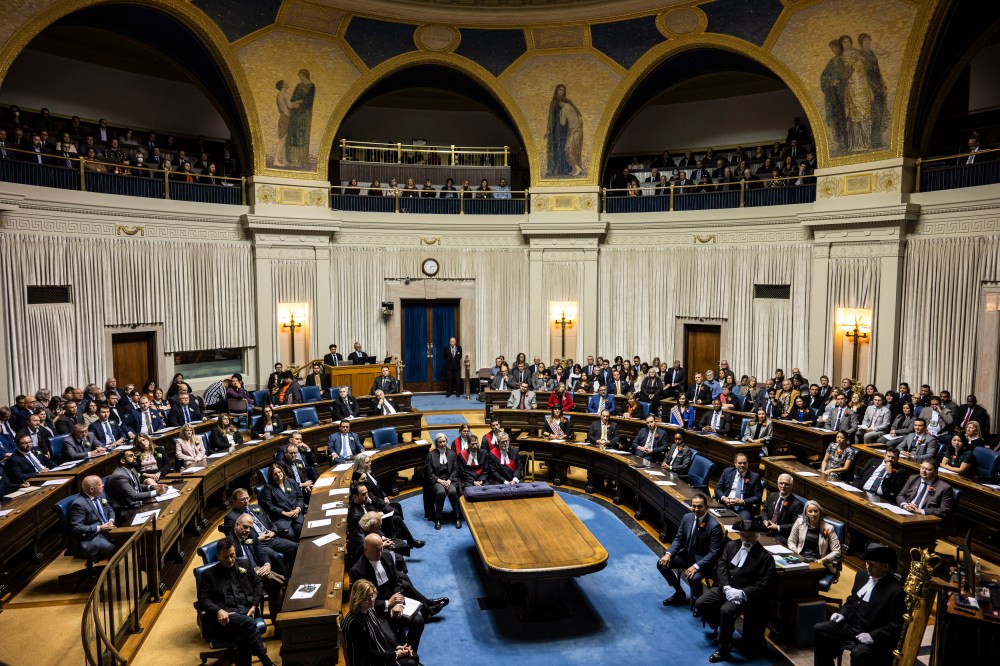
The announcement came on the first day of the spring sitting of the Manitoba legislature, which was dominated by health care.
The Opposition Progressive Conservatives reiterated calls for a public inquiry into the deaths of four people who, in separate incidents in recent months, faced long waits in hospitals.
“We should be looking at the systemic issues that lead to long wait times,” Tory health critic Kathleen Cook said.
The deaths include that of Stacey Ross. Family members have told media that Ross was sent home from a hospital in early January, her condition worsened and she returned several days later. She waited 11 hours before being admitted on the return visit and went into cardiac arrest soon after, her family said.
Kinew said the deaths are the subject of critical incident reviews conducted by health officials. The reviews provide information to the families but are not made public. Kinew said the reviews should provide answers.
“What we’re committed to is being in touch with these families … to see what exactly their reaction is. Do they feel that they have gotten that answer to … what actually happened. And then if so — if they do feel satisfied — all right, let’s figure out what the fix is here.”
Health care has been a key focus for the NDP government since being elected in 2023. It has promised to hire more nurses, doctors and other workers. The government has also promised several new legislative measures related to health care. They are among more than 30 bills scheduled to be brought forward during the spring sitting.
Among them are bills to set better nurse-to-patient ratios, reduce overtime pressure on nurses and improve access to breast cancer screening.
The government introduced one bill Wednesday — one that was initially put forward last fall but failed to pass. The bill would require any future Manitoba legislation that invokes the notwithstanding clause to be referred immediately to the province’s Court of Appeal.
Judges would not have the authority to strike down the legislation but could comment on it and say whether it would be unconstitutional if not for the notwithstanding clause.
Kinew has criticized other provincial governments that have invoked the clause, such as Saskatchewan’s recent law that prevents children under 16 from changing their names or pronouns at school without parental consent.
Kinew has also been critical of Quebec’s use of the notwithstanding clause to prohibit some public sector workers in positions of authority from wearing religious symbols while on the job.
If Manitoba’s bill becomes law, voters will know what judges think about any use of the clause by a Manitoba government, Kinew said.
This report by The Canadian Press was first published March 4, 2026.