
Skis and spas: Proposed Alberta All-season resort a test of new legislation
Advertisement
Read this article for free:
or
Already have an account? Log in here »
We need your support!
Local journalism needs your support!
As we navigate through unprecedented times, our journalists are working harder than ever to bring you the latest local updates to keep you safe and informed.
Now, more than ever, we need your support.
Starting at $15.99 plus taxes every four weeks you can access your Brandon Sun online and full access to all content as it appears on our website.
Subscribe Nowor call circulation directly at (204) 727-0527.
Your pledge helps to ensure we provide the news that matters most to your community!
To continue reading, please subscribe:
Add Brandon Sun access to your Free Press subscription for only an additional
$1 for the first 4 weeks*
*Your next subscription payment will increase by $1.00 and you will be charged $20.00 plus GST for four weeks. After four weeks, your payment will increase to $24.00 plus GST every four weeks.
Read unlimited articles for free today:
or
Already have an account? Log in here »
CALGARY, ALBERTA, CANADA – For now, it’s just a draft plan of a year-round, forested fun zone built on the bones of a failed predecessor — but it’s also the first big test of a provincial plan to deliver a big boost to tourism.
Fortress Mountain Resort is among three resorts poised to take advantage of the provincial government’s All-season Resorts Act, passed in December 2024, to draw private investment in Alberta tourism and, if plans go accordingly, drive tourism revenue to $25 billion by 2035.
The plan at Fortress resort is for close to 10,000 people each year heading to the resort in Kananaskis Country west of Calgary to take advantage of ziplines, spas and skiing.
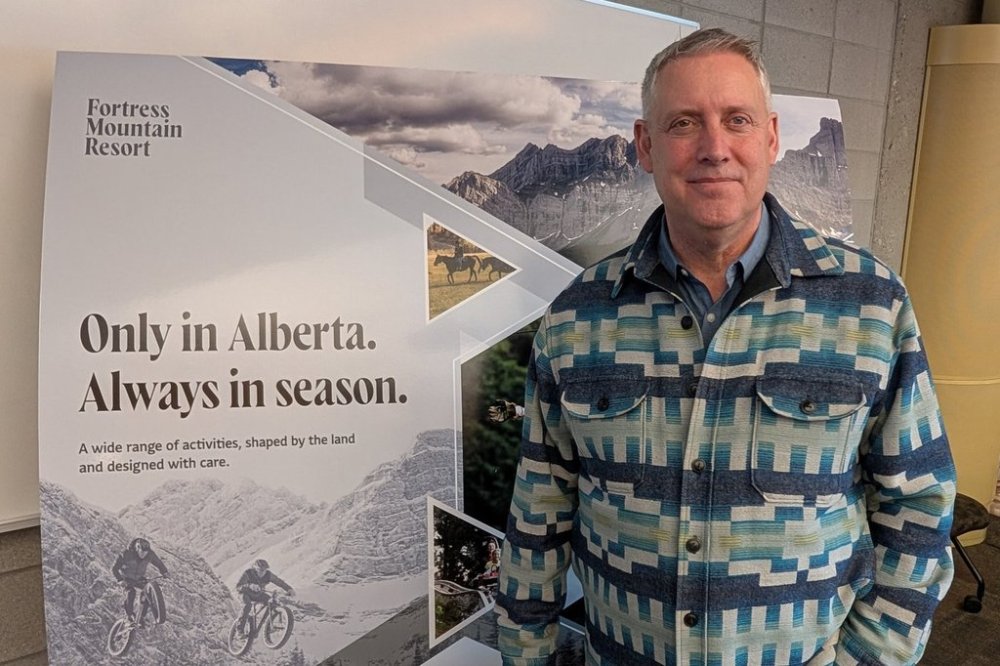
As part of the legislation, Fortress requires Indigenous consultation, public feedback and an environmental report before land is designated an All-season Resort Area.
Public feedback sessions were recently held in Canmore, Calgary and Edmonton. Not everyone is on board. Some worry about price and what kind of a footprint – or ski print – the resort will leave on the surrounding flora and fauna.
At the Calgary session, visitor Danica Hunt said she is concerned about environmental impacts and potentially high prices for Albertans.
“We’re dealing with inflation right now,” Hunt said. “And the fact that another resort is being built that’s probably going to cater to non-Albertans and non-Canadians is not ideal, and frankly, not really wanted either.”
Attendees, both for and against, said they need to know more: how is water and wastewater going to be managed; will it be affordable; and what about parking, which has been a growing problem for resorts in the area.
Chloe Hahn, with the Canadian Parks and Wilderness Society, said they are concerned the resort will change the character of Kananaskis Country, which is home to Spray Valley Provincial Park. Hahn said the proposal is in an area that contains grizzly bear, wolverine and bull trout habitat.
Another issue Hahn has with the development is that it could breach the boundaries of Spray Valley Provincial Park, arguing those protected borders shouldn’t be broken for industry convenience.
David McKenna, president of Ridge North America, contested that, stating it’s being built on Crown land.
McKenna also said nothing is settled as the resort looks to find its niche in a Rocky Mountain area already famous for its ski hills and winter recreation hotspots.
“Right now, the way you see the plans, well, they can all change,” said McKenna.
If the 15-year development plan, split into five phases, goes as outlined, Fortress will be among the larger resorts in Alberta’s Rocky Mountain region — smaller than the Lake Louise Ski Resort (about 1,700 hectares) but larger than the Banff Sunshine Village (about 1,357 hectares).
Phase 1 — mostly summer recreation — could start construction as early as 2027 if the development gets the green light, McKenna said.
Provincial documents say there are 1,470 hectares allocated to Fortress. There are already enough ski trails carved into the area from a former, failed ski resort of the same name to support about 3,000 skiers, says Fortress Resort’s master plan.
McKenna said developers are bringing a national park lens to Fortress and aren’t looking to ruin the aspects that popularize the area.
“The impact has already been had,” he said.
“If you go somewhere else, that’s going to be a greenfield site. And you’re going to knock down trees and (be) putting in roads and everything else.”
This report by The Canadian Press was first published March 7, 2026.