
B.C. challenge to Catholic hospital’s ‘traumatic’ denial of MAID enters closing phase
Advertisement
Read this article for free:
or
Already have an account? Log in here »
We need your support!
Local journalism needs your support!
As we navigate through unprecedented times, our journalists are working harder than ever to bring you the latest local updates to keep you safe and informed.
Now, more than ever, we need your support.
Starting at $15.99 plus taxes every four weeks you can access your Brandon Sun online and full access to all content as it appears on our website.
Subscribe Nowor call circulation directly at (204) 727-0527.
Your pledge helps to ensure we provide the news that matters most to your community!
To continue reading, please subscribe:
Add Brandon Sun access to your Free Press subscription for only an additional
$1 for the first 4 weeks*
- Enjoy unlimited reading on brandonsun.com
- Read the Brandon Sun E-Edition, our digital replica newspaper
*Your next Free Press subscription payment will increase by $1.00 and you will be charged $20.95 plus GST for four weeks. After four weeks, your payment will increase to $24.95 plus GST every four weeks.
Read unlimited articles for free today:
or
Already have an account? Log in here »
VANCOUVER – Allowing publicly funded faith-based health-care providers to impose religious beliefs on patients, including those seeking medical assistance in dying, is a breach of the British Columbia government’s “basic duty” to remain religiously neutral, the B.C. Supreme Court heard Monday.
Closing arguments in a legal challenge brought by the mother of a woman who was denied the procedure at the Catholic-run St. Paul’s Hospital began Monday morning.
The hospital is prohibited by Providence Health Care from offering MAID because of a decision by the Archbishop of Vancouver that it is “morally wrong” under Catholic beliefs.

The legal challenge was filed by the family of 34-year-old Samantha O’Neill, who was denied the procedure at St. Paul’s in 2023 and forced to be transferred by ambulance to another hospital. She was sedated and taken to another facility in an ambulance, but never regained consciousness.
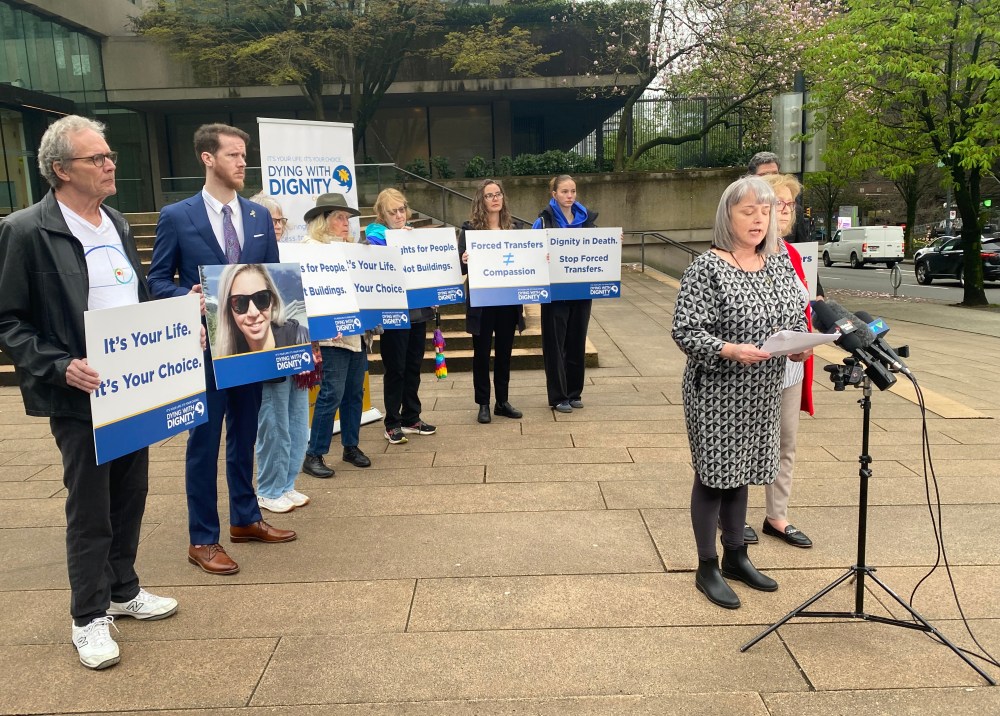
Her mother, Gaye O’Neill, said outside court before the hearing that her daughter’s final hour was “unbearably painful,” and the legal challenge of St. Paul’s policies is “built on her legacy.”
“It was also traumatic and unbearably cruel to witness,” O’Neill said. “I’m here today to fight for the rights of all Canadians.”
She said her daughter, who had advanced cervical cancer, had no way of knowing that an ambulance ride to St. Paul’s would mean the hospital would “impose” the archbishop’s beliefs on her and impede her access to medically assisted dying services.
“It stripped Sam of her dignity and caused unnecessary pain and suffering,” she said. “The act of a non-medically necessary transfers breaks their legal duty to prevent harm. It’s just cruel.”
The lawsuit challenges “institutional religious obstruction” to medical assistance in dying at Catholic-run, publicly funded hospitals, with support from the advocacy group Dying With Dignity Canada.
O’Neill alleges St. Paul’s Hospital imposed the Archbishop of Vancouver’s beliefs to impede her daughter’s access to the procedure.
The family’s lawyer, Robin Gage, told the court that the practice of forcing transfers of patients who choose MAID carries risks, and they “have no choice but to accept those risks” if they receive care at faith-based facilities.
Gage said forcing patients to move to access the procedure amounts to additional and medically unnecessary burdens that they wouldn’t face at secular hospitals.
Gage said forcing them to be transferred to satisfy the religious beliefs of others amounts to a “coercive burden” that runs afoul of the Charter.
She said there’s evidence the government is wrongfully acting with a preference towards Catholicism.
“What they’re doing clearly is preferring religion over non-religion,” Gage said. “It may not use its power in such a way as to promote the participation of certain believers or non-believers in public life to the detriment of others.”
She said the defendants had argued that the case could “result in chaos in the health-care system,” removing a provincially granted exemption from having to offer medically assisted dying services.
“That’s just pure speculation,” Gage said.
University of Ottawa law professor Daphne Gilbert, who sits on Dying With Dignity Canada’s board, said outside court Monday that the case has the potential to “change health care across the country.”
“I think that the faith-based institutions across this country hold a lot of power,” she said. “Provinces are notoriously risk-averse when it comes to change, and this will be a big change. So I’m not surprised that they’re letting the court decide.”
Closing arguments continue this week, and Gilbert hopes the court rules this fall, depending on the judge’s schedule.
She said the case is likely to eventually end up before the Supreme Court of Canada.
“I think that the question of religious institutional freedom is one that eventually the Supreme Court is going to have to weigh in on,” Gilbert said.
This report by The Canadian Press was first published April 13, 2026.