
B.C. tables treaty legislation after 30-year negotiation with K’omoks First Nation
Advertisement
Read this article for free:
or
Already have an account? Log in here »
We need your support!
Local journalism needs your support!
As we navigate through unprecedented times, our journalists are working harder than ever to bring you the latest local updates to keep you safe and informed.
Now, more than ever, we need your support.
Starting at $15.99 plus taxes every four weeks you can access your Brandon Sun online and full access to all content as it appears on our website.
Subscribe Nowor call circulation directly at (204) 727-0527.
Your pledge helps to ensure we provide the news that matters most to your community!
To continue reading, please subscribe:
Add Brandon Sun access to your Free Press subscription for only an additional
$1 for the first 4 weeks*
- Enjoy unlimited reading on brandonsun.com
- Read the Brandon Sun E-Edition, our digital replica newspaper
*Your next Free Press subscription payment will increase by $1.00 and you will be charged $20.95 plus GST for four weeks. After four weeks, your payment will increase to $24.95 plus GST every four weeks.
Read unlimited articles for free today:
or
Already have an account? Log in here »
A First Nation in British Columbia is one step closer to a fully ratified treaty after the province tabled implementation legislation on Tuesday, about 30 years after negotiations began.
The treaty would confirm K’omoks First Nation ownership of about 3,442 hectares of land scattered around Vancouver Island with an additional 1,592 hectares available for purchase from the province over time.
The document would replace an Indian Act-imposed band administration with a government authority for all K’omoks members and give the First Nation of about 350 members the ability to make laws around issues including taxation, child protective services and the administration of justice.
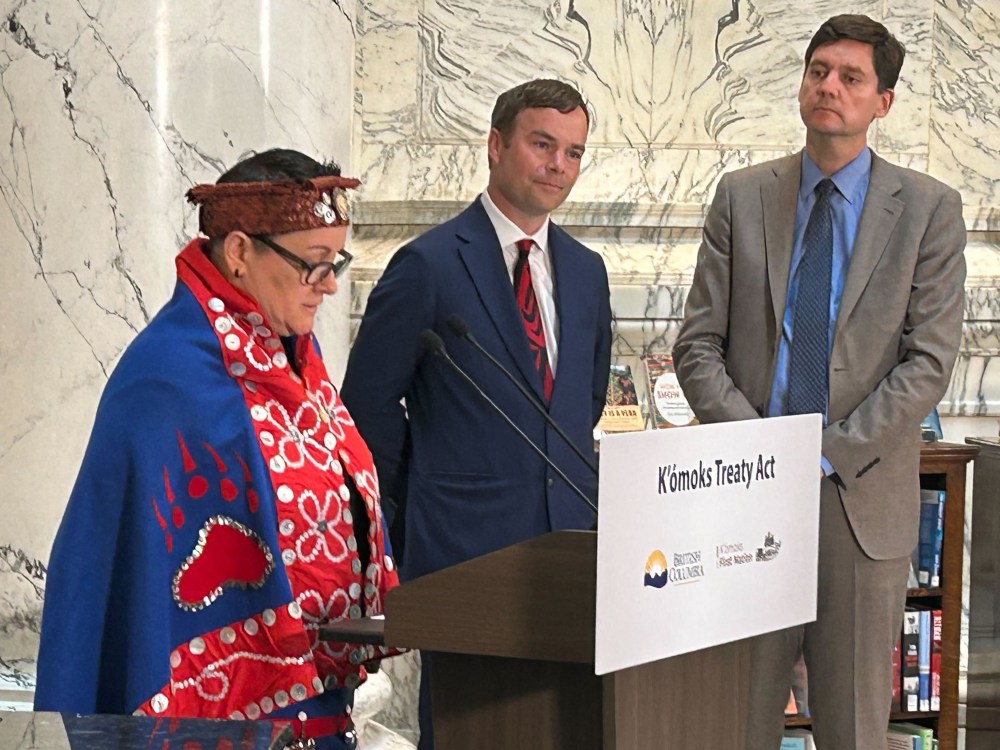
Chief Coun. Nicole Rempel told the legislature Tuesday that the move was a meaningful step toward a future where the nation can fully realize its potential.
“For K’omoks, this moment carries hope. Hope that began with our past leaders who believed that a better future was possible, and hope that lives today in our leadership, in our people, in our children and in the generations yet to come,” she said.
“Let us move forward together with purpose, with certainty and with a shared commitment in the future that we are building.”
The treaty sets out a process to co-develop shared decision-making agreements on several topics, including stewardship of wildlife, parks, fish and water, and includes plans for two public tribal parks, one made up of three small islands off of Denman Island and the second in the Wildwood forest.
It was ratified by First Nation members in March of 2025 and needs to be ratified by the federal government next to become legally binding, with government documents suggesting 2028 would be the earliest possible effective date.
It would make the K’omoks First Nation the eighth First Nation in B.C. to have a modern treaty.
Once the treaty is fully ratified, it comes with a $56 million one-time federal transfer payment, as well as ongoing funding for self-government.
All the land covered by the treaty is already owned by either the First Nation or the provincial government.
B.C. Premier David Eby called the treaty a “living agreement” that “will recognize the rights and title, including the inherent right to self-government, of the K’omoks people.”
“Courts have consistently recognized Indigenous rights and title in British Columbia, these rights cannot be erased by any government of any stripe. But for too long, that reality was ignored, the result was constant conflict, court battles and uncertainty,” he said.
“This is a path of healing, of partnership, of affirming long sought rights and self determination towards lasting reconciliation.”
The B.C. legislation comes amid controversy over Indigenous relations set off by a legal decision last year that found the Cowichan Tribes hold Aboriginal title over about 300 hectares of land on the Fraser River in Richmond, B.C. The ruling that found provincial Crown grants of private ownership interests “do not extinguish nor permanently displace Aboriginal title” is being appealed by multiple parties and has raised concerns over its impact on private property.
Eby has also faced heavy criticism over his government’s plan to suspend portions of its Declaration on the Rights of Indigenous People Act, known as DRIPA, after a different court ruled the act needed to be “properly interpreted” to incorporate the UN Declaration on the Rights of Indigenous Peoples into B.C. laws.
At a briefing Tuesday, government officials said even if a future government sought to change repeal DRIPA, treaties and the process involved would remain.
This report by The Canadian Press was first published April 14, 2026.