
Oh, give me a home: Alberta-raised wood bison calves safely relocated to Alaska
Advertisement
Read this article for free:
or
Already have an account? Log in here »
We need your support!
Local journalism needs your support!
As we navigate through unprecedented times, our journalists are working harder than ever to bring you the latest local updates to keep you safe and informed.
Now, more than ever, we need your support.
Starting at $15.99 plus taxes every four weeks you can access your Brandon Sun online and full access to all content as it appears on our website.
Subscribe Nowor call circulation directly at (204) 727-0527.
Your pledge helps to ensure we provide the news that matters most to your community!
To continue reading, please subscribe:
Add Brandon Sun access to your Free Press subscription for only an additional
$1 for the first 4 weeks*
- Enjoy unlimited reading on brandonsun.com
- Read the Brandon Sun E-Edition, our digital replica newspaper
*Your next Free Press subscription payment will increase by $1.00 and you will be charged $20.95 plus GST for four weeks. After four weeks, your payment will increase to $24.95 plus GST every four weeks.
Read unlimited articles for free today:
or
Already have an account? Log in here »
Dozens of Alberta-raised bison calves sent to Alaska as part of a relocation agreement with the state made it safely to their new home, but it wasn’t without months of logistical work and a 40-hour trip on treacherous northern roads.
Jonathan DeMoor, resource conservation manager for Elk Island National Park, said the 44 wood bison arrived in Fairbanks, Alaska, on Tuesday night.
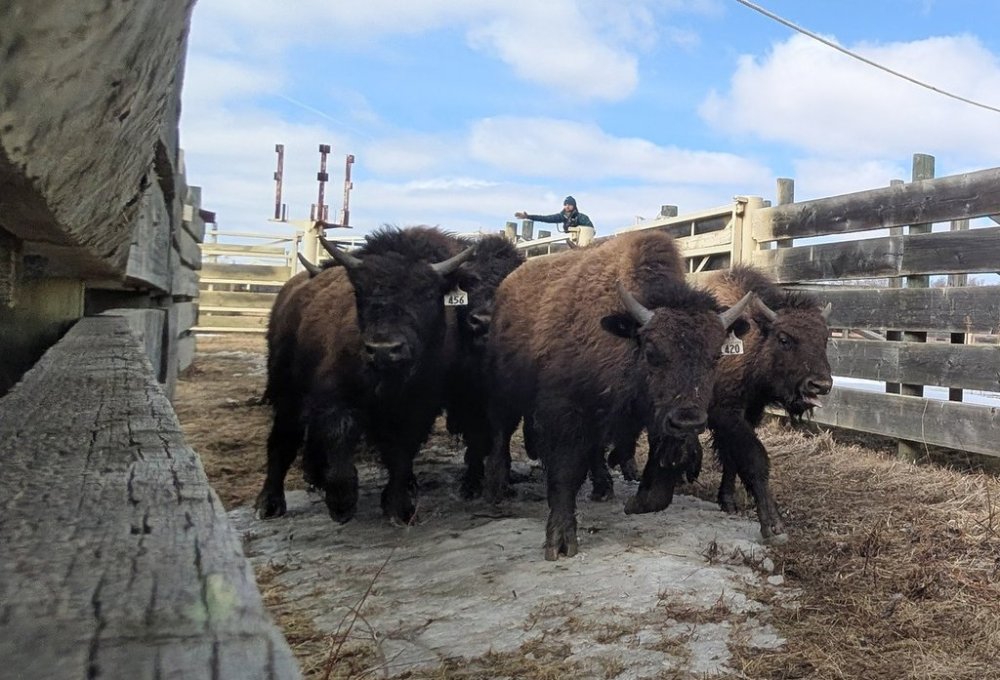
The calves, which are all under one years old, departed Monday morning from the park east of Edmonton on a cattle liner with wood chip bedding, water and hay — their food of choice. They were also given a tranquillizer to help calm their nerves.
DeMoor said the animals were inspected by the Canadian Food Inspection Agency before they were loaded onto the liner, which remained sealed for the non-stop drive to the Alaska interior.
“They unloaded every animal successfully,” DeMoor said in an interview Wednesday.
“We hold our breath a little bit, because it’s a long drive.”
He said the trip took a little longer than the usual 36 hours because of snow and slushy conditions on the road near Whitehorse.
The bison entourage included three Elk Island staff members in another vehicle, constantly monitoring the animals’ welfare.
“They have some contingency supplies along with them, just in case anything happens during the drive,” DeMoor said.
The only pit stop was in Whitehorse, where the truck driver handed the animals off to a second driver to finish the trek north.
Park staff spent months selecting the large-hoofed animals and getting them ready. They also had to undergo a 60-day quarantine, separated from other bison.
This was the fourth wood bison transfer from Elk Island to Alaska, which previously received herds from the park in 2008, 2022 and 2024.
DeMoor said the park has a memorandum of understanding with the state that includes another transfer in two years.
“We’re likely to renew that MOU, but we haven’t entered negotiation around that yet,” he said.
There are more than 170 wood bison in Alaska, which are all from Elk Island or descendants of ones that were.
The relocation program is part of a federal government plan to ensure survival of the species, which was once on the brink of extinction.
One of the main ways the fully fenced park manages its bison population is by moving them to other natural habitats, including Indigenous communities in North America.
Alaska isn’t the farthest Elk Island bison have travelled. The park used to have a memorandum of understanding with the Sakha Republic in Russia. Wood bison were sent to a national park there in 2006, 2011, 2013 and 2020.
For those transfers, DeMoor said, as many as 30 bison were loaded onto a military transport plane.
“The steppe bison population there was extirpated, but the wood bison are the closest living relative. So that’s why they were getting animals from Elk Island,” he said.
There are no more plans to send bison to the Siberian territory, after relations between Canada and Russian worsened with the war in Ukraine.
Elk Island has played a key role in the conservation of bison since the early 1900s.
DeMoor said plains bison are usually relocated to areas south of the park, while wood bison, which were introduced there in 1965, are better suited for boreal forests to the north.
This report by The Canadian Press was first published April 15, 2026.