
Climate change is eroding typical nighttime breaks in wildfire activity, study says
Advertisement
Read this article for free:
or
Already have an account? Log in here »
We need your support!
Local journalism needs your support!
As we navigate through unprecedented times, our journalists are working harder than ever to bring you the latest local updates to keep you safe and informed.
Now, more than ever, we need your support.
Starting at $15.99 plus taxes every four weeks you can access your Brandon Sun online and full access to all content as it appears on our website.
Subscribe Nowor call circulation directly at (204) 727-0527.
Your pledge helps to ensure we provide the news that matters most to your community!
To continue reading, please subscribe:
Add Brandon Sun access to your Free Press subscription for only an additional
$1 for the first 4 weeks*
- Enjoy unlimited reading on brandonsun.com
- Read the Brandon Sun E-Edition, our digital replica newspaper
*Your next Free Press subscription payment will increase by $1.00 and you will be charged $20.95 plus GST for four weeks. After four weeks, your payment will increase to $24.95 plus GST every four weeks.
Read unlimited articles for free today:
or
Already have an account? Log in here »
Climate change is breaking down typical nighttime lulls in wildfire activity, a new study by researchers in Canada suggests, eroding opportunities for crews to contain the intensifying blazes.
The study co-authored by researchers in British Columbia and Alberta suggests the number of fire-friendly hours has surged across North America in the past 50 years, and especially in Western Canada’s wildfire hotspots.
The study, published Friday in the peer-reviewed journal Science Advances, suggests much of Western Canada has seen an additional four to five hours of fire-conducive conditions each wildfire season for the past half-century.
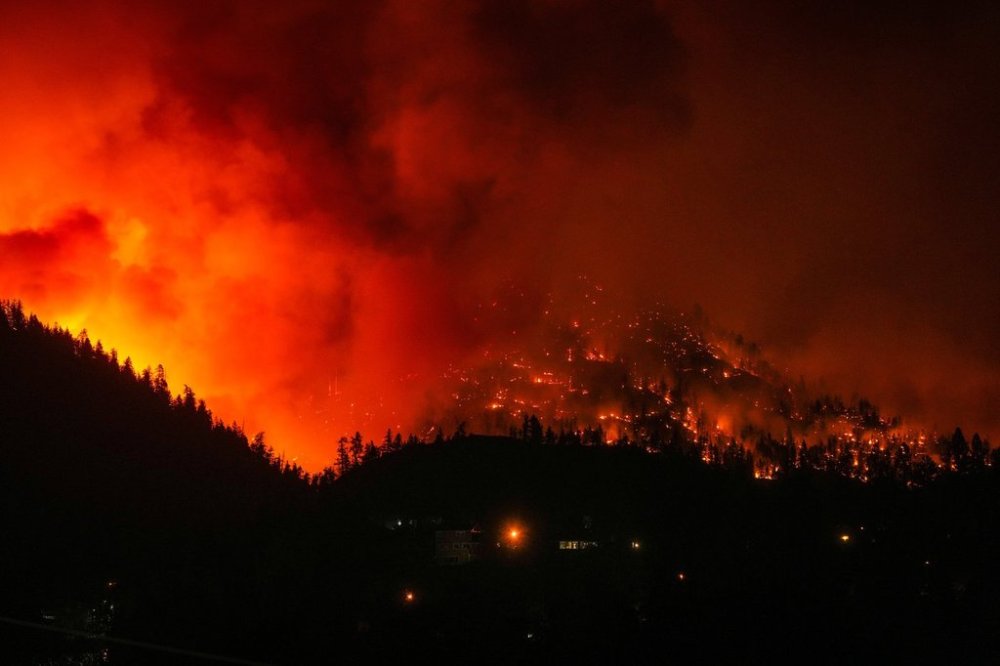
In British Columbia and Alberta, that translates to about 200 to 250 more hours of fire-fuelling conditions in current seasons compared to those in the 1970s, cutting into once-quieter overnight hours and periods in the spring and fall.
By mid-century, co-author Kaiwei Luo says Canada’s record-breaking 2023 fire season could be “rapidly normalized.”
“Extreme fire seasons will be rapidly normalized if these day and night fire constraints continue to shrink or continue to weaken,” said Luo, who conducted the research during his PhD at the University of Alberta.
“So that means once the fire ignites, there’s no nighttime conditions to hinder it or to stop it.”
Nights and mornings — when, typically, temperatures are lower, humidity is higher and winds are calmer — can help to slow wildfire spread and give firefighters a crucial reprieve. Even the most active areas in Canada only support about nine hours of fire-friendly conditions on an average day during the fire season, the study says.
But the researchers say climate change, which is largely driven by fossil-fuel emissions, is fuelling a surge in the number of days that can support more than 12 hours or burning, or even a full 24 hours of fire-friendly conditions.
“Addressing these challenges will require innovative approaches in fire science and management that account for the changing temporal dynamics of wildfires at hourly scales,” says the study, co-authored by researchers at the University of Alberta, Thomson Rivers University and Natural Resources Canada.
Days with the potential for round-the-clock fire-friendly conditions, once rare in northern Alberta and the Northwest Territories, have jumped by 232 per cent since the 1970s in those parts of the boreal tundra woodland, the study says. Days with more than 12 hours of fire-friendly conditions have increased by 80 per cent.
Similar increases were noted in temperate mountain forests, including in the B.C. Interior and the U.S. Pacific northwest.
Alberta and B.C. have both expanded their nighttime aerial firefighting in recent seasons, equipping more helicopter pilots with night-vision goggles.
Canada is warming about twice as fast as the global average and even faster in northern parts of the country, in part due to the loss of snow and sea ice cover that acts as a shield to reflect the sun’s radiation.
Other studies have looked at changes to the length and severity of wildfire seasons, but fewer have looked at burn activity over a 24-hour cycle. The same researchers behind Friday’s study published a 2024 paper linking extreme overnight fire activity to drought.
For this study, the researchers analyzed hourly satellite data from 2017 to 2023 for nearly 9,000 wildfires across North America. They found 60 per cent of those fires hit their peak intensity in less than 24 hours, and 14 per cent peaked at night.
The research team then trained a machine-learning model on those recent hourly observations to estimate wildfire activity from 1975 to 2024 based on historical weather conditions.
The study suggests that, across the continent, annual potential burning hours increased by 36 per cent over those 50 years.
Summer — peak wildfire season — saw the largest absolute gains in potential burning hours, but the typically quiet spring and fall seasons saw steeper relative gains with 57 and 48 per cent increases, respectively, the study says.
This report by The Canadian Press was first published April 17, 2026.