
El Nino expected to lessen the number of tropical storms and hurricanes this season
Advertisement
Read this article for free:
or
Already have an account? Log in here »
We need your support!
Local journalism needs your support!
As we navigate through unprecedented times, our journalists are working harder than ever to bring you the latest local updates to keep you safe and informed.
Now, more than ever, we need your support.
Starting at $15.99 plus taxes every four weeks you can access your Brandon Sun online and full access to all content as it appears on our website.
Subscribe Nowor call circulation directly at (204) 727-0527.
Your pledge helps to ensure we provide the news that matters most to your community!
To continue reading, please subscribe:
Add Brandon Sun access to your Free Press subscription for only an additional
$1 for the first 4 weeks*
- Enjoy unlimited reading on brandonsun.com
- Read the Brandon Sun E-Edition, our digital replica newspaper
*Your next Free Press subscription payment will increase by $1.00 and you will be charged $20.95 plus GST for four weeks. After four weeks, your payment will increase to $24.95 plus GST every four weeks.
Read unlimited articles for free today:
or
Already have an account? Log in here »
HALIFAX – The Canadian Hurricane Centre is predicting a slightly below average hurricane season because of the anticipated arrival of a disruptive El Nino climate pattern, but a senior meteorologist says Canadians should not let their guard down.
The Atlantic hurricane season starts June 1 and ends Nov. 30.
Environment Canada meteorologist Bob Robichaud said Thursday the arrival of El Nino results in warmer water rising to the surface of the Pacific Ocean near the equator, which is expected to happen around the same time hurricane season peaks in September.
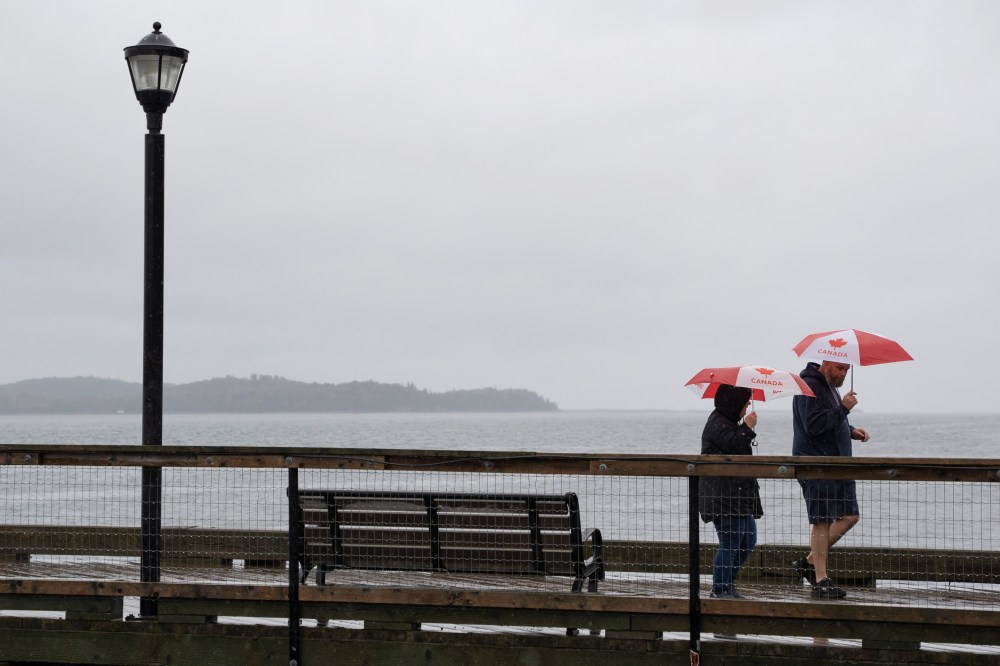
The cyclical El Nino phenomenon creates wind shear on the western side of the Atlantic, where high-altitude winds can disrupt the formation of hurricanes by tearing them apart, Robichaud told a media briefing in Halifax.
“It’s amazing how wind shear can really dampen the formation or intensification of a hurricane, even when everything else is perfect for a storm to develop,” he said. “That’s really the main driver when we look at El Nino. It’s that wind shear component … that results in fewer storms.”
Still, Robichaud stressed that Canadians should always prepare for damaging weather. One or two named storms typically have some impact on Canadian territory every year, he said.
“Even in an El Nino year, you can still have major hurricanes developing in the Atlantic, and we’ve seen numerous examples of that,” he said, citing September 2002 when Hurricane Gustav made landfall in Cape Breton.
The storm lashed the eastern side of Nova Scotia with heavy rain and winds gusting at more than 100 kilometres an hour, knocking out power in parts of Halifax before moving on to Prince Edward Island.
And in 2022, only one post-tropical storm made landfall in the Atlantic region. Fiona’s arrival in Nova Scotia on Sept. 24 heralded Atlantic Canada’s costliest weather event, causing more than $800 million in insured damage. The storm, as powerful as a Category 2 hurricane, was also blamed for killing three people in Canada.
“When we talk about a forecast of below average (hurricane) activity, people start to let their guard down and they think that it’s not going to be that bad,” Robichaud said. “But it only takes one …. And (Fiona) is a perfect example of that.”
As well, Robichaud said the wind shear expected over the western Atlantic this season won’t be a constant presence.
“In those periods of time when it decreases, that’s the window of opportunity for a storm to develop. And when a storm does develop …. we could still get an impactful storm here in Canada.”
Earlier in the day, the U.S.-based National Oceanic and Atmospheric Administration issued its seasonal outlook for the Atlantic, forecasting eight to 14 named storms, with three to six of them becoming strong enough to hit hurricane status and one to three of those intensifying to major hurricanes.
An average hurricane season has 14 named storms, seven of them becoming hurricanes and three of them reaching major hurricane level, which is more than 177 km per hour.
Meanwhile, Colorado State University, a leader in seasonal forecasting, is predicting the lowest overall hurricane activity since 2015, which marked the arrival of the strongest El Nino in the last 75 years.
This season, many private and government forecasts are calling for a strong, super-strong or even record-setting El Nino.
The latest forecasts stand is sharp contrast to the previous 10 Atlantic hurricane seasons, all of which were anticipated to be above normal or even hyperactive.
This report by The Canadian Press was first published May 21, 2026.
— With files from The Associated Press