
Legendary grizzly bear ‘The Boss’ removes tracking collar at Banff National Park
Advertisement
Read this article for free:
or
Already have an account? Log in here »
We need your support!
Local journalism needs your support!
As we navigate through unprecedented times, our journalists are working harder than ever to bring you the latest local updates to keep you safe and informed.
Now, more than ever, we need your support.
Starting at $15.99 plus taxes every four weeks you can access your Brandon Sun online and full access to all content as it appears on our website.
Subscribe Nowor call circulation directly at (204) 727-0527.
Your pledge helps to ensure we provide the news that matters most to your community!
To continue reading, please subscribe:
Add Brandon Sun access to your Free Press subscription for only an additional
$1 for the first 4 weeks*
- Enjoy unlimited reading on brandonsun.com
- Read the Brandon Sun E-Edition, our digital replica newspaper
*Your next Free Press subscription payment will increase by $1.00 and you will be charged $20.95 plus GST for four weeks. After four weeks, your payment will increase to $24.95 plus GST every four weeks.
Read unlimited articles for free today:
or
Already have an account? Log in here »
BANFF – One of Canada’s best-known bears was one of three recently trapped and collared as part of a program to better track grizzlies in Rocky Mountain national parks, but The Boss managed to rip it off in no time.
Parks Canada says Bear 122, or affectionately known as The Boss by locals, was captured on May 13 by wildlife specialists using a culvert trap.
“Bear 122 is a well-known, wide-ranging bear that spends significant time near populated areas and is frequently observed by visitors,” said Justin Brisbane, a Parks Canada spokesperson in an email statement.
“However, within a week he was able to remove the collar, which is not unusual for a large male grizzly to do.”
The federal agency is collaring grizzlies in the area as part of ongoing monitoring to better understand habitat security and how the animals are using the landscape, Brisbane said.
Grizzly bears are considered a species of special concern under the federal Species at Risk Act. In Alberta, they are listed as threatened.
Brisbane said data from the GPS collars are to provide information that supports “evidence-based, adaptive management,” including refining the grizzly bear habitat security model, a commitment in the 2022 management plan for Banff National Park.
“This model helps improve understanding of habitat suitability and importance, by considering season, levels of human disturbance, and connectivity between habitat patches,” he said.
Parks Canada did not say whether there are plans to recapture and collar The Boss, who has fathered about three-quarters of the cubs in the Banff area.
The 700-pound grizzly has also survived two train collisions and is believed to be between 25 to 30 years old.
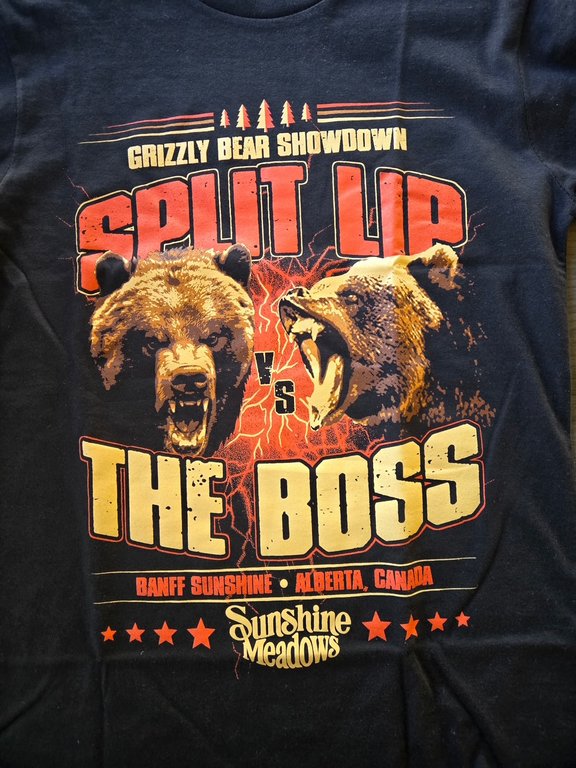
The Boss even has his own Wikipedia page and merchandise sold by the Banff Sunshine Village Ski & Snowboard Resort.
A T-shirt, which looks like a fight poster, is sold at the resort that reads “Grizzly Bear Showdown; Split Lip vs. The Boss,” referring to a younger grizzly starting to challenge the famous bruin and widely believed to be the heir apparent.
Earlier this week, Parks Canada also issued a no-stopping zone along a stretch of the Bow Valley Parkway after receiving reports of several bear jams on the roadway.
The agency said visitors will not be allowed to stop their vehicles along the 1.5-kilometre stretch of the highway between Baker Creek Chalets and Protection Mountain Campground in Banff National Park.
The designation comes after responded to unsafe parking along the roadway and people leaving their vehicles to approach bears, Parks Canada said in a news release.
“Crowding bears along the roadside and actively pursuing them causes bears stress and may result in them avoiding critical food sources and habitat,” Parks Canada said.
“Crowds of people can also block critical escape routes for bears who may be trying to avoid oncoming trains.”
June is also mating season for bears, and male bears can display unpredictable behaviour, Parks Canada said.
“These stressors, combined with high levels of human presence, create the risk of a negative human-bear encounter.”
This report by The Canadian Press was first published June 6, 2026.
— By Daniela Germano in Edmonton