
B.C. Supreme Court finds Victoria has authority to restrict camping in city parks
Advertisement
Read this article for free:
or
Already have an account? Log in here »
We need your support!
Local journalism needs your support!
As we navigate through unprecedented times, our journalists are working harder than ever to bring you the latest local updates to keep you safe and informed.
Now, more than ever, we need your support.
Starting at $15.99 plus taxes every four weeks you can access your Brandon Sun online and full access to all content as it appears on our website.
Subscribe Nowor call circulation directly at (204) 727-0527.
Your pledge helps to ensure we provide the news that matters most to your community!
To continue reading, please subscribe:
Add Brandon Sun access to your Free Press subscription for only an additional
$1 for the first 4 weeks*
- Enjoy unlimited reading on brandonsun.com
- Read the Brandon Sun E-Edition, our digital replica newspaper
*Your next Free Press subscription payment will increase by $1.00 and you will be charged $20.95 plus GST for four weeks. After four weeks, your payment will increase to $24.95 plus GST every four weeks.
Read unlimited articles for free today:
or
Already have an account? Log in here »
VICTORIA – The B.C. Supreme Court has found that the City of Victoria did not go beyond its authority by passing bylaws restricting overnight camping in some city parks.
Three homeless petitioners sought to quash two bylaws passed by the city in 2024 and 2025 that prohibited “temporary overnight sheltering” in Irving and Victoria West parks.
Petitioners Krystle Fox, Kimberly Scheu and Shea Smith claimed the city exceeded its authority by enacting bylaws that didn’t properly consider whether washrooms were available where camping was allowed, or account for international legal obligations affirming the peoples’ rights to housing and water.
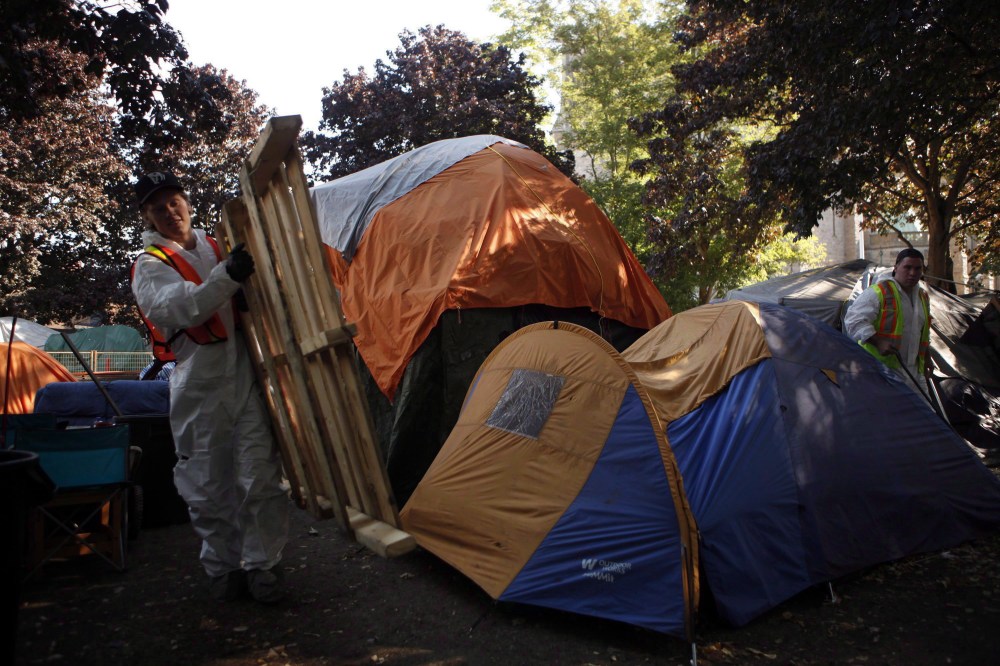
The ruling said Scheu is now housed and Smith is now deceased, and the action continued with just Fox as the petitioner with “private interest standing.”
The ruling said that “courts have recognized that when there are inadequate accessible indoor shelter spaces to accommodate persons genuinely experiencing homelessness, those persons are entitled to erect temporary overnight shelters in public parks.”
“The difficult circumstances faced by the petitioners and other unhoused persons in finding and maintaining adequate shelter are not disputed,” the judge wrote.
“Nor is the fact that there are insufficient indoor shelter spaces available for unhoused persons in the city. The city thus accepts that it cannot enact a complete prohibition on temporary overnight sheltering in its parks.”
The court found the city was within its authority to enact the bylaws and dismissed the petition, but left the door open for an action to “directly challenge the constitutionality of the bylaws.”
B.C. Human Rights Commissioner Kasari Govender was an intervener in the case and said in a statement that she was disappointed with the decision.
She said the ruling “presents another obstacle to unhoused people seeking to challenge municipal bylaws that undermine their rights and dignity.”
“People with disabilities and Indigenous peoples are significantly more likely to be unhoused,” she said.
Alexander Kirby, the petitioners’ lawyer, said they are “considering our options going forward.”
The petitioners, the court found, had mistakenly tried to claim that the question whether the bylaw was unconstitutional was “settled,” rather than “a disputed constitutional question.”
“The constitutionality of the 2025 bylaw remains to be determined,” Justice Jacqueline Hughes wrote.
“That determination cannot be made on the record presently before the Court. It requires the evidentiary rigours and procedural safeguards that customarily apply in a constitutional challenge proceeding by way of civil action.”
This report by The Canadian Press was first published June 12, 2026