
Montreal hospital livestreams surgeries for educational purposes
Advertisement
Read this article for free:
or
Already have an account? Log in here »
We need your support!
Local journalism needs your support!
As we navigate through unprecedented times, our journalists are working harder than ever to bring you the latest local updates to keep you safe and informed.
Now, more than ever, we need your support.
Starting at $15.99 plus taxes every four weeks you can access your Brandon Sun online and full access to all content as it appears on our website.
Subscribe Nowor call circulation directly at (204) 727-0527.
Your pledge helps to ensure we provide the news that matters most to your community!
To continue reading, please subscribe:
Add Brandon Sun access to your Free Press subscription for only an additional
$1 for the first 4 weeks*
- Enjoy unlimited reading on brandonsun.com
- Read the Brandon Sun E-Edition, our digital replica newspaper
*Your next Free Press subscription payment will increase by $1.00 and you will be charged $20.95 plus GST for four weeks. After four weeks, your payment will increase to $24.95 plus GST every four weeks.
Read unlimited articles for free today:
or
Already have an account? Log in here »
MONTRÉAL – A Montreal hospital is livestreaming complex eye surgeries to give medical trainees a real-time window into the operating room.
The Angus Centre for outpatient ophthalmic surgery at the Maisonneuve-Rosemont Hospital is hoping to become an international leader in this field.
Dr. Flavio Rezende performed a series of retinal surgeries on Tuesday, which were all broadcast live to a downtown observation room.
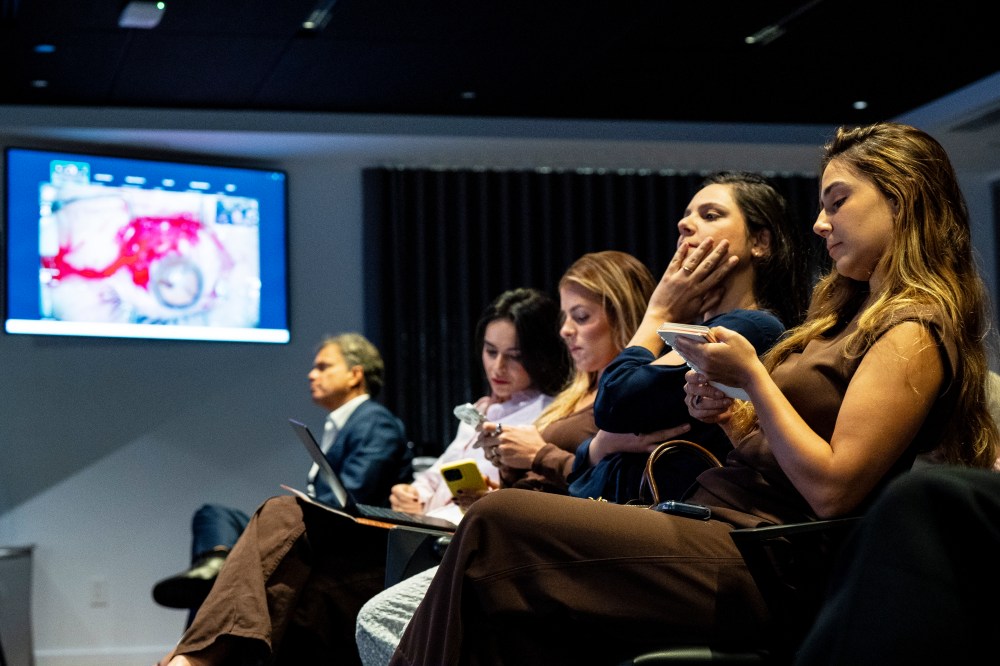
Doctors from all over the world are in the city for the annual American Society of Retina Specialists congress, which began Wednesday, and were able to watch Rezende’s livestream.
Rezende chose cases of varying difficulty to give viewers a broad look at different surgical techniques.
“I find it really useful because it helps you understand the thought process of the surgeon performing the procedure,” said Dr. Fares Antaki, a vitreoretinal surgeon who will begin working at the Centre hospitalier de l’Université de Montréal in September.
“You can try to apply some of the things you learned during the session.”
He added that he appreciated being able to ask specific questions about what he was seeing in real time and having discussions with the surgeon afterward.
It took about four years to organize Tuesday’s broadcast, which required specialized cameras and a reliable high-speed internet connection to prevent lagging.
Retinal surgery involves microscopic operations.
The Maisonneuve-Rosemont’s expertise lies in performing these types of surgeries using a small tube equipped with a camera.
“Normally, when we operate, we see images of the retina through the cornea. It’s like a transparent layer that allows us to see through it,” Rezende explained.
“There are patients whose corneas are opaque because they’ve suffered trauma or something similar. So, we wouldn’t be able to perform the surgery if we didn’t have the camera inside the eye.”
Dr. Cynthia Qian, a retinal surgeon and colleague of Rezende, said that when students or doctors attend conferences, the surgeries presented are often carefully staged.
“Sometimes, five-hour procedures are summarized in two minutes. So it doesn’t really reflect what happens in real time,” she said.
But by watching sensitive and complex surgeries live, students can learn from real-life situations, said Dr. Bruna Gil Ferreira, a retinal surgeon who did her postgraduate training at Université de Montréal and now practices in Brazil.
“Sometimes, when you go to a conference or take a course, you’re only taught classic, straightforward cases, but real life doesn’t work that way,” Gil Ferreira pointed out. “Here … we can see firsthand what he’s doing and how it’s going.”
Operating rooms being quite small, having the operation broadcast in another room allows for a larger audience, said Qian.
Rezende also hopes the livestreams can help curb the spread of misinformation on social media. He said he is concerned about some surgical videos circulating online.
“There are a lot of videos posted online in one way or another, with very little quality control,” he said. “So the goal is to build something in Quebec … to create high-quality, high-level, highly complex surgical content.”
And by holding more of these livestream sessions, Rezende hopes to boost the Montreal hospital’s international reputation.
—
The Canadian Press’s health coverage is supported by a partnership with the Canadian Medical Association. The Canadian Press is solely responsible for this journalistic content.