
Advocates planting the seed of a tree protection law in Winnipeg’s election
Advertisement
Read this article for free:
or
Already have an account? Log in here »
We need your support!
Local journalism needs your support!
As we navigate through unprecedented times, our journalists are working harder than ever to bring you the latest local updates to keep you safe and informed.
Now, more than ever, we need your support.
Starting at $15.99 plus taxes every four weeks you can access your Brandon Sun online and full access to all content as it appears on our website.
Subscribe Nowor call circulation directly at (204) 727-0527.
Your pledge helps to ensure we provide the news that matters most to your community!
To continue reading, please subscribe:
Add Brandon Sun access to your Free Press subscription for only an additional
$1 for the first 4 weeks*
- Enjoy unlimited reading on brandonsun.com
- Read the Brandon Sun E-Edition, our digital replica newspaper
*Your next Free Press subscription payment will increase by $1.00 and you will be charged $20.95 plus GST for four weeks. After four weeks, your payment will increase to $24.95 plus GST every four weeks.
Read unlimited articles for free today:
or
Already have an account? Log in here »
WINNIPEG – The giants that Diane Poulin used to live among are all dead, but she’s hoping to protect the ones still left in Winnipeg.
“I had five mature elm trees right in front of my house that leaned over the street and formed a beautiful canopy, and they’re all gone now,” she says.
In her backyard was the biggest of the bunch.
“He was like the grandfather of the neighbourhood … his canopy filled our backyard, and he’s gone.”
The city’s trees are under threat from disease, pests and climate change, but there’s limits on how much can be done to push back against these forces of nature.
So, Poulin and other advocates at Trees Please Winnipeg are also pushing to hold back another threat — property owners.
The group wants Winnipeg to put a bylaw in place to control the cutting of trees on private property, since there’s currently little stopping owners from cutting down as many trees, however big, as they please.
Advocates like Poulin say protecting the urban canopy is crucial because of the many benefits trees bring to all residents, such as providing shade in heat waves, cleaning the air, controlling rainwater and beautifying the city.
With more than 80 per cent of the city’s trees on private property, there needs to be a way to preserve those trees, too, she says.
To ramp up pressure, Trees Winnipeg has pushed candidates in the municipal election to sign a pledge that includes a commitment to enact a bylaw that would control the removal of all tress more than 15 centimetres in diameter.
Many cities across Canada already have some form of private tree bylaw, which generally still allow cutting trees for development or when they’re unhealthy, but not when someone just doesn’t want to rake leaves anymore.
Surrey, B.C., passed protections in 2006, while cities such as Ottawa, Vancouver and Toronto have since joined in. Edmonton has one in the works.
“We’re really falling behind on that front,” Poulin says.
About 75 per cent of candidates have signed on to the pledge, she says, though there are some notable gaps, including incumbent mayor Scott Gillingham.
At a recent campaign stop, he said he was proud of his record on trees, which saw the city boost funding and its replacement rate for trees. But he would only commit to council talking about a bylaw protecting trees on private property, not passing one.
“We have to take a look at what it is and what the nuances are, what the requirements would be, what the terms of any bylaw would be,” he said.
The mayor and council have been made aware of how passionate many Winnipeggers are about trees. When city leaders tried to fill a financial gap this summer by cutting the forestry budget, there was enough of an outcry they backed down.
But going so far as to tell private property owners what they can do with their trees can also raise passions.
In Toronto, for example, such bylaws have led to frustrated homeowners who have been told they can’t cut down their mature ginkgo trees, despite the trees starting to produce their noxious-smelling fruit.
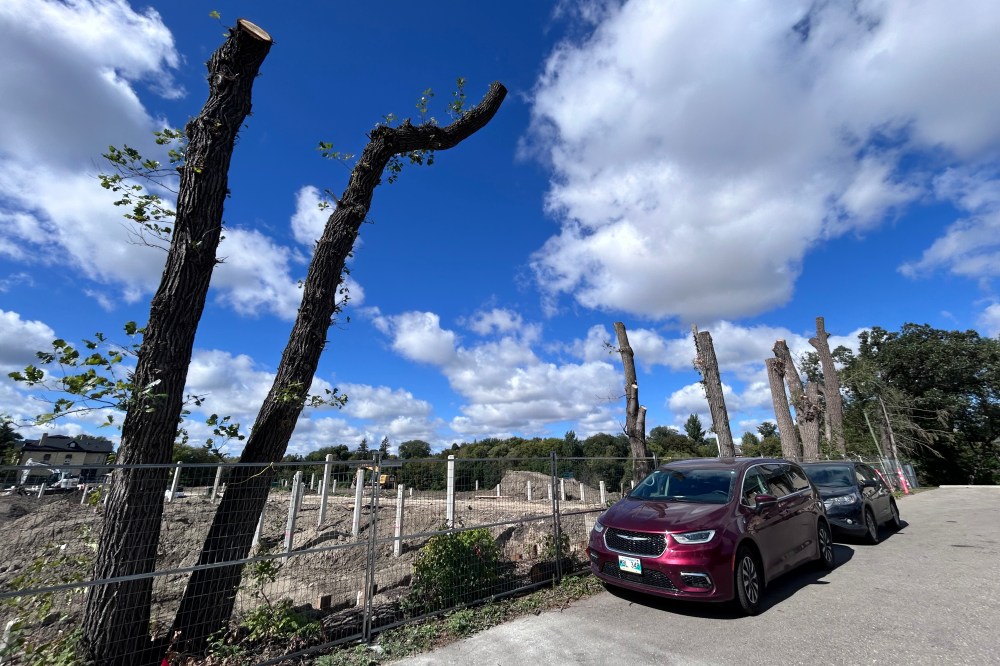
Such a bylaw could have also made it challenging for Paul Taylor to clearcut his tree-covered lot in Winnipeg, which stood as something of an extension of the city’s Assiniboine forest.
Taylor says he did it over security concerns, as the trees hid his old family home from the street, leading to break-ins and vandalism, so he flattened the whole place.
The business owner says he’s still in favour of some kind of bylaw protecting trees, as long as it leaves room for genuine safety and liability situations. He also supports having a requirement to replant trees, as he plans to do on his property.
“I’m generally supportive of protecting Winnipeg’s urban tree canopy, and I don’t see that as being at odds with being a developer,” he says.
Neighbours that were asked about the clearcut didn’t jump to support laws to prevent it.
Brian Paterson, who has lived next door for 67 years and enjoyed the view of the ancient oaks and other trees that grew there, says that within reason, people should be able to decide for themselves.
“Would I rather the trees be there? Yeah, but he has a right to whatever he wants to do with his property.”
Across the street, Bianca Johnson says she loves the idea of protecting trees, but worries about how far a law may go, and what kind of hassle someone might have to go through to deal with, say, a diseased tree.
“In general it sounds great, but details are always the important nitty-gritty bit,” Johnson says.
“There’s always the personal rights versus communal rights.”
While such bylaws do limit the personal, it’s not so different from many existing laws, said Erna Buffie, who published a book earlier this year on saving the urban canopy.
“I have to pull a permit if I want to do any kind of renovation on my property or in my house, but I can go ahead and cut down a tree that’s 100 years old without any repercussions,” she says.
“There’s something fundamentally wrong with that.”
She says the current lack of protections means, for example, that the owner of the Lemay Forest was within their rights to cut down the roughly 17,000 trees on the property. The forest, and the graves within it, were only saved when the province stepped in to expropriate it last year.
With the city’s trees still largely unprotected, Poulin at Trees Please has also been working to add new ones.
She helped raise money to plant eight trees across from her house, even though she won’t be around to see them grow to the grandeur of what they replaced.
“We do this for the next generation of Winnipeggers and kids and grandkids, who need to inherit a city that is livable for them.”
This report by The Canadian Press was first published Oct. 18, 2026.